
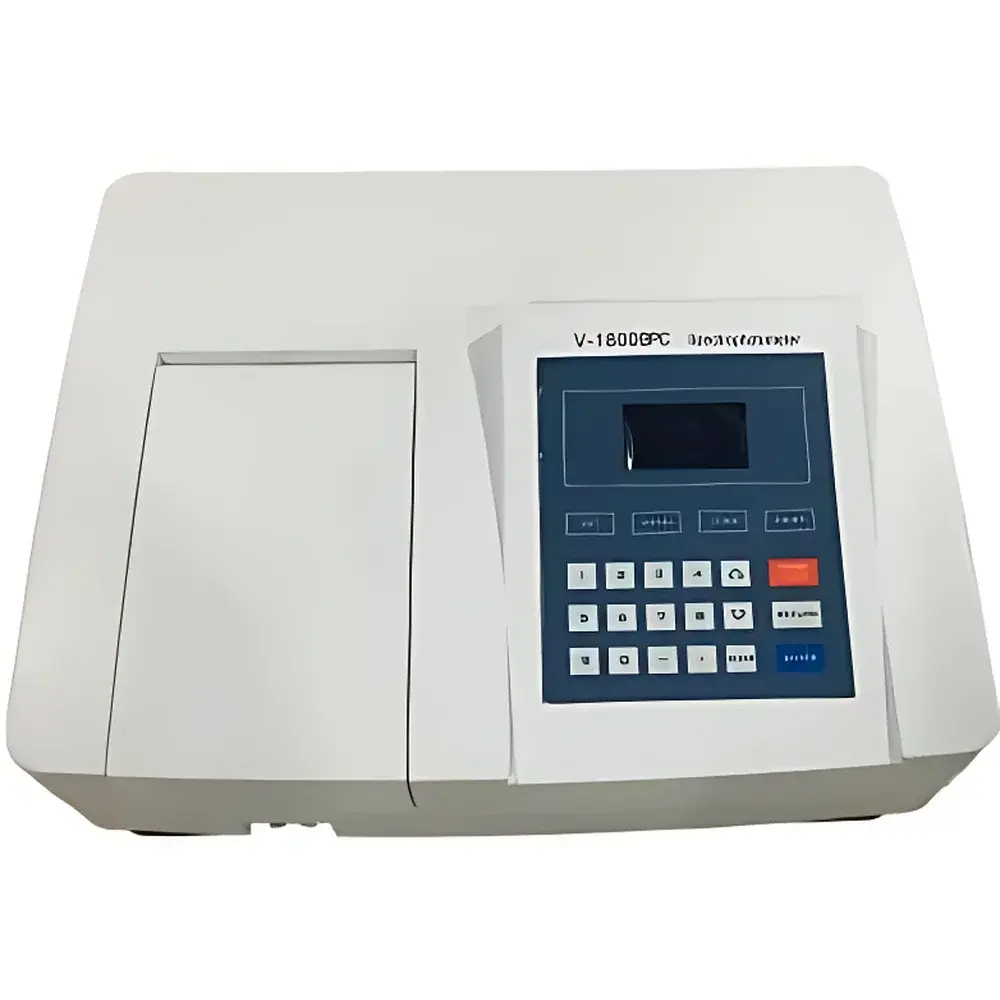
Mapada UV-1800B and UV-1800BPC Single-Beam Ultraviolet-Visible Spectrophotometers
| Brand | Mapada |
|---|---|
| Origin | Shanghai, China |
| Model | UV-1800B, UV-1800BPC |
| Optical System | Single-beam |
| Detector | Imported silicon photodiode array |
| Wavelength Range | 190–1100 nm |
| Spectral Bandwidth | 2 nm |
| Wavelength Accuracy | ±0.5 nm |
| Wavelength Repeatability | ≤0.2 nm |
| Stray Light | ≤0.05% T @ 220 nm and 340 nm |
| Photometric Accuracy | ±0.3% T (0–100% T), ±0.002 A (0–0.5 A), ±0.004 A (0.5–1 A) for UV-1800B |
| Photometric Repeatability | ≤0.15% T (0–100% T), 0.001 A (0–0.5 A), 0.002 A (0.5–1 A) for UV-1800B |
| Baseline Stability | ±0.001 A/h @ 500 nm |
| Absorbance Range | –0.3 to 3.0 A / 0–200% T (UV-1800B) |
| Data Interface | USB port |
| Power Supply | AC 220 V/50 Hz or AC 110 V/60 Hz |
| Dimensions | 490 × 360 × 240 mm |
| Weight | 14 kg |
Overview
The Mapada UV-1800B and UV-1800BPC are single-beam ultraviolet-visible (UV-Vis) spectrophotometers engineered for routine quantitative and qualitative analysis in academic laboratories, quality control environments, and industrial R&D settings. Based on Beer-Lambert law principles, these instruments measure absorbance, transmittance, and energy across a broad spectral range (190–1100 nm), enabling reliable characterization of organic compounds, transition metal complexes, biomolecules (e.g., nucleic acids and proteins), and colored solutions. The UV-1800BPC variant extends functionality with PC-based scanning software and enhanced kinetic measurement capability—making it one of the few entry-level UV-Vis systems capable of time-resolved spectral acquisition without requiring high-end optical architecture.
Key Features
- High-stability optical design incorporating a 1200 lines/mm holographic grating and imported silicon photodiode array detector for consistent signal fidelity and low-noise performance.
- Automated wavelength calibration and lamp switching logic: real-time monitoring of deuterium and tungsten lamp operating hours, automatic source selection based on wavelength region (D2 for UV, W for Vis/NIR), and plug-in lamp modules eliminating post-replacement optical alignment.
- Large-capacity sample compartment accommodating cuvettes from 5 mm to 100 mm pathlength, supporting both standard 10 mm quartz cells and specialized long-path or micro-volume configurations.
- Integrated 128 × 64 pixel LCD display providing direct visualization of calibration curves, kinetic traces, spectral scans, and up to 200 stored data sets—enabling standalone operation without external computing resources.
- USB interface compliant with standard HID protocols, supporting seamless data export to third-party spreadsheet or analytical software, as well as firmware updates via host PC.
- Dual-mode operation: fixed-wavelength photometry and full-spectrum scanning (up to 1 nm resolution), with programmable scan speed and data point density suitable for method development and validation workflows.
Sample Compatibility & Compliance
These instruments support aqueous, organic, and mixed-solvent samples in standard quartz, glass, or plastic cuvettes. The 2 nm spectral bandwidth meets typical requirements for general-purpose UV-Vis applications per ISO 6425 and ASTM E275 standards. While not designed for GLP/GMP-regulated production environments, the UV-1800BPC’s PC software supports audit-trail-enabled data logging when deployed with appropriate IT infrastructure and user access controls. All models comply with IEC 61010-1 safety standards for laboratory electrical equipment and electromagnetic compatibility (EMC) per EN 61326-1.
Software & Data Management
The UV-1800BPC includes Mapada’s proprietary ScanPro software—a Windows-compatible application supporting spectral acquisition, multi-point calibration (linear and polynomial), concentration determination via standard curve regression, kinetic time-course analysis (with adjustable interval and duration), DNA/protein quantification (using built-in extinction coefficients), and multi-wavelength ratio calculations. Raw absorbance and transmittance data are exportable in CSV format; spectra may be saved as image files (BMP/PNG) or vector graphics (SVG). Software-generated reports include instrument ID, date/time stamps, operator name fields, and parameter metadata—facilitating traceability in teaching labs and preliminary research applications.
Applications
- Quantitative analysis of pharmaceutical actives and excipients in dissolution testing and stability studies.
- Enzyme kinetics monitoring via NADH/NADPH absorbance at 340 nm or tyrosine/tryptophan detection at 280 nm.
- Water quality assessment: nitrate (220 nm), phosphate (880 nm after colorimetric reaction), and COD-related chromogenic assays.
- Educational use in undergraduate chemistry and biochemistry curricula for Beer’s law verification, equilibrium constant determination, and spectral identification exercises.
- Industrial QC of dyes, pigments, and polymer additives where batch-to-batch consistency is evaluated against reference spectra.
FAQ
What is the difference between UV-1800B and UV-1800BPC?
The UV-1800BPC includes a dedicated PC interface, bundled ScanPro software, and expanded kinetic measurement capability—not available on the base UV-1800B model.
Can the instrument perform DNA/RNA quantification?
Yes—the UV-1800BPC software includes preconfigured methods for nucleic acid concentration calculation using A260/A280 ratios and standard extinction coefficients.
Is wavelength calibration traceable to NIST standards?
The instrument supports user-performed calibration using certified holmium oxide or didymium filters; however, factory calibration is not NIST-traceable unless performed by an accredited third-party service provider.
What cuvette materials are compatible?
Quartz cuvettes are required for measurements below 350 nm; optical glass or polystyrene cuvettes may be used above 350 nm depending on application sensitivity requirements.
Does the software support 21 CFR Part 11 compliance?
No—ScanPro does not include electronic signature, role-based access control, or audit trail features required for FDA-regulated environments; it is intended for non-GxP laboratory use.




