
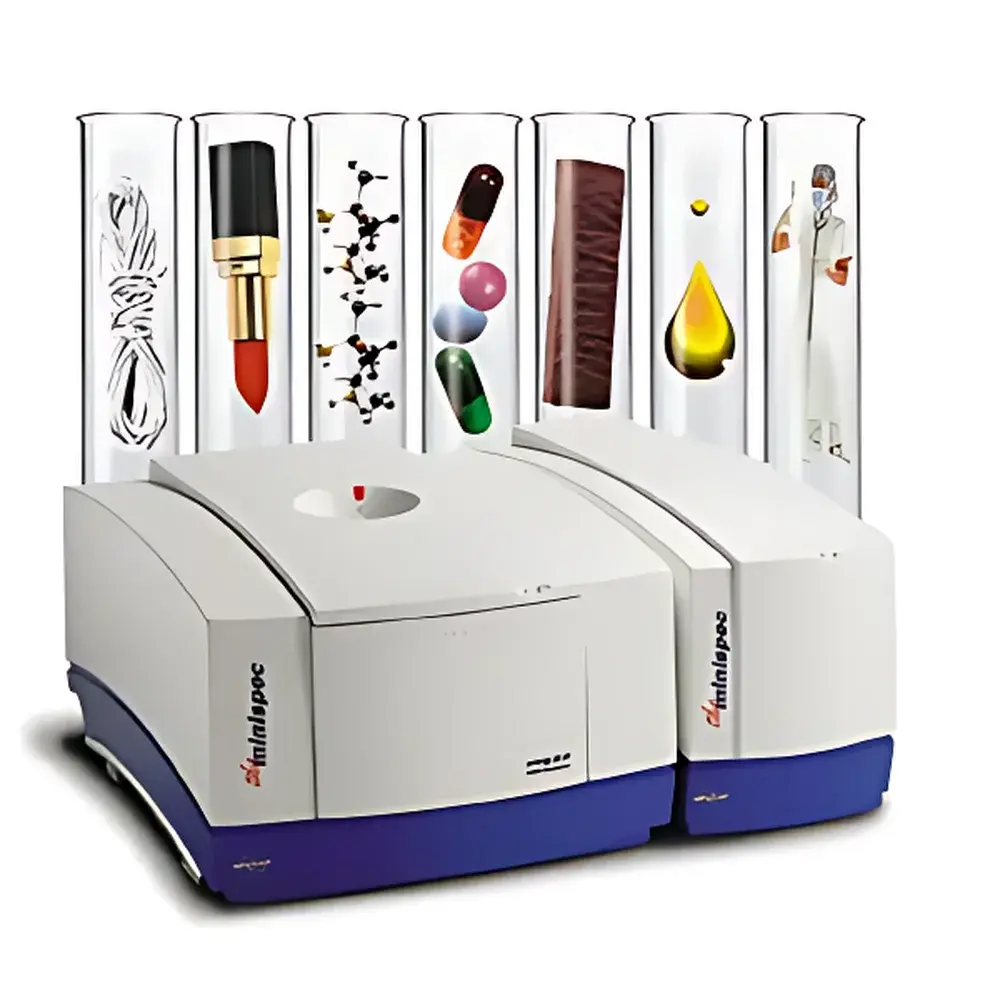
Bruker minispec MQ20 & MQ10 Time-Domain Nuclear Magnetic Resonance (TD-NMR) Analyzer
| Origin | Germany |
|---|---|
| Manufacturer Type | Authorized Distributor |
| Origin Category | Imported Instrument |
| Models | mq20, mq10 |
| Pricing | Upon Request |
Overview
The Bruker minispec MQ20 and MQ10 are benchtop time-domain nuclear magnetic resonance (TD-NMR) analyzers engineered for quantitative, non-destructive, and solvent-free analysis of molecular mobility and phase composition in heterogeneous materials. Unlike high-field FT-NMR spectrometers, these instruments operate on the principle of pulsed NMR in low-to-medium field permanent magnets (0.2–1.4 T), detecting transverse relaxation (T₂) and spin–lattice relaxation (T₁) behavior of 1H nuclei. The resulting free induction decay (FID) signal encodes information about local molecular dynamics: solid-phase protons exhibit rapid signal decay (short T₂), while liquid-phase protons show slower decay (longer T₂). This fundamental contrast enables precise quantification of solid/liquid ratios—most notably solid fat content (SFC)—without calibration curves requiring reference standards in many routine applications. Designed for industrial QA/QC environments, the minispec series delivers long-term thermal and magnetic stability, high reproducibility (<0.5% RSD for SFC at 20 °C), and robust architecture suitable for 24/7 operation in production labs.
Key Features
- Permanent magnet system with field homogeneity optimized for TD-NMR; field strengths range from 0.2 T to 1.4 T, corresponding to 1H Larmor frequencies of 7.5 MHz to 60 MHz
- Modular, fully digital electronics architecture with high-precision pulse generation, real-time signal digitization (≥16-bit ADC), and temperature-stabilized RF amplifiers
- Wide sample compatibility: accommodates diameters from 5 mm to 50 mm; supports powders, pastes, emulsions, gels, polymers, and live small-animal specimens (e.g., mice)
- Programmable temperature control from –190 °C to +200 °C with digital PID regulation and ramping profiles—enabling full SFC melting curve acquisition per ISO 8585 and AOAC 986.19
- Optional gradient coil system (up to 4 T/m) for diffusion-weighted measurements and rudimentary 1D imaging applications
- Pre-validated application methods compliant with ASTM D6379 (SFC), ISO 16934 (polyolefin density), and USP (fat content in pharmaceuticals)
Sample Compatibility & Compliance
The minispec platform is validated across regulated and non-regulated industrial sectors. In food manufacturing, it complies with ISO 16934 for solid fat content determination in cocoa butter, margarine, and dairy fats—supporting GLP-aligned workflows with full audit trails. For polymer and petrochemical QA, methods align with ASTM D7277 (crosslink density in elastomers) and ASTM D7643 (xylene solubles in polypropylene). All firmware and method libraries adhere to FDA 21 CFR Part 11 requirements when deployed with Bruker’s optional compliance-ready software package, including electronic signatures, user access controls, and immutable data archiving. No sample preparation—no solvents, no derivatization, no surface sensitivity—is required, eliminating inter-laboratory variability associated with gravimetric or chromatographic alternatives.
Software & Data Management
The minispec is operated via Bruker’s proprietary mqSeries software, a Windows-based interface supporting method development, sequence editing, real-time FID visualization, multi-exponential T₂ fitting, and automated report generation. The software includes an embedded method library covering >120 pre-optimized protocols—from SFC profiling and oil-in-seed quantification to polymer crystallinity assessment and rubber swelling kinetics. All raw FID data, processed spectra, and metadata are stored in vendor-neutral formats (e.g., ASCII, HDF5), enabling integration with LIMS and ELN systems. Optional modules provide advanced statistical modeling (PLS regression), multivariate calibration transfer, and remote diagnostics via secure TLS-encrypted connections. Software validation documentation (IQ/OQ/PQ templates) is supplied for GMP-regulated users.
Applications
- Food & Agriculture: Solid fat content (SFC) and melting profile analysis; moisture and oil content in seeds, milk powder, and cereals; droplet size distribution in oil-in-water emulsions
- Polymers & Elastomers: Crosslink density mapping in vulcanized rubber; polyethylene density estimation; xylene-soluble fraction in polypropylene; plasticizer migration kinetics
- Petrochemicals: Total hydrogen content in distillates and coal; oil-in-wax quantification; viscosity prediction via molecular mobility correlation
- Pharmaceuticals & Biomedicine: Fat absorption screening in fecal samples; in vivo body composition analysis (lean mass/fat mass/fluid) in murine models; excipient hydration state monitoring
FAQ
Is the minispec MQ series compliant with ISO/ASTM standards for SFC measurement?
Yes—methods are aligned with ISO 16934, AOAC 986.19, and ASTM D6379, and include built-in temperature ramping, signal averaging, and T₂ inversion recovery sequences required by these standards.
Can the instrument analyze intact packaged samples?
Yes—non-invasive measurement allows direct analysis of sealed containers (e.g., aluminum tubes, glass vials, laminated pouches), provided wall thickness and material do not attenuate RF transmission.
What level of technical support is available outside Germany?
Bruker maintains certified service engineers and application specialists across North America, EMEA, and APAC, with remote diagnostics, on-site training, and method development support included in annual service contracts.
Does the system require cryogens or external cooling?
No—permanent magnet design eliminates need for liquid helium or nitrogen; only standard 230 V AC power and ambient lab ventilation are required.
How is data integrity ensured for regulated environments?
With optional 21 CFR Part 11 compliance mode enabled, the system provides role-based access, electronic signatures, audit trail logging, and encrypted database storage—all validated per GAMP 5 guidelines.
Related Products





