
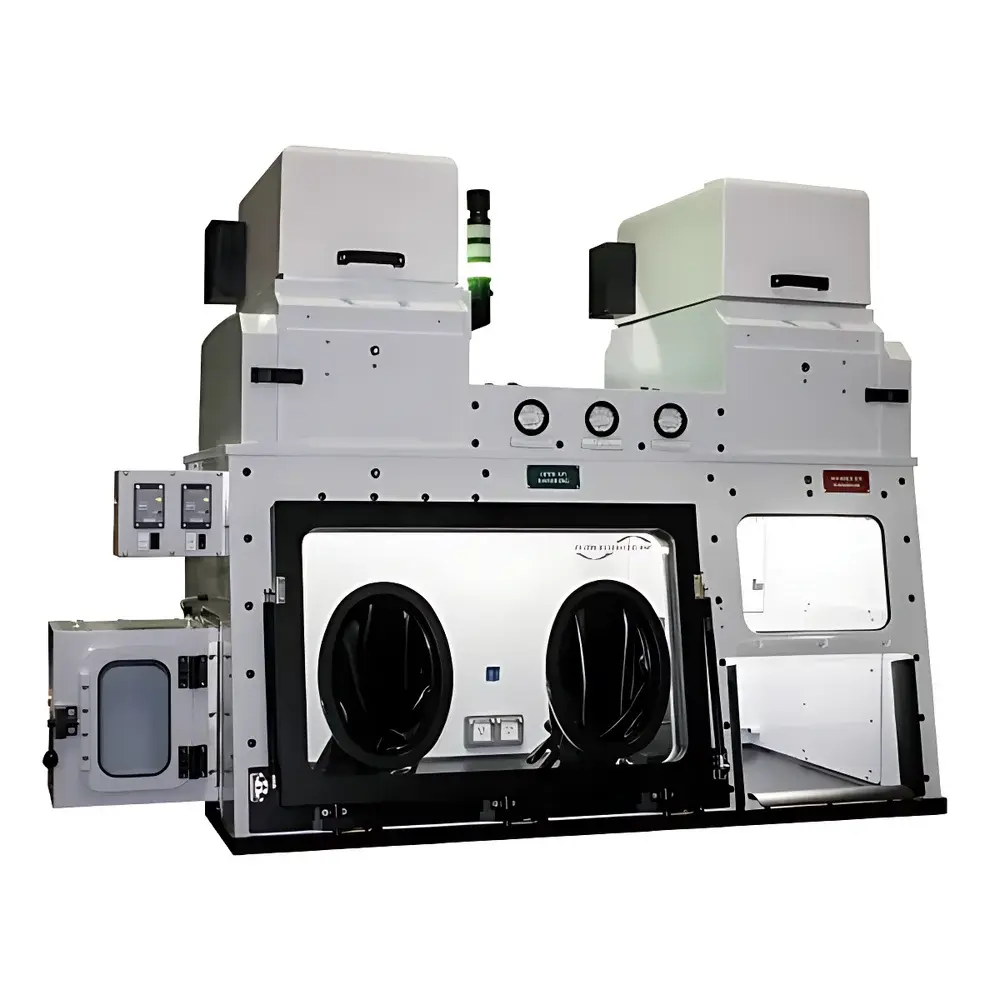
Flow Sciences EC Series High-Containment Isolator Workstation
| Brand | Flow Sciences |
|---|---|
| Origin | USA |
| Model | EC Series |
| Structural Frame | Polypropylene with Phenolic Resin-Coated Base |
| Viewing Panels | Acrylic (ECP) or Tempered Glass (ECG) |
| Standard Widths | 1500 mm / 1800 mm / 2100 mm |
| Depth | 914 mm |
| Internal Height | 629 mm |
Overview
The Flow Sciences EC Series High-Containment Isolator Workstation is an engineered containment solution designed for handling highly potent active pharmaceutical ingredients (HPAPIs), cytotoxic compounds, and other nanogram-level hazardous materials in research, development, and small-scale manufacturing environments. It operates on the principle of negative-pressure, unidirectional airflow—integrated across two physically coupled but functionally distinct zones: a primary ISO 5 (Class 100) glovebox workspace and an adjacent Verified Barrier Enclosure (VBE) transfer and decontamination chamber. This dual-zone architecture enables sequential material handling under validated containment integrity: materials enter via pass-through ports, undergo manipulation within the ISO 5 environment, and are subjected to secondary cleaning or decontamination in the VBE prior to exit. The system’s core containment performance—verified at <10 ng/m³ airborne exposure during worst-case powder spill scenarios—is achieved through rigorously balanced airflow dynamics, redundant HEPA filtration (inlet + dual-stage exhaust), and leak-tight construction certified per ASHRAE 110-2016 tracer gas testing.
Key Features
- Dual-sealed isolator architecture integrating ISO 5 glovebox functionality with a dedicated VBE transfer zone for sequential containment verification.
- ISO 5-compliant internal environment maintained by a 10 cm-thick HEPA inlet filter; exhaust air passes through two independent 10 cm HEPA stages—enabling safe recirculation into laboratory space or external ducting per facility HVAC requirements.
- OEB-5 rated containment validated for high-potency APIs, with documented exposure levels ≤10 ng/m³ under worst-case powder dispersion conditions (third-party testing confirmed).
- Modular structural design using chemical-resistant polypropylene frame and phenolic resin-coated base—ensuring durability against solvents, acids, and cleaning agents used in GMP/GLP environments.
- Interchangeable viewing panels: standard acrylic (ECP Series) for impact resistance and cost efficiency; optional tempered glass (ECG Series) for enhanced UV stability and abrasion resistance.
- Factory Acceptance Testing (FAT) performed on all standard units per ASHRAE 110-2016 methodology—including quantitative tracer gas leakage assessment, face velocity mapping, and airflow visualization.
- Optional integrated LED lighting: white spectrum (5000K CCT) for general task illumination or amber wavelength (590 nm peak) to support photolabile compound handling without degradation.
Sample Compatibility & Compliance
The EC Series accommodates a broad range of analytical and process equipment—including analytical balances (up to 32 kg capacity), vacuum ovens, sieve shakers, and micro-dosing systems—within its ISO 5 interior. Its containment integrity remains effective across variable powder mass loads and particle size distributions (typical d50 1–50 µm), provided handling protocols align with OEB-5 operational limits. The system complies with international occupational health standards including ISO 14644-1 (cleanroom classification), ASTM D6377 (vapor pressure measurement compatibility), and supports alignment with USP <800>, EU GMP Annex 1 (2022), and ICH Q5C guidelines for handling potent compounds. All units ship with FAT documentation traceable to ASHRAE 110-2016, enabling direct integration into FDA 21 CFR Part 11–compliant validation protocols where electronic audit trails and IQ/OQ documentation packages are required.
Software & Data Management
While the EC Series is a hardware-integrated isolator (not a digitally controlled instrument), it supports full data governance within regulated environments. Integrated pressure differential sensors, airflow monitors, and filter status indicators interface with third-party Building Management Systems (BMS) or Laboratory Information Management Systems (LIMS) via 4–20 mA or Modbus RTU outputs. Real-time parameters—including static pressure differentials (±0.5 Pa resolution), total airflow (±2% FS accuracy), and cumulative filter usage hours—are logged and archived for GLP/GMP audit readiness. Optional digital dashboards provide visual alarms for filter saturation, loss of negative pressure, or door interlock failure—ensuring continuous compliance with ALCOA+ data integrity principles.
Applications
- HPAPI formulation development and milligram-to-gram scale synthesis under OEB-5 containment.
- Stability testing of light- or oxygen-sensitive compounds using amber LED configuration.
- High-risk analytical sample preparation—including dissolution testing, HPLC vial filling, and residual solvent analysis—where operator exposure must remain below occupational exposure limits (OELs).
- Containment validation studies supporting regulatory submissions (e.g., FDA IND/IMPD modules requiring ISO 5 environmental control evidence).
- Hybrid lab operations requiring flexible reconfiguration: the modular glove panel design permits operation with or without gloves, adapting to varying OEB levels (OEB-3 to OEB-5) within a single footprint.
FAQ
What ISO class does the internal workspace meet?
The EC Series maintains a validated ISO 5 (Class 100) clean environment per ISO 14644-1, verified by particle count testing at ≥0.5 µm and airflow uniformity mapping.
Can exhaust air be recirculated into the lab?
Yes—dual-stage HEPA exhaust filtration enables safe recirculation when facility risk assessments and local regulations permit; otherwise, ducted exhaust to outside is supported.
Is FAT documentation included with shipment?
All standard EC Series units ship with full FAT reports per ASHRAE 110-2016, including tracer gas leakage rates (<0.01% of total airflow), face velocity profiles, and filter integrity test records.
What customization options are available beyond standard widths?
Custom depths, heights, glove port configurations, integrated balance mounts, and specialized surface coatings (e.g., ESD-safe finishes) are available upon engineering review and additional FAT validation.
Does the system support 21 CFR Part 11 compliance?
While the isolator itself is not software-driven, its sensor outputs integrate with compliant LIMS/BMS platforms to support electronic signatures, audit trails, and role-based access control when deployed in regulated workflows.



