
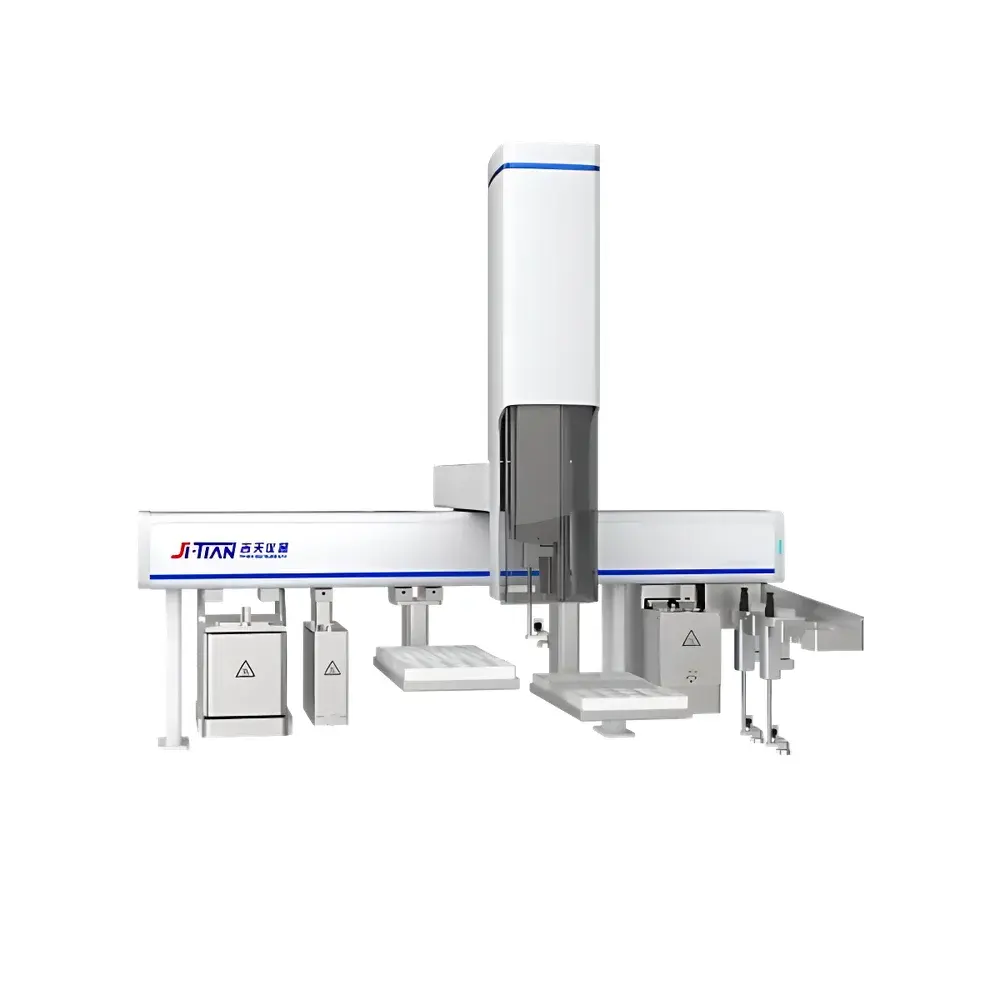
Titan Instruments AMSP-100 Multifunctional Automated Sample Introduction Platform
| Brand | Titan Instruments |
|---|---|
| Origin | Beijing, China |
| Manufacturer Type | Original Equipment Manufacturer (OEM) |
| Product Category | Domestic |
| Model | AMSP-100 |
| Instrument Type | Multifunctional Autosampler |
| Sample Introduction Modes | Headspace, Liquid Injection, Solid-Phase Microextraction (SPME) |
| Automation Features | Automatic Needle Exchange, Bottle Bottom Detection, Collision Detection, Oscillatory Mixing |
| Compliance | Designed for GLP/GMP-aligned laboratories |
| Software Interface | RS-232/USB/Ethernet-compatible control protocol |
Overview
The Titan Instruments AMSP-100 Multifunctional Automated Sample Introduction Platform is an integrated front-end sample handling system engineered for precise, reproducible, and unattended sample introduction into gas chromatography (GC) and gas chromatography–mass spectrometry (GC-MS) instruments. Unlike conventional single-mode autosamplers, the AMSP-100 implements a modular mechanical architecture that supports three primary sampling modalities—static headspace analysis, direct liquid-phase injection, and solid-phase microextraction (SPME)—within a single instrument footprint. Its operation is governed by a closed-loop stepper motor control system with real-time positional feedback, enabling sub-microliter volumetric accuracy and nanoliter-level residual volume management. The platform is designed to operate under method-defined sequences compliant with ISO/IEC 17025 quality management requirements and supports audit-ready execution logs essential for regulated environments.
Key Features
- Tri-Modal Sample Introduction: Seamlessly switches between headspace vial pressurization and transfer, syringe-based liquid injection (1–100 µL range), and SPME fiber exposure/thermal desorption protocols—all programmable within one method file.
- Intelligent Needle Management: Equipped with a multi-position needle carousel supporting up to four interchangeable needle assemblies (e.g., 10-µL GC syringe, 1-mL headspace loop, SPME holder, derivatization needle); automatic exchange occurs without user intervention or tooling.
- Bottle Bottom Detection: Uses capacitive sensing to detect vial base position in real time, dynamically adjusting needle insertion depth to ensure consistent aspiration of the final 10 µL—even from low-volume or irregularly shaped vials.
- Collision-Avoidance System: Integrates dual-axis inertial measurement units (IMUs) and proximity sensors to halt motion immediately upon detecting unexpected resistance, protecting both fiber coatings and GC inlet liners from mechanical damage.
- Oscillatory Mixing Mechanism: Replaces traditional magnetic stir bars with a controlled lateral oscillation profile (0.5–3 Hz, ±2 mm amplitude), providing homogeneous sample equilibration for headspace and SPME applications while eliminating fiber abrasion risks associated with rotating stir elements.
Sample Compatibility & Compliance
The AMSP-100 accommodates standard 10–22 mL crimp-top or screw-cap vials (including ASTM D6866-compliant headspace vials), 1.5 mL microcentrifuge tubes, and SPME arrow or CAR/PDMS-coated fibers. It interfaces natively with major GC and GC-MS platforms—including Agilent, Thermo Fisher, Shimadzu, and PerkinElmer—via vendor-agnostic command sets (ASTM E1384-compliant ASCII protocol). All operational parameters are traceable via timestamped event logs meeting FDA 21 CFR Part 11 requirements for electronic records and signatures when paired with validated LIMS integration. The system meets IEC 61000-6-2/6-3 EMC standards and operates within ambient lab conditions (15–30 °C, 30–70% RH, non-condensing).
Software & Data Management
Control is executed through Titan’s proprietary AutoMethod Suite v3.2—a Windows-based application supporting method cloning, sequence templating, and conditional branching (e.g., “if vial volume < 2 mL, activate bottom-sense mode”). Raw instrument commands are logged in CSV format with SHA-256 hash integrity verification. The software exports audit trails compliant with ISO/IEC 17025 Clause 7.9 and enables role-based access control (RBAC) for analyst, supervisor, and administrator tiers. Remote monitoring is supported via HTTPS-enabled web dashboard with TLS 1.2 encryption; no cloud storage or third-party data routing is performed by default.
Applications
- Environmental Monitoring: Quantification of VOCs (e.g., benzene, chloroform) and SVOCs (e.g., PAHs, phthalates) in aqueous, soil leachate, and air-captured samples per EPA Methods 502.2, 8260D, and 8270E.
- Public Health & Drinking Water: Multi-residue screening of trihalomethanes, haloacetic acids, and pesticides in compliance with US EPA Method 524.4 and ISO 22069.
- Food Safety: Residue analysis of organophosphates, carbamates, and veterinary antibiotics using QuEChERS-extracted matrices; SPME-GC-MS quantitation of packaging migrants (e.g., BADGE, NOGE) per EU Commission Regulation (EC) No 10/2011.
- Industrial R&D: High-throughput flavor compound profiling in beverages and fragrances; stability-indicating assays for polymer additives under ICH Q1A(R2) guidelines.
- Academic Research: Teaching platform for chromatographic sampling theory; customizable method development for novel extraction chemistries (e.g., in-tube SPME, dynamic headspace).
FAQ
Does the AMSP-100 require vendor-specific drivers to interface with GC systems?
No—it uses open ASCII command protocols compliant with ASTM E1384 and supports hardware-level handshaking via RS-232, USB CDC, or TCP/IP Ethernet.
Can the oscillatory mixing function be disabled for methods requiring static equilibration?
Yes—mixing activation is method-parameterized and can be omitted on a per-vial basis within sequence definitions.
Is SPME fiber conditioning supported directly by the platform?
Fiber thermal conditioning (baking at 250–300 °C) must be performed externally; however, the AMSP-100 fully automates exposure, retraction, and GC inlet insertion steps.
What maintenance intervals are recommended for the needle exchange mechanism?
The carousel gearbox and linear guide rails are rated for ≥500,000 cycles; Titan recommends biannual inspection and lubrication using Klüberplex BEM 41-132 grease.
How is method validation documented for regulatory submissions?
AutoMethod Suite generates IQ/OQ/PQ checklists with embedded calibration certificates, and all run logs include digital signatures verifiable against NIST-traceable time sources.






