
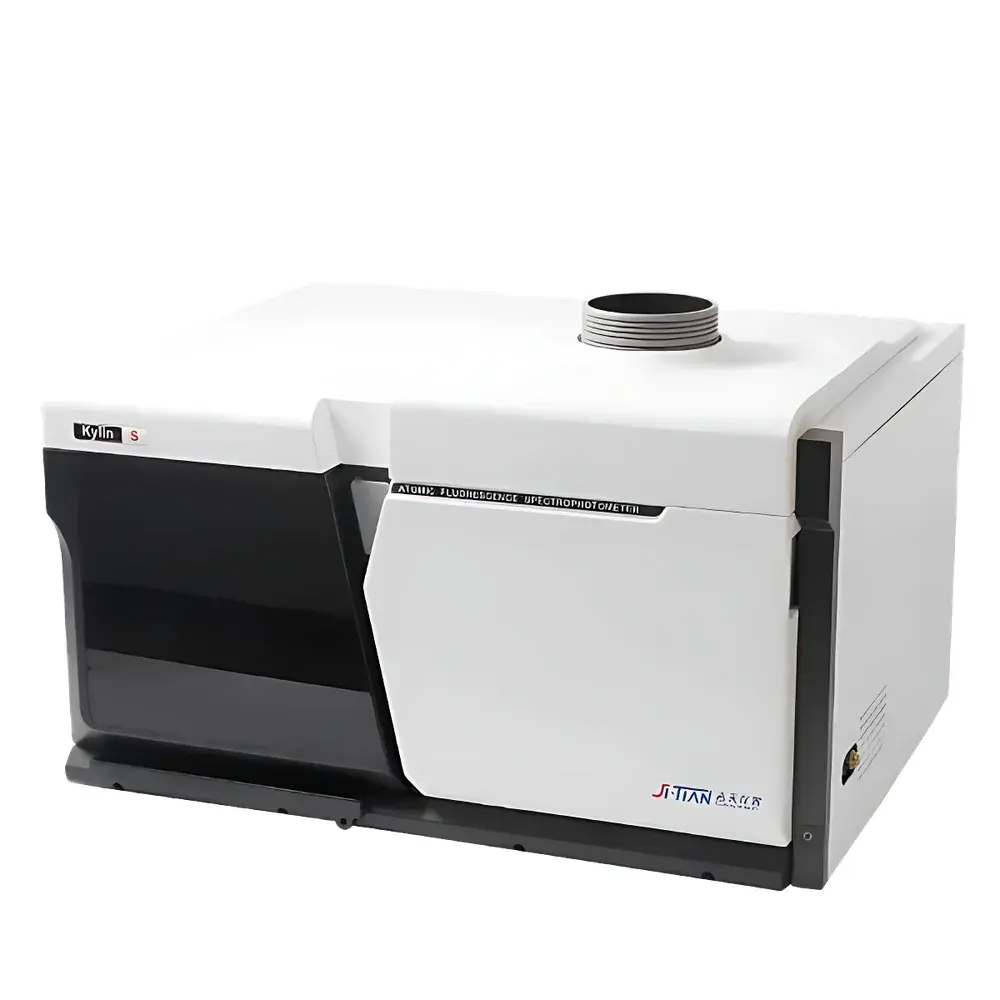
Titan Instruments Kylin S12 Dual-Channel Atomic Fluorescence Spectrometer
| Brand | Titan Instruments |
|---|---|
| Origin | Beijing, China |
| Manufacturer Type | Direct Manufacturer |
| Instrument Type | Multi-channel Atomic Fluorescence Spectrometer |
| Sample Introduction | Dual Sequential Injection Pump |
| Waste Disposal | Rear Exhaust Configuration |
| Hydride Generation Mode | Vapor Generation / Hydride Generation |
| Gas Flow Control | Mass Flow Controller (MFC) |
| Detectable Elements | As, Sb, Bi, Sn, Se, Te, Pb, Ge, Hg, Cd, Zn |
| RSD | <0.6% |
| Linear Dynamic Range | >3 orders of magnitude |
| Detection Limits (As, Sb, Se, Bi, Te, Hg, Sn, Pb) | <0.01 µg/L |
| PMT Wavelength Range | 160–320 nm |
| Atomizer Temperature Control Range | 100–350 °C |
Overview
The Titan Instruments Kylin S12 Dual-Channel Atomic Fluorescence Spectrometer is an engineered solution for trace-level quantification of hydride-forming and cold-vapor elements in environmental, food, clinical, pharmaceutical, and industrial matrices. It operates on the principle of atomic fluorescence spectroscopy (AFS), where analyte atoms—generated in situ via hydride generation (HG) or cold vapor (CV) techniques—are atomized in a quartz tube furnace and excited by a high-intensity, element-specific hollow cathode lamp. The resulting fluorescence emission at characteristic wavelengths is collected orthogonally to minimize stray light interference and detected by a low-noise photomultiplier tube (PMT) with spectral response from 160 nm to 320 nm. Its dual-channel architecture enables simultaneous, independent measurement of two elements—such as As and Se, or Hg and Sb—without spectral overlap or cross-talk, delivering enhanced throughput while preserving analytical integrity under routine laboratory conditions.
Key Features
- Dual sequential injection pump system ensures precise, reproducible sample and reagent delivery with sub-microliter accuracy; eliminates carryover and supports programmable reaction timing for optimized hydride formation kinetics.
- Orthogonal dual-beam optical design with symmetrical channel geometry guarantees identical optical path lengths and signal gain across both detection channels—enabling real-time reference drift correction and long-term signal stability.
- Multi-lamp turret accommodates up to eight hollow cathode lamps; automated lamp selection and alignment reduce manual intervention and support unattended multi-element analysis sequences.
- Plug-and-play intelligent hollow cathode lamps feature embedded EEPROM memory for lamp identity, usage hours, and optimal current profiles—eliminating manual focusing and enabling traceable lamp lifecycle management.
- Atomizer temperature is dynamically controlled between 100 °C and 350 °C via PID-regulated heating, allowing adaptive optimization for volatile (e.g., Hg) and refractory (e.g., Bi, Te) elements.
- EFC-based gas flow control provides continuous monitoring of Ar carrier gas pressure and flow rate, with configurable alarms for deviations exceeding ±2% of setpoint—ensuring consistent atomization efficiency and plasma stability.
- PTFE-coated carbon-fiber sampling probes replace fragile quartz capillaries, improving mechanical durability and reducing maintenance frequency in high-throughput labs.
- Comprehensive self-diagnostic suite monitors operational status of optical module, hydride generator, atomizer, gas manifold, liquid level sensors, and lamp subsystems—reporting fault codes and actionable diagnostics via graphical UI.
Sample Compatibility & Compliance
The Kylin S12 is validated for use with aqueous digests and extracts prepared by microwave-assisted acid digestion (per EPA Method 3052, HJ 680-2013), alkaline leaching (HJ 702-2014), and direct hydride generation (HJ 694-2014). It meets performance criteria specified in key regulatory standards including GB 5009.11–2014 (total and inorganic arsenic in food), GB 5009.17–2014 (mercury speciation), HJ 1133–2020 (particulate-bound As/Se/Bi/Sb in ambient air), and ISO 17294-2:2016 (elemental analysis in water by HG-AFS). System software supports 21 CFR Part 11-compliant audit trails, role-based access control, electronic signatures, and method versioning—facilitating GLP and GMP-aligned workflows in regulated environments.
Software & Data Management
The Kylin AFS Control Suite offers bilingual (English/Chinese) operation with intuitive graphical workflow navigation. It includes integrated method development tools for reaction optimization, automatic calibration curve generation with forced zero-point inclusion, and customizable report templates compliant with ISO/IEC 17025 requirements. All raw spectra, peak integration parameters, instrument logs, and user actions are time-stamped and cryptographically hashed. Data export conforms to ASTM E1382-compliant .csv and .xlsx formats; optional LIMS connectivity via ASTM E1467-compliant HL7 or ODBC interfaces enables seamless integration into enterprise laboratory informatics infrastructure.
Applications
- Environmental Monitoring: Quantification of As, Hg, Sb, Se, and Pb in drinking water (EPA 1631), wastewater effluents, soil extracts (HJ 680), airborne particulates (HJ 1133), and solid waste leachates (HJ 702).
- Food & Agriculture Safety: Screening of total arsenic and inorganic arsenic in rice, infant formula, seafood, and animal feed per GB 5009.11 and Codex Alimentarius STAN 193–1995.
- Clinical & Biomonitoring: Trace metal analysis in whole blood, urine, hair, and nail samples for occupational exposure assessment (e.g., As in smelter workers, Hg in dental personnel).
- Pharmaceutical Quality Control: Elemental impurity testing of excipients and APIs in accordance with ICH Q3D guidelines, particularly for Class 1 (As, Cd, Pb, Hg) and Class 2A (Sb, Se) elements.
- Geological & Metallurgical Analysis: Determination of Ge, Au, Te, and Bi in rock digests, ore concentrates, and alloy dissolution samples—supporting exploration geochemistry and refining process control.
FAQ
What hydride-forming elements can the Kylin S12 quantify with certified detection limits?
The instrument achieves sub-10 ng/L detection limits for As, Sb, Se, Bi, Te, Hg, Sn, and Pb when operated under optimized HG-AFS conditions per HJ 694-2014.
Does the system support cold vapor atomic fluorescence (CV-AFS) for mercury analysis?
Yes—dedicated CV-AFS mode is implemented with automatic mercury lamp ignition, SnCl₂ reduction, and gold trap preconcentration for ultra-trace Hg determination in water and biological matrices.
Is method validation documentation available for regulatory submissions?
Titan Instruments provides IQ/OQ documentation packages, system suitability test protocols, and application notes aligned with USP , EP 2.4.20, and Chinese Pharmacopoeia IV section 0408.
Can the Kylin S12 interface with third-party LIMS or ELN platforms?
Yes—via configurable ODBC drivers, RESTful API endpoints, and ASTM E1467-compliant messaging; integration support includes data mapping, error logging, and handshake protocol configuration.
What maintenance intervals are recommended for routine operation?
Daily: rinse lines and check liquid levels; weekly: clean quartz atomizer tube and inspect pump tubing; quarterly: calibrate MFC and verify PMT dark current; annually: full optical alignment and lamp energy verification per manufacturer SOPs.
Related Products





