
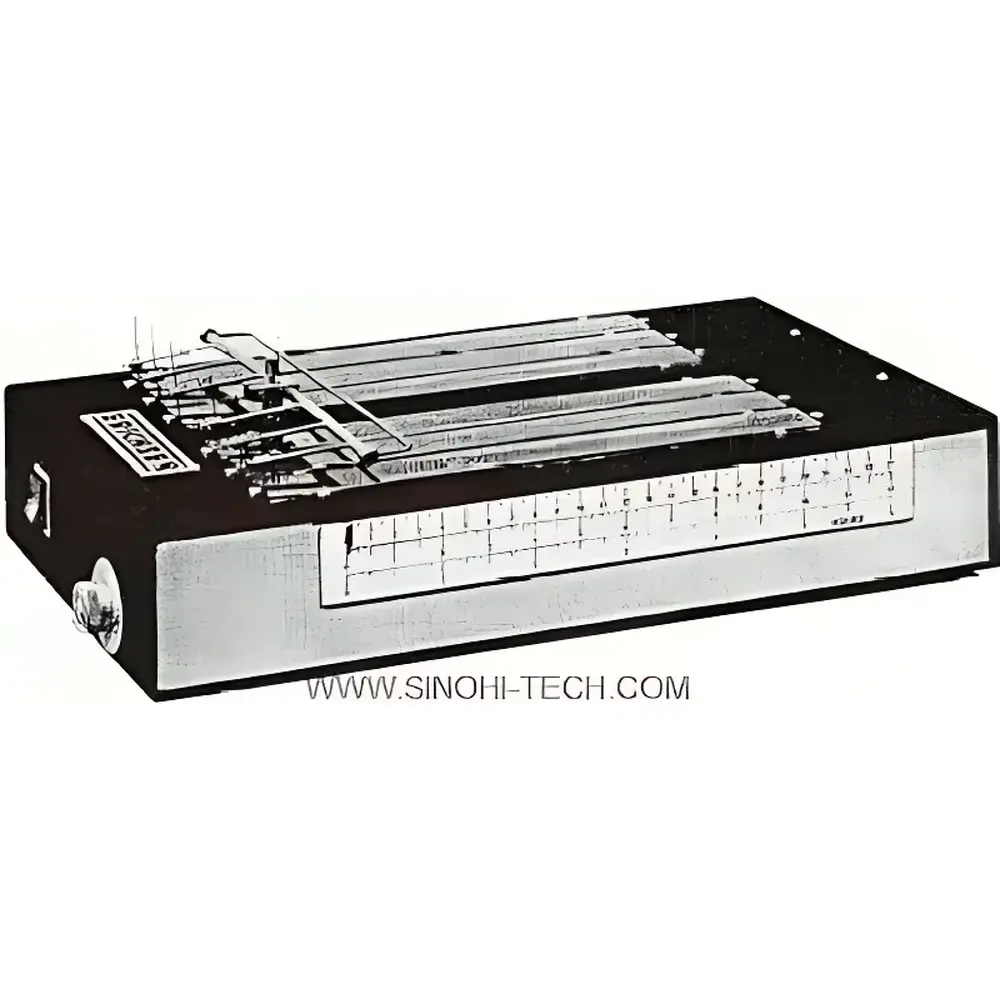
Erichsen #504 Automatic Drying Time Recorder
| Origin | Germany |
|---|---|
| Manufacturer Type | Authorized Distributor |
| Origin Category | Imported |
| Model | #504 |
| Pricing | Upon Request |
Overview
The Erichsen #504 Automatic Drying Time Recorder is a precision mechanical instrument engineered for objective, repeatable assessment of drying behavior in liquid coatings—including paints, varnishes, lacquers, and industrial finishes—applied to rigid planar substrates. It operates on the principle of controlled mechanical indentation and trajectory analysis: six hardened steel needles traverse coated glass slides at fixed linear speeds (corresponding to 6 h, 12 h, or 24 h total travel time over 300 mm), generating characteristic trace patterns that correlate directly with progressive solvent evaporation, polymer crosslinking, and film coalescence. Unlike subjective thumb-tack or finger-pressure methods, the #504 delivers standardized, observer-independent drying stage classification per ISO 9117-3 (Determination of drying time — Part 3: Ballotini method) and ASTM D1640 (Standard Test Methods for Drying, Curing, and Film Formation of Organic Coatings). Its design emphasizes mechanical stability, thermal inertia minimization, and operator-independent endpoint detection—critical for QC laboratories operating under GLP or ISO/IEC 17025 accreditation frameworks.
Key Features
- Modular six-channel testing platform: accommodates six 300 × 25 mm glass slides simultaneously, enabling parallel evaluation of replicate samples or comparative drying kinetics across formulation variants.
- Calibrated needle traversal system: hardened steel needles mounted on a rigid stainless-steel carriage move at precisely defined constant velocities (0.0139 mm/s for 6 h mode; 0.0069 mm/s for 12 h; 0.0035 mm/s for 24 h), ensuring reproducible mechanical stress application.
- Three-tiered time-scale calibration: engraved metallic time scales adjacent to each needle track allow direct visual correlation between needle position and elapsed time—eliminating stopwatch dependency and human timing error.
- Adjustable needle loading: optional copper weights (5 g each, sold separately) enable increased normal force to evaluate high-solids, UV-curable, or ceramic-based coatings with elevated surface resistance.
- Robust mechanical architecture: die-cast aluminum base with powder-coated steel cover plate ensures dimensional stability across ambient temperature fluctuations (15–30 °C recommended); no electronics or firmware required—maximizing long-term reliability and serviceability.
- Compliance-ready documentation: supplied English operating manual includes traceable calibration guidance, maintenance intervals, and sample reporting templates aligned with internal audit requirements.
Sample Compatibility & Compliance
The #504 is validated for use with smooth, non-porous substrates—primarily standardized float glass (e.g., Erichsen #360 Film Applicator-produced 13 mm wide films). It supports waterborne, solventborne, and 100% solids systems provided film thickness remains within 20–150 µm (measured via wet-film combs or dry-film micrometers). The instrument conforms to the mechanical test methodology referenced in ISO 9117-3, ASTM D1640 Types I–IV (surface dry, tack-free, hard-dry, and through-dry assessments), and JIS K 5600-8-3. While not an electronic data logger, its physical trace output is fully admissible in regulated environments when paired with controlled laboratory procedures, documented operator training, and periodic mechanical verification (e.g., carriage travel distance ±0.2 mm tolerance per 300 mm run).
Software & Data Management
The Erichsen #504 operates without embedded software, firmware, or digital interfaces—intentionally designed for environments where electromagnetic interference, cybersecurity protocols, or FDA 21 CFR Part 11 compliance constraints preclude electronic instrumentation. All data are generated as permanent physical traces on glass substrates, which serve as primary raw records. Users document results manually using the engraved time scales and standardized drying stage nomenclature (e.g., “continuous trace = initial set”, “interrupted trace = dust-free stage”). For laboratories requiring electronic archiving, trace images may be captured via calibrated macro photography (≥5 MP resolution, consistent lighting, scale bar) and stored in LIMS or ELN systems with full metadata (sample ID, coating batch, substrate lot, ambient RH/T, operator ID, date/time). No proprietary drivers, cloud services, or license keys are involved.
Applications
- Formulation R&D: comparative drying profiling of resin blends, catalyst packages, and solvent architectures.
- Production QC: release testing of batch-coated components prior to handling, stacking, or secondary processing.
- Technical service: field validation of recoat windows and overcoating compatibility under controlled lab conditions.
- Standards laboratories: reference method implementation for interlaboratory round-robin studies per ISO/IEC 17043 guidelines.
- Educational use: hands-on demonstration of film formation physics, including evaporation-controlled vs. reaction-controlled drying regimes.
FAQ
What substrates are compatible with the #504?
Standard 300 × 25 mm clear float glass slides are mandatory. Alternative substrates (e.g., metal panels, plastic sheets) are not supported due to dimensional tolerance and surface flatness requirements.
Can the instrument measure drying under forced-air or elevated-temperature conditions?
No—the #504 is strictly a room-temperature, ambient-condition instrument. Environmental chambers must be used externally; the device itself contains no heating, cooling, or airflow control.
How often does the carriage mechanism require maintenance?
Annual inspection of linear bearing surfaces and needle alignment is recommended; lubrication is not required. Carriage travel accuracy should be verified quarterly using a certified caliper or laser displacement sensor.
Is the #360 Film Applicator necessary for valid results?
Yes—consistent 13 mm film width and uniform thickness (±5 µm) are prerequisites for inter-laboratory comparability. The #360 applicator is specified in ISO 2808 Annex A for this purpose.
Are replacement parts traceable to original Erichsen specifications?
All genuine Erichsen spare parts—including #0504.02.53 needles and #0504.01.53 glass slides—carry batch-specific certificates of conformance referencing DIN EN ISO 9001:2015 manufacturing controls.
Related Products



