
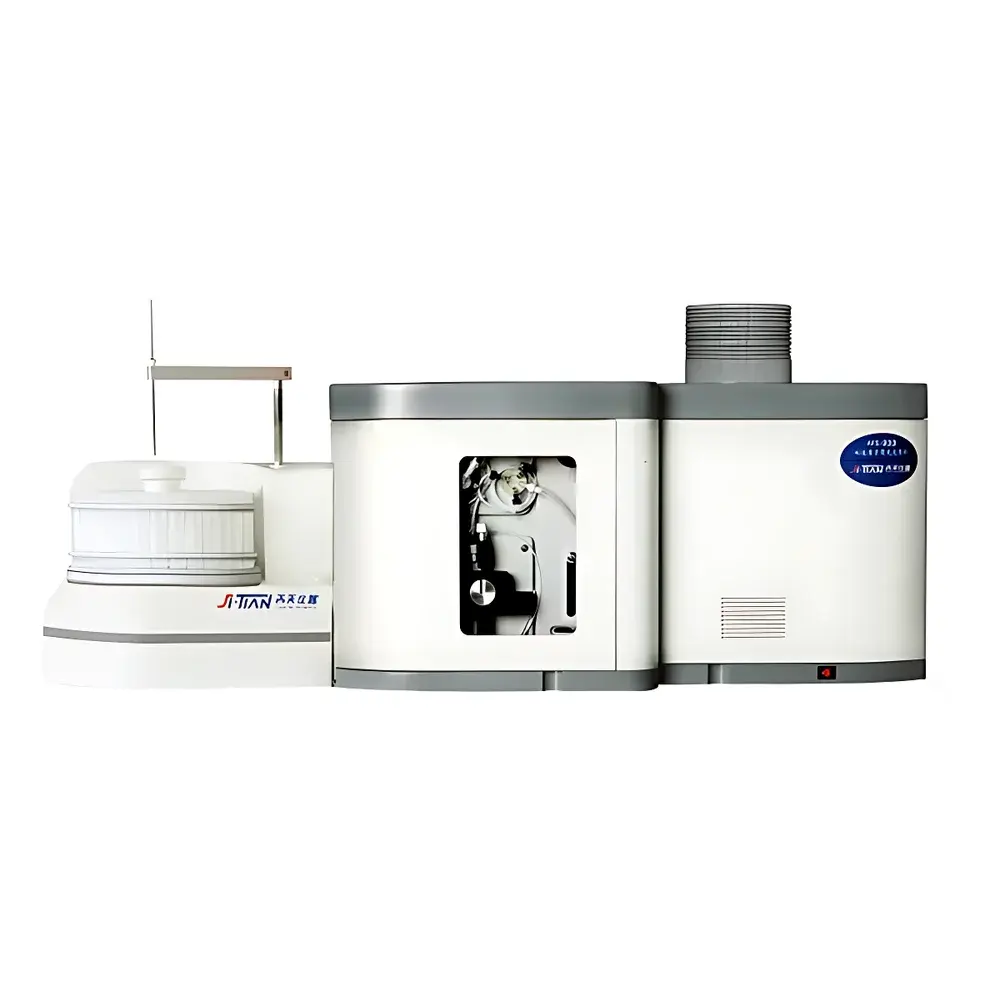
Titan Instruments AFS-933 Dual Sequential Injection Atomic Fluorescence Spectrometer
| Brand | Titan Instruments |
|---|---|
| Origin | Beijing, China |
| Manufacturer Type | Original Equipment Manufacturer (OEM) |
| Instrument Type | Multi-channel Atomic Fluorescence Spectrometer |
| Sample Introduction | Dual Sequential Injection Pump |
| Waste Liquid Disposal | Peristaltic Pump Extraction |
| Hydride Generation Mode | Vapor Generation / Hydride Generation |
| Gas Flow Control | Valve Island System |
| Detectable Elements | As, Se, Bi, Hg, Te, Sn, Ge, Pb, Zn, Cd, Au |
| Relative Standard Deviation (RSD) | < 0.8% |
| Linear Dynamic Range | > 3 orders of magnitude |
| Detection Limits | As, Bi, Sb < 0.01 µg/L |
| Photomultiplier Tube Wavelength Range | 160–320 nm |
| Atomizer Temperature Control Range | Ambient to 1000 °C (adjustable) |
Overview
The Titan Instruments AFS-933 is a high-performance, dual sequential injection atomic fluorescence spectrometer engineered for trace-level quantification of hydride-forming and cold-vapor elements in complex matrices. It operates on the principle of atomic fluorescence spectroscopy (AFS), where analyte atoms—generated in situ via hydride vapor generation (HVG) or cold vapor atomic fluorescence (CV-AFS)—are excited by element-specific hollow cathode lamp (HCL) radiation and emit characteristic fluorescent photons at discrete wavelengths. The emitted signal is collected by a solar-blind photomultiplier tube (PMT) with optimized spectral response between 160–320 nm, minimizing background interference from ambient visible light. Designed for laboratory environments requiring regulatory compliance and method reproducibility, the AFS-933 integrates precision fluidics, thermally stabilized atomization, and digital gas-flow regulation to deliver sub-part-per-trillion detection sensitivity and robust inter-day repeatability.
Key Features
- Dual sequential injection system: Two independent, programmable syringe pumps enable precise, pulse-free reagent and sample delivery—ensuring consistent reaction stoichiometry, minimized memory effects, and long-term volumetric accuracy across thousands of injections.
- Valve island–controlled pneumatic system: Electromagnetically actuated solenoid valves regulate carrier gas (Ar), shielding gas (Ar/H₂), and reaction gas flow with real-time feedback, eliminating mechanical drift and supporting ASTM D6725–22-compliant gas management protocols.
- Low-temperature argon-hydrogen flame atomizer: Features a double-shielded quartz furnace core with active temperature control (ambient to 1000 °C), enabling stable atom cloud formation while suppressing oxide interference and enhancing signal-to-noise ratio for volatile hydride elements.
- High-intensity, pulsed hollow cathode lamps: Optimized for As, Sb, Bi, Hg, Se, and Te; driven by short-pulse, high-current power supplies to extend lamp lifetime (> 5000 h) and improve spectral line intensity stability (RSD < 0.3% over 4 h).
- Solar-blind photomultiplier tube detector: UV-optimized PMT with spectral cutoff at 320 nm reduces stray-light contribution, improving baseline stability and lowering effective detection limits—particularly critical for low-background environmental and clinical applications.
- Integrated 3D polar-coordinate autosampler: Supports up to 144 sample positions with programmable rinse cycles, cross-contamination mitigation, and barcode-compatible vial recognition for unattended operation compliant with GLP/GMP data integrity requirements.
Sample Compatibility & Compliance
The AFS-933 accommodates aqueous digests (microwave- or hot-block–assisted), filtered environmental waters, acid-extracted soils/sediments, biological tissue homogenates, and pharmaceutical filtrates. Its hydride generation module supports standard EPA Method 1631E (Hg), ISO 17892-10 (As in soils), and Chinese national standards including GB 5009.11–2014 (total inorganic As in food), GB 5009.17–2014 (total/organic Hg), HJ 694–2014 (As, Hg, Se, Bi, Sb in water), and HJ 702–2014 (solid waste analysis). All instrument control logic and data acquisition firmware comply with FDA 21 CFR Part 11 audit trail requirements, including electronic signature enforcement, user role-based access, and immutable raw-data archiving.
Software & Data Management
Titan AFS Control Suite v4.2 provides intuitive method development, real-time signal visualization, multi-point calibration (linear/log-linear), and automatic blank subtraction. The software supports IQ/OQ/PQ documentation templates aligned with ISO/IEC 17025:2017 and includes built-in validation reports for RSD, LOD/LOQ, recovery, and linearity (r² ≥ 0.9995 over 3+ decades). Raw spectral traces, peak integration parameters, and audit logs are stored in vendor-neutral .csv and .xml formats compatible with LIMS integration (e.g., Thermo Fisher SampleManager, LabVantage). Optional secure remote monitoring enables IT-managed TLS 1.3–encrypted data transmission and centralized fleet diagnostics.
Applications
The AFS-933 delivers validated performance across regulated analytical domains: routine monitoring of arsenic and mercury in municipal drinking water per WHO Guidelines; speciation-ready quantification of total Se and Bi in fortified infant formula; screening of Cd and Hg in textile dye extracts per OEKO-TEX® Standard 100; multi-element analysis of geological core samples following HJ 680–2013; and rapid assessment of Pb and Sb leachability in consumer product coatings under CPSC testing frameworks. Its direct solid/liquid Hg–Cd co-detection upgrade eliminates digestion steps for clinical urine and hair samples, reducing turnaround time by >65% versus conventional ICP-MS workflows.
FAQ
What hydride-forming elements can the AFS-933 quantify simultaneously?
The instrument supports concurrent measurement of As, Se, Bi, Sb, Te, Sn, and Pb using multi-channel detector configuration and wavelength-selective PMT gating.
Is the system compatible with existing laboratory information management systems (LIMS)?
Yes—data export adheres to ASTM E1461–21 standard formats and supports ODBC/JDBC connectivity for seamless integration with major LIMS platforms.
Can the AFS-933 meet US EPA Method 1631E requirements for mercury analysis?
Yes—the cold vapor module, certified quartz atomizer, and sub-1 pg absolute detection capability satisfy all instrumental performance criteria specified in Method 1631E Appendix B.
What maintenance intervals are recommended for the sequential injection pumps?
Pump tubing should be replaced every 3 months under continuous operation; syringe seals require inspection every 6 months, with full pump recalibration recommended annually per ISO/IEC 17025 Clause 6.4.6.
Does the software support 21 CFR Part 11-compliant electronic signatures?
Yes—user authentication, biometric or token-based e-signature capture, and tamper-evident audit trails are enabled by default and configurable via administrator policy settings.





