
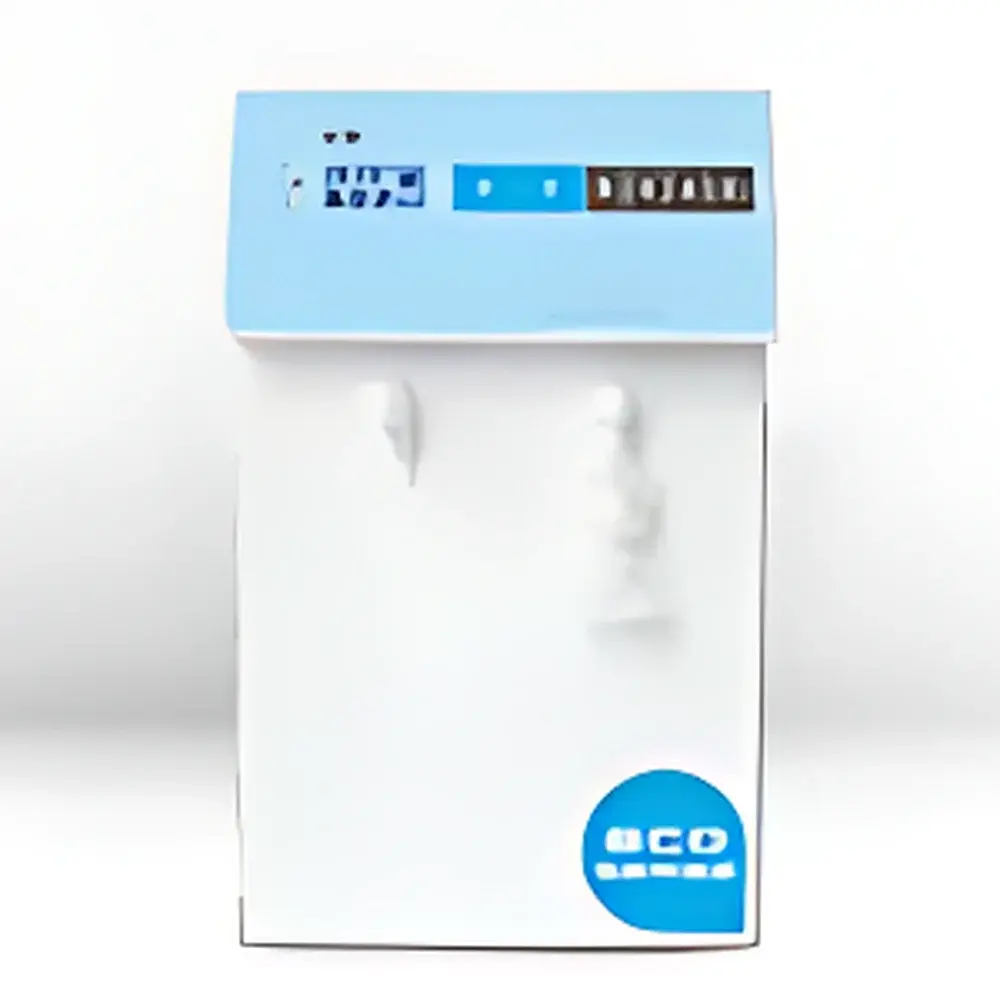
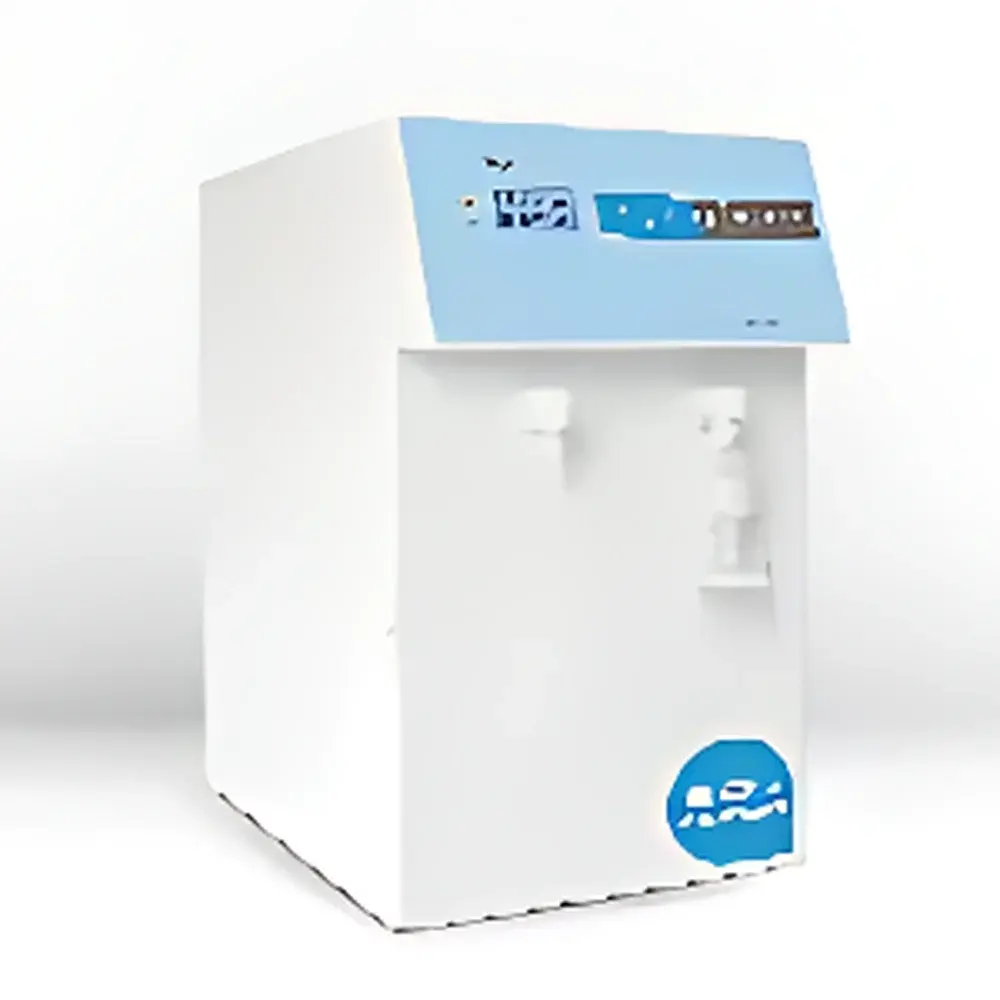
HHitech Eco-Q Series Deionized Pure Water System
| Brand | HHitech |
|---|---|
| Origin | Shanghai, China |
| Manufacturer Type | Direct Manufacturer |
| Product Category | Domestic |
| Model | Eco-Q15 / Eco-Q15UT / Eco-Q30 / Eco-Q30UT |
| Price Range | USD 1,400 – 4,200 (FOB Shanghai) |
| Feed Water Requirement | Municipal tap water (TDS ≤ 200 ppm recommended |
| Operating Temperature | 5–45 °C |
| Inlet Pressure | 1.0–4.0 bar |
| Resistivity (DI Output) | 16–18.2 MΩ·cm @ 25 °C |
| Heavy Metals & Soluble Silica | < 0.1 ppb |
| Particulates (>0.1 � | m): < 1 particle/mL |
| Microbial Count | < 0.1 CFU/mL (Eco-QUT models with UV + TF) |
| Endotoxin | Not specified |
| TOC | Not specified |
| RO Salt Rejection | 96–99% (new membrane) |
| Organic Rejection (MW > 200 Da) | >99% |
| Bacterial/Particulate Rejection (RO stage) | >99% |
| Production Rate (25 °C) | 15 L/h (Eco-Q15), 30 L/h (Eco-Q30) |
| Instant Flow Rate | 2.0 L/min (with integrated 12 L pressurized tank) |
| Output Ports | Dual touch-button dispensing — RO water & DI water |
| Dimensions (W×D×H) | 50 × 38 × 48 cm |
| Weight | ~22 kg |
| Power Supply | 220 V, 50 Hz |
| Rated Power | 72 W |
| Standard Configuration | Main unit + 1 set DI cartridges + built-in 12 L pressurized storage tank + accessory kit |
| Pretreatment Stages | PF (Sediment Filter) + KDF (Copper-Zinc Alloy) + AC (Activated Carbon) + RO (Thin-Film Composite Membrane) |
| Polishing Stages (UT models) | UV (254 nm germicidal lamp) + TF (0.22 µm terminal filter) |
Overview
The HHitech Eco-Q Series Deionized Pure Water System is an engineered laboratory-grade water purification platform designed to deliver consistent Type I ultrapure water per ISO 3696:1987 and ASTM D1193-06 specifications. Built upon a multi-stage purification architecture—comprising prefiltration (PF), kinetic degradation flux (KDF), activated carbon (AC), reverse osmosis (RO), and deionization (DI)—the Eco-Q system removes particulates, chlorine, organic contaminants, dissolved ions, and microorganisms from municipal tap feed water. UT variants integrate a 254 nm UV lamp and a 0.22 µm terminal filter to further suppress microbial regrowth and ensure end-point sterility, making them suitable for sensitive applications requiring low bioburden. The system operates under ambient conditions (5–45 °C) and maintains stable resistivity between 16–18.2 MΩ·cm at 25 °C—indicative of sub-ppb ionic purity—without reliance on recirculation loops or external pumps. Its compact footprint (50 × 38 × 48 cm), low power draw (72 W), and integrated 12 L pressurized storage tank enable deployment in space-constrained labs while supporting continuous, on-demand delivery at up to 2.0 L/min.
Key Features
- Modular dual-output design: Independent, touch-activated dispensing of RO water (for glassware rinsing, feedstock for other systems) and DI water (for analytical applications)
- Robust pretreatment train: PF + KDF + AC stages extend RO membrane life and reduce fouling risk in variable municipal water conditions
- High-rejection thin-film composite RO membrane: Achieves 96–99% salt rejection and >99% removal of organics with MW > 200 Da
- Optimized DI resin configuration: Mixed-bed ion exchange media delivers stable 16–18.2 MΩ·cm resistivity with low silica and heavy metal leaching (< 0.1 ppb)
- UV/TF polishing (Eco-QUT models): 254 nm germicidal irradiation combined with 0.22 µm final filtration ensures microbial control (< 0.1 CFU/mL) and particulate retention (0.1 µm)
- Intuitive human-machine interface: LED status indicators and tactile dispensing buttons simplify operation and minimize contamination risk
- Compliance-ready construction: All wetted materials meet USP Class VI and FDA CFR 21 requirements; no leachable plasticizers or extractables
Sample Compatibility & Compliance
The Eco-Q Series is validated for compatibility with common laboratory feed sources—municipal tap water meeting WHO drinking water guidelines (TDS ≤ 200 ppm recommended). It meets the minimum water quality requirements for ISO 3696 Grade 1 (Type I), CLSI EP22-A2, and ASTM D1193-06 Type I specifications. While TOC and endotoxin values are not routinely monitored in base models, Eco-QUT configurations support GLP/GMP-aligned workflows when paired with periodic verification using certified reference standards (e.g., NIST SRM 3104a for conductivity calibration). The system’s non-recirculating design avoids biofilm accumulation, reducing deviation risk during extended operation. All electrical components comply with IEC 61010-1 safety standards, and the housing conforms to IP20 ingress protection.
Software & Data Management
The Eco-Q Series operates as a standalone hardware platform without embedded software or network connectivity. Operational parameters—including inlet pressure, DI cartridge service life estimation (based on cumulative volume and resistivity drift), and UV lamp runtime—are tracked manually via visual indicators and maintenance logs. For regulated environments, users may integrate external data loggers compliant with FDA 21 CFR Part 11 (e.g., calibrated temperature/resistivity transmitters with audit-trail-capable SCADA interfaces). HHitech provides comprehensive maintenance documentation, including cartridge replacement protocols, UV lamp validation procedures, and traceable calibration certificates for factory-installed resistivity sensors—all aligned with ISO/IEC 17025 documentation expectations.
Applications
- Feed water for ultra-high-purity systems (e.g., LC-MS, ICP-MS, TOC analyzers)
- Rinsing and cleaning of volumetric glassware, pipettes, and semiconductor wafers
- Preparation of buffers, cell culture media, and molecular biology reagents (e.g., PCR master mixes)
- Mobile phase preparation for HPLC, UPLC, and IC systems
- Spectrophotometric assays (UV-Vis, AAS) requiring low background absorbance
- Calibration and blanking in clinical chemistry analyzers and immunoassay platforms
- Supply water for autoclaves, washer-disinfectors, environmental test chambers (e.g., salt fog, humidity, thermal cycling units)
- General lab use in QA/QC laboratories operating under ISO 17025 or CAP accreditation frameworks
FAQ
What feed water quality is required for optimal Eco-Q performance?
Municipal tap water with TDS ≤ 200 ppm, pH 5–8, and free chlorine 200 ppm), HHitech recommends adding an external water softener to prevent premature RO scaling.
How often must the DI cartridges be replaced?
Cartridge lifespan depends on feed water quality and daily usage volume. Under typical lab conditions (TDS ~100 ppm, 40 L/day), replacement is required every 6–12 months. Resistivity monitoring and scheduled verification against NIST-traceable standards are advised.
Is the Eco-Q system compatible with GLP or GMP environments?
Yes—when deployed with documented maintenance records, calibrated resistivity sensors, and UV lamp validation logs, the Eco-Q meets foundational requirements for GLP-compliant water systems per OECD Principles and supports GMP Annex 1 water system risk assessments.
Does the system include real-time TOC monitoring?
No. TOC measurement requires an external online TOC analyzer. Eco-Q systems are designed for resistivity-driven purity assurance; TOC validation should be performed offline using EPA Method 415.3 or ISO 8573-7 protocols.
Can the Eco-Q supply water to multiple instruments simultaneously?
The standard configuration supports single-point dispensing. For multi-outlet distribution, HHitech offers optional manifold kits with stainless steel tubing and sterile diaphragm valves—validated for bacterial retention and pressure drop < 0.5 bar at 2 L/min flow.



