
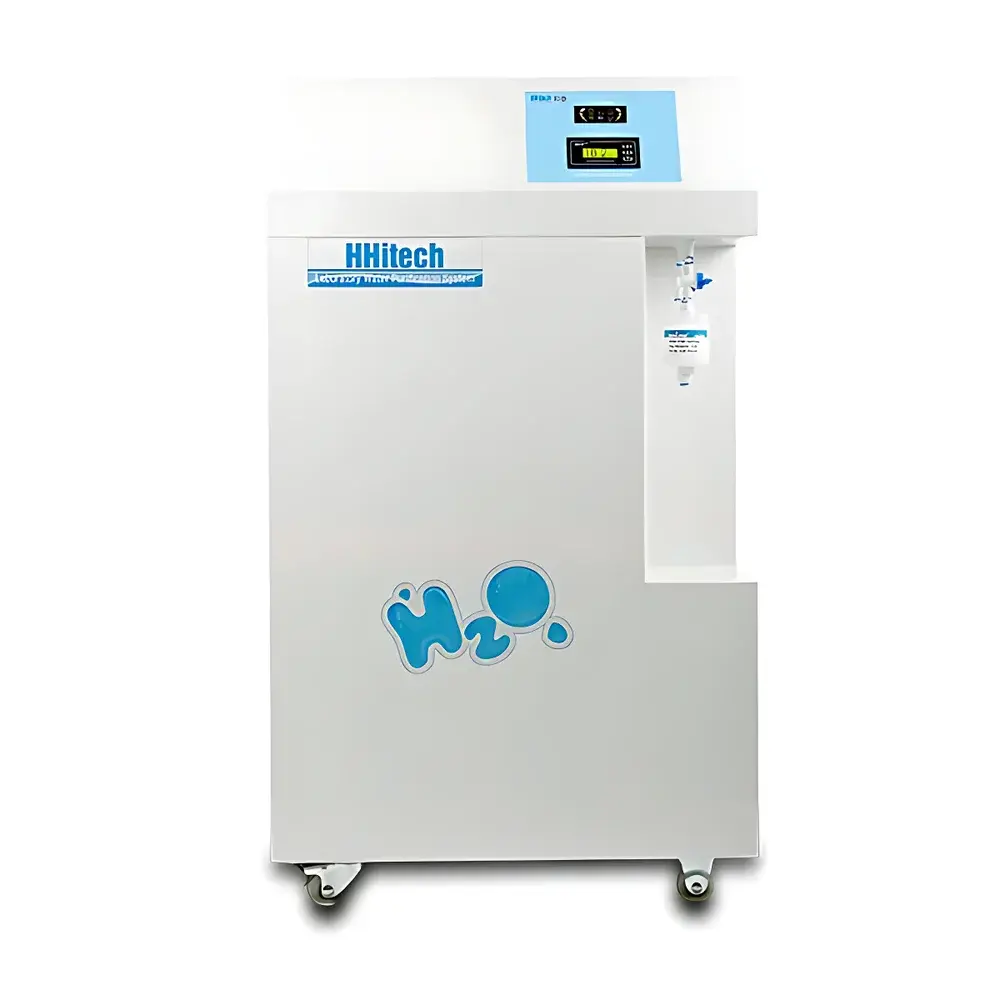
HHitech Pilot-E Economical Ultra Pure Water System
| Brand | HHitech |
|---|---|
| Origin | Shanghai, China |
| Manufacturer Type | Direct Manufacturer |
| Product Category | Domestic |
| Model | Pilot-E |
| Price Range | USD 4,200 – 7,000 (est.) |
| Purified Water Grade | ASTM Type I / ISO 3696 Grade 1 / GB/T 33087-2016 Class I |
| Resistivity | 18.2 MΩ·cm @ 25 °C |
| Heavy Metals & Soluble Silica | <0.01 ppb |
| Total Organic Carbon (TOC) | <3 ppb |
| Microbial Count | <0.001 EU/mL |
| Particles (>0.1 µm) | <1 particle/mL |
Overview
The HHitech Pilot-E Economical Ultra Pure Water System is a compact, floor-standing laboratory water purification platform engineered for consistent production of ASTM Type I (ISO 3696 Grade 1) ultrapure water from municipal tap feed. It employs a multi-stage purification architecture—comprising pre-filtration (PP + activated carbon), high-rejection reverse osmosis (RO), dual-stage deionization (DI), and terminal 0.2 µm PES membrane filtration—to deliver water meeting stringent requirements for molecular biology, cell culture, HPLC, LC-MS, trace elemental analysis, and pharmaceutical process validation. The system operates at ambient temperatures (5–45 °C) with inlet pressure between 1.0–4.0 kgf/cm² and tolerates feedwater TDS up to 200 ppm. Its core design emphasizes operational reliability, service longevity, and compliance-ready documentation—notably through NSF-certified fluid path components, GLP-aligned hardware construction, and built-in real-time resistivity monitoring.
Key Features
- Integrated dual 15-L pressurized storage tanks—reducing footprint while ensuring stable UP water delivery during peak demand
- Automated microprocessor control with backlit LCD interface displaying animated status indicators for rinse, production, tank full, low-water, leak detection, and maintenance alerts
- Three programmable RO membrane anti-scaling rinse cycles (startup, low-flow recovery, and 2-hour cumulative production trigger), each executing a 30-second flush to extend membrane service life
- Real-time online conductivity/resistivity monitoring for RO, DI, and UP water streams using high-accuracy, temperature-compensated electrodes
- Stainless steel powder-coated chassis—corrosion-resistant, non-shedding, and compliant with GLP environmental integrity standards
- Modular internal layout with reserved space for optional recirculation pump and loop distribution—enabling future integration as a central water supply node
- NSF-certified tubing, quick-connect fittings, and sanitary-grade PES final filter (0.2 µm pore size) ensure end-point microbial retention
Sample Compatibility & Compliance
The Pilot-E is validated for continuous generation of water suitable for sensitive analytical and biological applications requiring minimal ionic, organic, particulate, and endotoxin contamination. Its output meets or exceeds specifications defined in ASTM D1193-20 (Type I), ISO 3696:1987 (Grade 1), CLSI EP22-A, USP , EP 2.2.43, and GB/T 33087-2016 (Class I). The inclusion of imported Dow Filmtec™ RO membranes and nuclear-grade Dow ion exchange resins ensures long-term stability in resistivity and TOC performance. For cell-based workflows—including IVF and primary neuronal culture—the optional UF module (MWCO 5000 Da) reduces endotoxin levels to <0.001 EU/mL, satisfying FDA-recommended thresholds for sterile process water.
Software & Data Management
While the Pilot-E does not incorporate cloud-connected firmware or proprietary data logging software, its embedded controller supports audit-trail-capable event logging per GLP principles—including timestamps for all alarm conditions (e.g., low inlet pressure, tank overfill, conductivity excursion), manual interventions (e.g., resin replacement, UV lamp reset), and scheduled maintenance prompts. All electrical components comply with IEC 61000-4 immunity standards; power supply conforms to 220 VAC ±10%, 50 Hz, with thermal overload protection. Optional external data loggers may be interfaced via analog 4–20 mA outputs for resistivity and flow rate signals, facilitating integration into facility-wide SCADA or LIMS environments under 21 CFR Part 11-compliant validation protocols.
Applications
- HPLC and UHPLC mobile phase preparation where low TOC and silica content prevent column fouling and baseline drift
- Cell culture media formulation and buffer preparation requiring endotoxin-free water for mammalian and stem cell expansion
- ICP-MS and GF-AAS sample dilution and standard preparation, where sub-ppt metal contamination must be excluded
- Next-generation sequencing library prep and qPCR master mix preparation demanding RNase/DNase-free water (achievable with UV/UF configurations)
- Pharmaceutical quality control testing aligned with USP purified water specifications for injection and biologics manufacturing support
FAQ
What feedwater quality is required for optimal Pilot-E performance?
Municipal tap water with TDS ≤200 ppm, temperature between 5–45 °C, and inlet pressure of 1.0–4.0 kgf/cm² is recommended. For higher TDS feed, an external softener is advised to prevent premature RO scaling.
Can the Pilot-E be validated for GMP environments?
Yes—the system’s NSF-certified wetted parts, stainless steel housing, alarm-logged operation history, and compatibility with IQ/OQ/PQ documentation templates support qualification under GMP Annex 1 and FDA guidance for purified water systems.
How often must consumables be replaced?
Pre-filters require replacement every 3–6 months depending on feedwater quality; RO membranes typically last 2–3 years; DI cartridges vary between 6–12 months based on usage volume and inlet TDS; UV lamps are rated for 9,000 hours of continuous operation.
Is remote monitoring supported?
The base Pilot-E model lacks Ethernet or Wi-Fi connectivity, but analog outputs (resistivity, flow) allow connection to third-party PLCs or data acquisition systems for centralized oversight.
Does the system meet ISO 15195 calibration traceability requirements?
While the onboard resistivity sensor is factory-calibrated against NIST-traceable standards, users must perform periodic verification using certified reference solutions (e.g., KCl 0.01 mol/L) per ISO 15195:2018 Clause 7.3 for metrological assurance in accredited labs.



