
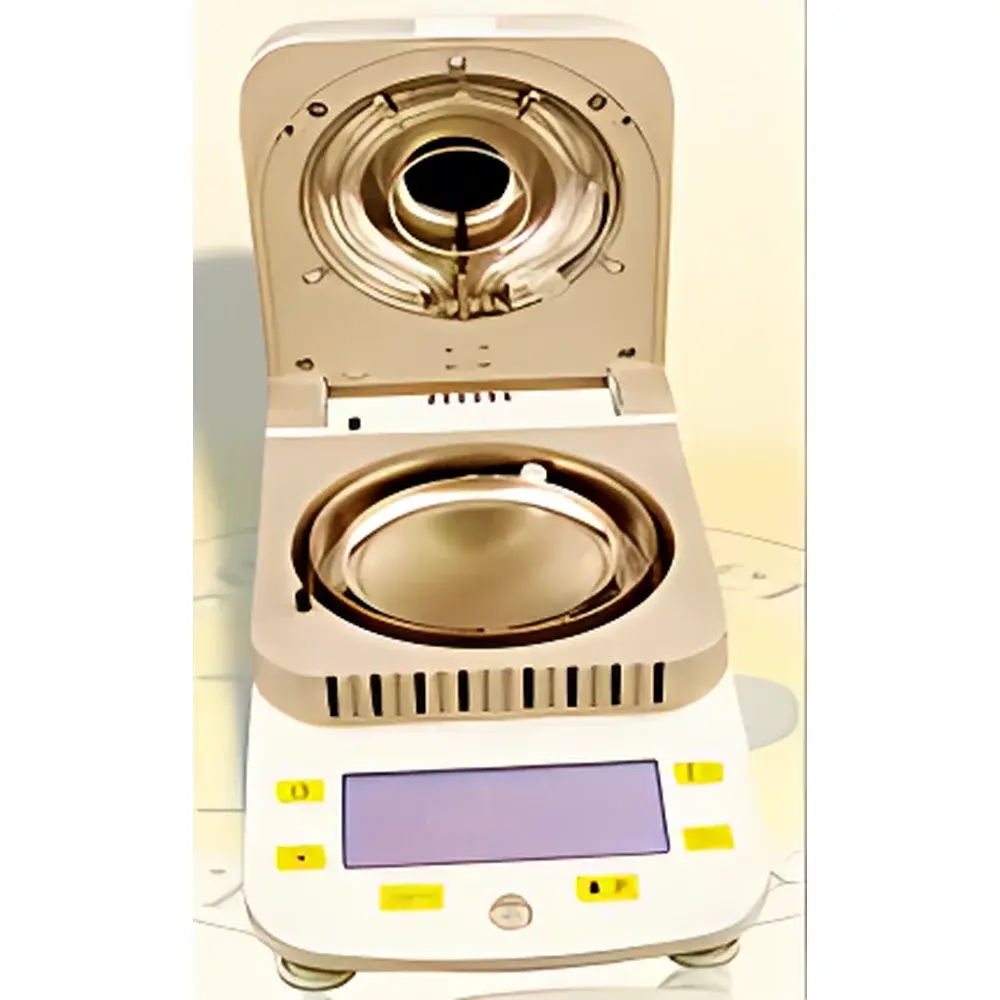
PP P2MA-50 Dairy Moisture Analyzer
| Brand | PP |
|---|---|
| Origin | USA |
| Model | P2MA-50 |
| Automation | Fully Automatic |
| Analysis Speed | ≤2 min per sample |
| Measurement Range | 0.5–50 g sample mass |
| Repeatability | ±0.5% (with 3 g sample) |
| Accuracy | ±0.01 g weight resolution |
| Heating Source | Halogen Infrared Lamp |
| Temperature Range | 50–160 °C |
| Display | Real-time moisture %, initial/final mass, temperature |
| Pan Diameter | 100 mm |
| Dimensions | 28.5 × 16 × 15 cm |
| Net Weight | 4.2 kg |
Overview
The PP P2MA-50 Dairy Moisture Analyzer is a fully automated thermogravimetric instrument engineered specifically for rapid, precise moisture determination in dairy matrices—including raw milk, pasteurized milk, yogurt, cottage cheese, cheddar and soft cheeses, whey powders, and specialty spreads such as cheese sauces. It operates on the principle of loss-on-drying (LOD), utilizing a calibrated halogen infrared heating source to uniformly desiccate samples under controlled thermal conditions. Unlike generic moisture analyzers, the P2MA-50 integrates dairy-specific drying profiles, dynamic temperature ramping logic, and moisture endpoint detection algorithms validated across high-fat, high-protein, and viscous乳制品 formulations. Its design addresses key industry challenges: sample spattering during rapid heating, casein denaturation interference, and surface crust formation that impedes complete water evaporation. The instrument delivers total moisture content (%) with traceable weight resolution of ±0.01 g and repeatability of ±0.5% RSD (n=10, 3 g representative cheese sample), meeting routine QC throughput requirements while maintaining alignment with AOAC Official Method 952.07 and ISO 5530-1 for dairy product moisture analysis.
Key Features
- Fully automatic operation: One-touch start initiates pre-programmed or user-defined drying protocols; no manual intervention required during analysis.
- Dairy-optimized halogen infrared heating system: Provides rapid, uniform thermal energy distribution across heterogeneous samples—minimizing localized overheating and ensuring complete moisture removal without charring.
- Sealed membrane keypad and IP54-rated enclosure: Resistant to splashes, dust, and ambient dairy plant humidity; suitable for production floor, QC lab, and R&D environments.
- High-contrast backlit LCD display: Simultaneously shows real-time moisture %, initial mass, final mass, current temperature, and elapsed time; retains final result until next test initiation.
- Integrated auto-shutdown and cooling detection: System terminates heating when mass change falls below threshold (0.001 g/5 s) and initiates forced-air cooling before result confirmation.
- Robust 100 mm stainless-steel weighing pan: Chemically inert, easy-clean surface compatible with acidic (yogurt) and fatty (cheese curd) residues.
Sample Compatibility & Compliance
The P2MA-50 accommodates sample masses from 0.5 g to 50 g, with optimal performance observed at 1–10 g for most dairy solids. It reliably analyzes viscous, semi-solid, and particulate-containing matrices without pre-homogenization or solvent addition. Validation data confirm compliance with critical regulatory frameworks: results are audit-ready for FDA 21 CFR Part 11 (when paired with compliant LIMS), support GLP/GMP documentation requirements, and align with ISO/IEC 17025 method validation criteria for moisture testing. Instrument calibration is traceable to NIST-certified weights, and built-in diagnostics monitor heater stability, balance drift, and environmental compensation (temperature/humidity). Routine verification follows ASTM D4052-22 Annex A3 for thermogravimetric moisture instruments used in food applications.
Software & Data Management
Data output is exported via USB interface in CSV format, retaining full metadata: sample ID, operator, date/time stamp, method name, initial/final mass, moisture %, drying curve timestamped points (mass vs. time), and instrument serial number. Optional PC software enables method library management, statistical process control (SPC) charting (X-bar/R), and automated report generation compliant with internal QA templates. All measurement records include immutable timestamps and user authentication logs—enabling full traceability for internal audits or third-party inspections. No cloud connectivity or remote access functionality is embedded, preserving data sovereignty per EU GDPR and U.S. HIPAA-aligned food safety IT policies.
Applications
- Moisture specification verification for cheese grading (e.g., Cheddar ≤39%, Mozzarella ≤45%, Feta ≤55%) per Codex Alimentarius STAN 262-2006.
- Shelf-life modeling: Correlating moisture content with water activity (aw) trends to predict microbial growth thresholds in ripened cheeses.
- R&D formulation optimization: Quantifying moisture loss during thermal processing of Greek yogurt or whey protein concentrates.
- Supplier qualification: Rapid screening of incoming milk powder or dried whey for compliance with contractual moisture limits (typically 3.0–5.0%).
- Economic yield calculation: Moisture directly impacts net payable weight in bulk dairy commodity contracts—accuracy ensures fair financial settlement.
FAQ
Does the P2MA-50 require external calibration standards for daily use?
No—built-in internal calibration uses factory-traceable reference masses; only periodic verification with certified weights (e.g., 10 g, 20 g NIST-traceable) is recommended per ISO 8655-6.
Can it analyze liquid milk directly without pre-treatment?
Yes, but for optimal reproducibility, standardized sample cups with defined depth and surface area are required; homogenization prior to dispensing is advised for non-uniform batches.
Is method development supported for novel dairy products like plant-based cheese analogs?
Yes—the instrument allows custom profile creation (ramp/hold segments, endpoint sensitivity, max temperature), with validation guidance provided in the technical manual per AOAC 2020.01.
What maintenance intervals are specified for the halogen lamp and weighing mechanism?
Lamp replacement is recommended every 12 months under continuous operation; balance recalibration is performed automatically at power-on and may be manually triggered—no scheduled mechanical servicing is required within first 36 months.
How does the P2MA-50 handle samples with high sugar content, such as sweetened condensed milk?
Its adaptive endpoint algorithm detects caramelization onset by monitoring second-derivative mass loss rate; users may select “high-sugar” mode to reduce max temperature and extend hold time, preventing Maillard interference.





