
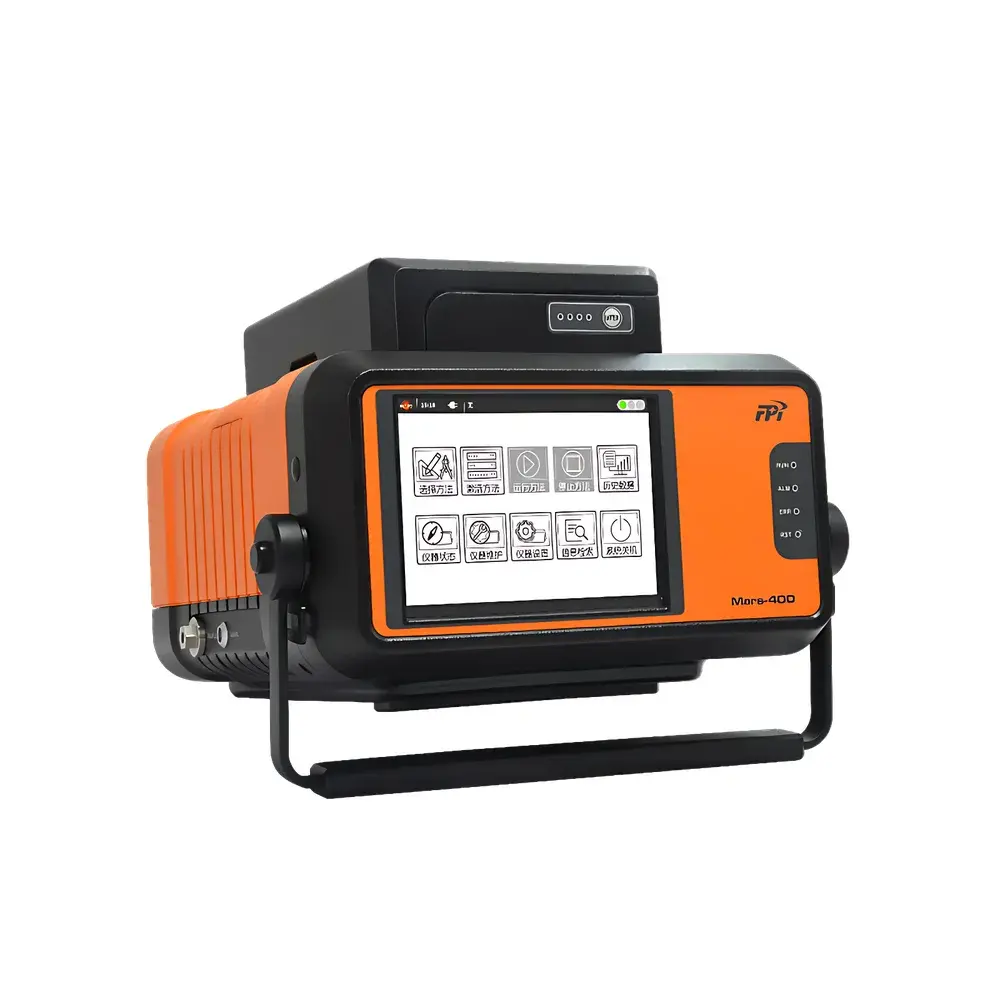
FPI Mars-400 Plus Portable Gas Chromatography-Mass Spectrometer
| Brand | FPI |
|---|---|
| Origin | Zhejiang, China |
| Manufacturer Type | Authorized Distributor |
| Product Origin | Domestic (China) |
| Model | Mars-400 Plus |
| Instrument Type | Ion Trap Mass Spectrometer |
| Chromatography Type | Low Thermal Mass (LTM) GC |
| Mass Range | 15–550 amu |
| Resolution | Unit Mass Resolution |
| Detection Limit | < 1 ppb (for selected VOCs, e.g., benzene, toluene) |
| Scan Speed | 10,000 amu/s |
| Power Supply | Integrated Rechargeable Li-ion Battery |
| Carrier Gas | Built-in Helium or Hydrogen Micro-Gas Cylinder (30–60 min runtime) |
| Weight | < 19 kg |
Overview
The FPI Mars-400 Plus Portable Gas Chromatography-Mass Spectrometer (GC-MS) is an integrated field-deployable analytical platform engineered for real-time qualitative and quantitative analysis of volatile and semi-volatile organic compounds (VOCs and SVOCs) in uncontrolled environments. It combines low thermal mass (LTM) gas chromatography with a compact 3D quadrupole ion trap mass analyzer to deliver laboratory-grade identification performance under non-laboratory conditions. Unlike benchtop GC-MS systems requiring stable power, external gas supplies, and climate-controlled spaces, the Mars-400 Plus operates autonomously using internal battery power and miniaturized carrier gas storage—enabling deployment within minutes at incident sites including chemical spills, industrial emissions, hazardous waste zones, and post-blast forensic scenes. Its core measurement principle relies on chromatographic separation followed by electron ionization (EI) and ion trapping with resonant ejection, enabling full-scan, selected ion monitoring (SIM), and MS/MS acquisition modes for enhanced specificity and interference rejection.
Key Features
- Field-Optimized LTM-GC Architecture: Utilizes micro-fabricated resistively heated columns with rapid thermal ramping (up to 120 °C/s), reducing typical GC run times to under 3 minutes while maintaining peak capacity and resolution comparable to conventional ovens.
- High-Speed Ion Trap MS: Features a robust 3D ion trap with pulse-modulated internal ion source technology, improving ion transmission efficiency and signal-to-noise ratio for trace-level analytes—validated for sub-ppb detection limits across C2–C16 hydrocarbons, chlorinated solvents, PAHs, and organophosphates.
- Multi-Phase Sample Introduction: Supports direct gas sampling via handheld probe, static/dynamic headspace analysis for aqueous and solid matrices, split injection for SPME fibers or liquid microsamples (1–10 µL), and high-concentration VOC analysis via gas-tight syringe—eliminating need for off-site sample preservation or derivatization.
- Ruggedized Portability: Engineered with shock-absorbing chassis, conformal coating on PCBs, and sealed optical/mass analyzer compartments; certified to MIL-STD-810G for vibration, drop, and temperature cycling (-10 to +50 °C operating range).
- Intuitive Touch-Driven Workflow: Embedded Android-based software provides guided method setup, automated calibration (tune & mass check), real-time spectral deconvolution, and NIST library matching (v2.4) with customizable compound libraries—all accessible via 7-inch capacitive touchscreen with glove-compatible operation.
Sample Compatibility & Compliance
The Mars-400 Plus accommodates environmental matrices per standard regulatory protocols: ambient air (EPA TO-14A/TO-15), surface water and groundwater (EPA 8260D), soil and sediment (EPA 8270E), and wipe samples (NIOSH 5515). Its analytical output supports compliance reporting under ISO 17025-accredited laboratories when used with documented chain-of-custody procedures and instrument-specific uncertainty budgets. Data integrity meets FDA 21 CFR Part 11 requirements through electronic signatures, audit trails, and immutable raw data archiving (including .RAW and .CDF formats). All firmware and software updates are version-controlled and validated per GLP/GMP-aligned change management practices.
Software & Data Management
The embedded GC-MS Control Suite v3.2 includes integrated data acquisition, processing, and reporting modules. Raw spectra undergo real-time background subtraction and retention time alignment using adaptive algorithms. Quantitative workflows support internal standard calibration curves (linear/log-linear), surrogate recovery correction, and matrix-matched standardization. Export options include PDF analytical reports, CSV peak tables, and XML-formatted results compatible with LIMS platforms (e.g., LabWare, Thermo Fisher SampleManager). All processed data and metadata (method parameters, tune logs, calibration history) are stored locally with optional encrypted cloud sync via TLS 1.3–secured Wi-Fi or LTE module (optional add-on).
Applications
- Environmental Emergency Response: Rapid identification of unknown plumes during chemical releases, landfill gas monitoring, and post-remediation verification.
- Industrial Hygiene & OSHA Compliance: Real-time workplace air monitoring for benzene, formaldehyde, styrene, and other regulated VOCs per Method 0031 and NIOSH 1501.
- Forensic Toxicology & Criminalistics: Detection of ignitable liquids in arson debris, accelerants in fire investigations, and illicit drug precursors in clandestine labs.
- Petrochemical & Refinery Field QA/QC: On-site verification of product purity, catalyst degradation markers, and fugitive emission screening (LDAR support).
- Military & CBRN Defense: Mobile detection of chemical warfare agent simulants (e.g., DMMP, GB analogs) and TICs/TIMs in tactical reconnaissance scenarios.
FAQ
What carrier gases are supported, and how long does a single charge last?
Helium and hydrogen micro-cylinders (30 mL, 10 MPa) are pre-installed; runtime averages 45–60 minutes per cylinder depending on flow rate and oven ramp profile. The integrated lithium-ion battery provides ≥ 90 minutes of continuous operation under typical analytical conditions.
Is method transfer from lab-based GC-MS systems possible?
Yes—retention indices and spectral libraries are fully compatible with NIST MS Search, AMDIS, and OpenChrom. Method parameters (ramp rates, dwell times, isolation windows) can be imported/exported via .XML templates.
Does the system support EPA-approved methods?
The Mars-400 Plus has been validated against EPA Methods 8260D (VOCs) and 8270E (SVOCs) for field screening applications; final quantitation requires confirmatory lab analysis per regulatory submission guidelines.
How is calibration maintained in variable field conditions?
Automatic daily tuning using perfluorotributylamine (PFTBA) standard is triggered at startup. Drift compensation is applied via real-time retention time locking (RTL) using internal alkane markers co-eluted with each sample.
Can the instrument be operated remotely?
Remote diagnostics and method push are enabled via secure SSH tunneling and VNC-over-HTTPS; however, physical sample introduction and probe positioning require on-site personnel.





