
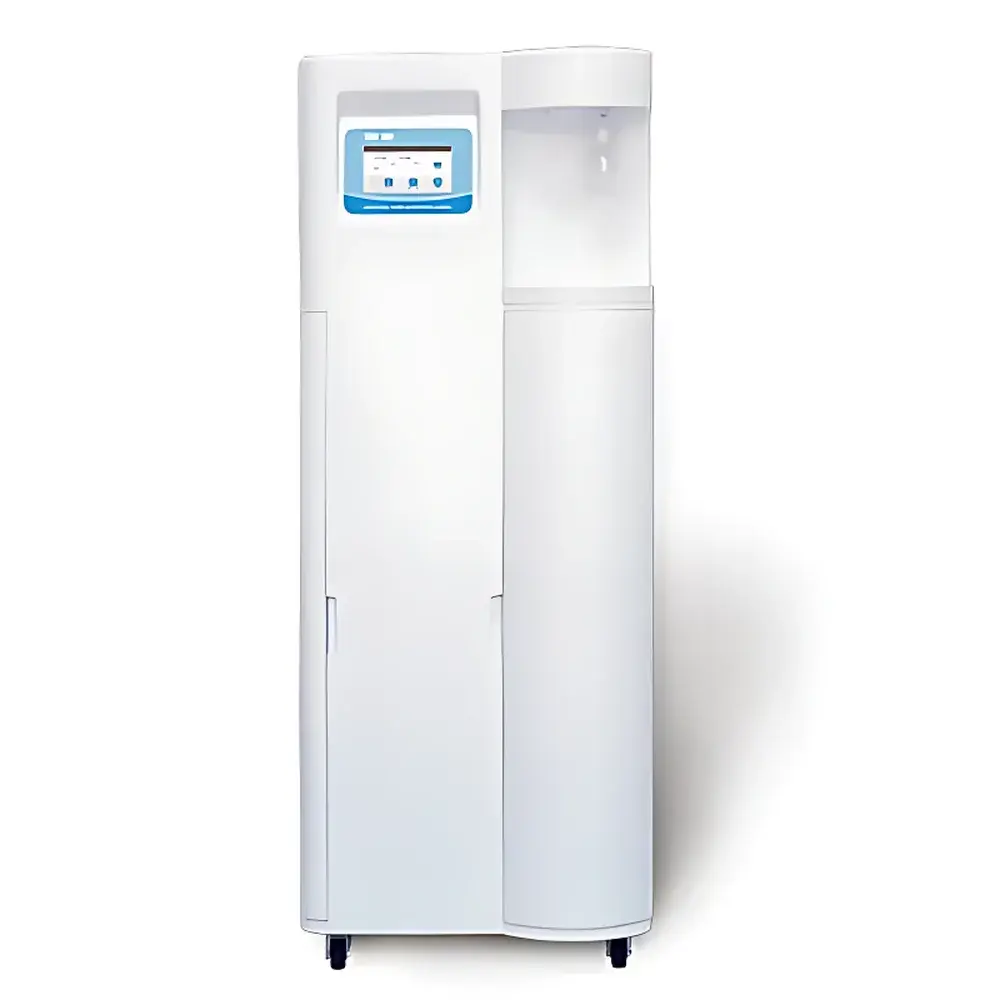
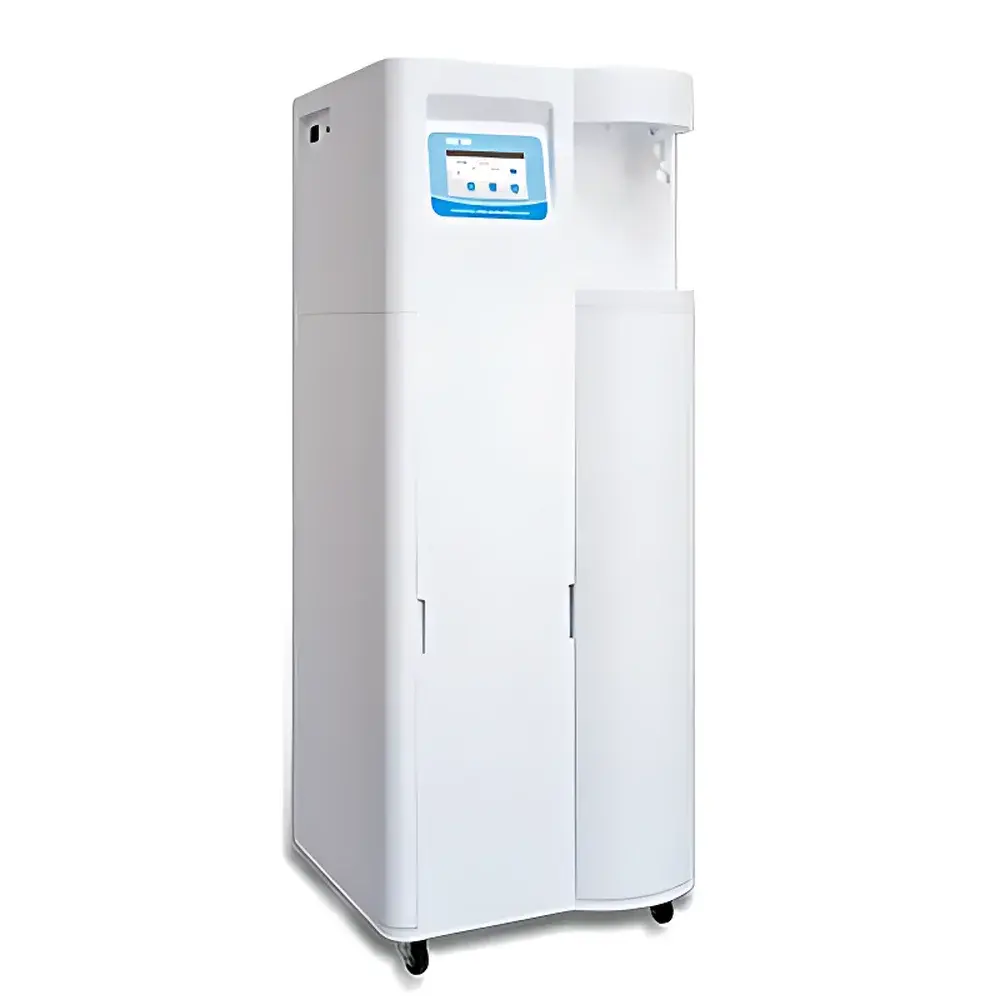
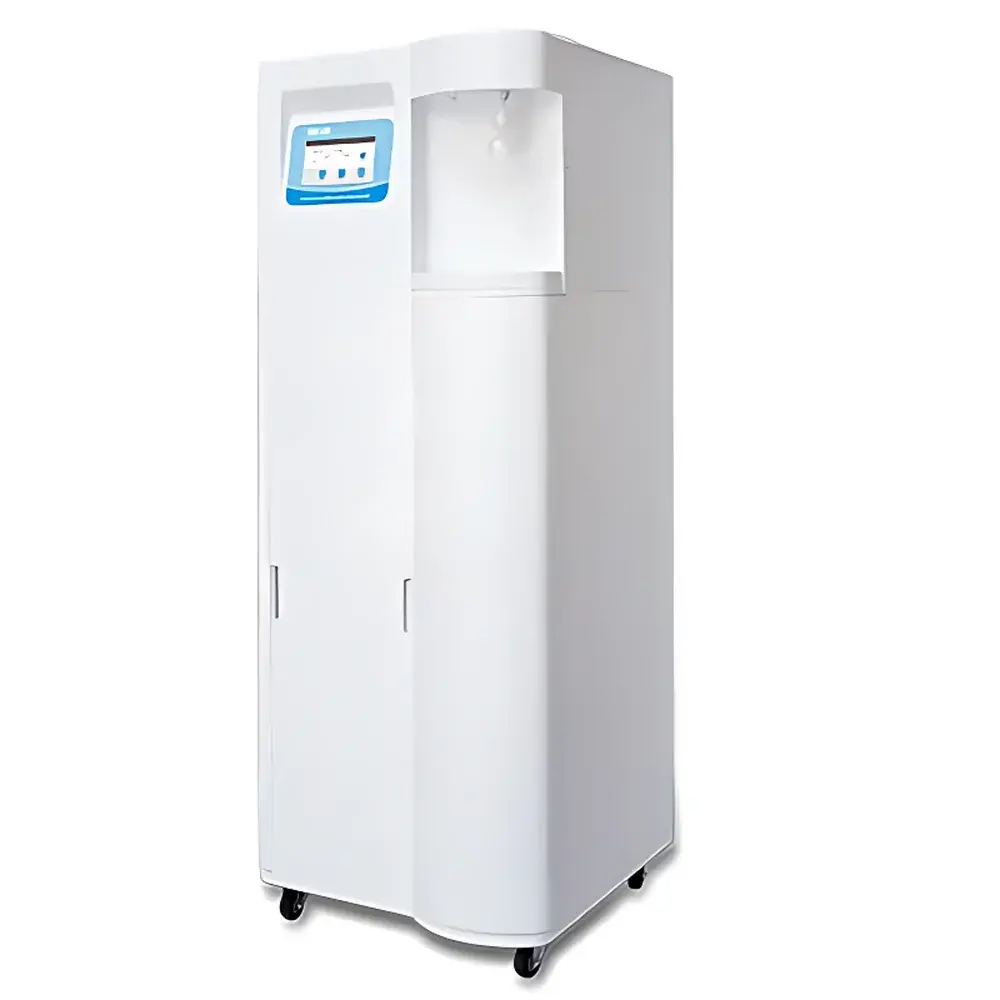
The Lab Center45/60/90-F/V/FV Ultra Pure Water System
| [Brand | The Lab |
|---|---|
| Origin | USA |
| Model | Center45/60/90-F/V/FV |
| Purified Water Grade | Type I (ASTM D1193, USP <1231>, CLSI EP22-A, ISO 3696) |
| Resistivity | 18.2 MΩ·cm @ 25°C |
| Heavy Metals & Soluble Silica | <0.01 ppb |
| Total Organic Carbon (TOC) | <3 ppb (FV model) |
| Endotoxin | <0.001 EU/mL (F/V/FV models) |
| Microbial Count | <0.01 CFU/mL |
| Particles (>0.2 µm) | <1 particle/mL |
| UV Wavelength | 254 nm & 185 nm |
| UF Membrane MWCO | 5,000 Da |
| Final Filtration | 0.2 µm PES membrane |
| RO Membrane | Dow FilmTec™ |
| Ion Exchange Resin | Nuclear-grade, low-TOC leaching |
| Flow Rate | Up to 2.0 L/min UP water (with full reservoir) |
| Dimensions | 610 × 585 × 1580 mm |
| Weight | ~70 kg |
| Power | 220 V, 50 Hz, 480 W] |
Overview
The Lab Center45/60/90-F/V/FV Ultra Pure Water System is an integrated, modular laboratory water purification platform engineered for consistent production of Type I ultrapure water per ASTM D1193-20, USP , ISO 3696:1995, CLSI EP22-A, and CAP-accredited clinical laboratory requirements. It employs a rigorously validated multi-stage purification architecture: dual-stage reverse osmosis (RO) with transitional storage, electrodeionization (EDI), ultraviolet photo-oxidation (254 nm + 185 nm), ultrafiltration (5,000 Da MWCO), and final 0.2 µm polyethersulfone (PES) filtration. This sequence ensures removal of particulates, microorganisms, endotoxins, nucleases (RNase/DNase), colloidal silica, heavy metals, and organic contaminants—critical for sensitive applications including HPLC mobile phase preparation, cell culture media formulation, molecular biology assays (qPCR, NGS), and trace elemental analysis (ICP-MS).
Key Features
- Dual-pump, dual-membrane RO system with intermediate buffer tank—reduces energy consumption by up to 30% and wastewater ratio to ≤1:2 under typical municipal feedwater conditions.
- Real-time, three-channel water quality monitoring: RO permeate conductivity (1–5 µS/cm), EDI product resistivity (>10 MΩ·cm), and UP water resistivity (up to 18.2 MΩ·cm) — all displayed without manual sampling.
- Two independent, programmable dispensing modes: volumetric (10–999,999 mL) and resistivity-triggered (0.0–18.25 MΩ·cm), enabling precise, application-specific delivery.
- GLP-compliant data logging: 12 months of operational history stored internally; exportable via USB or SD card with timestamped records of alarms, consumable usage, maintenance events, and calibration actions.
- Three-door modular chassis design with removable spill tray and NSF-certified quick-connect fluidic pathways—facilitates rapid, tool-free service and minimizes cross-contamination risk during cartridge replacement.
- Dow FilmTec™ RO membranes and nuclear-grade ion exchange resin ensure long-term stability in resistivity and low TOC leaching (<3 ppb in FV configuration); UV lamps rated for ≥12,000 hours at full output.
Sample Compatibility & Compliance
The Center series supports direct integration with both pressurized storage (20 L internal stainless-steel-compatible pressure tank) and gravity-fed PE reservoirs (20 L internal). All wetted materials—including tubing, fittings, and housings—comply with NSF/ANSI Standard 61 and FDA 21 CFR Part 11 for electronic record integrity. System firmware implements audit-trail functionality with role-based access control (factory and user passwords), mandatory change logging, and immutable event timestamps—fully aligned with GLP, GMP, and ISO/IEC 17025 documentation requirements. Certificates of Conformance are provided for each unit, traceable to NIST-calibrated reference standards.
Software & Data Management
The 7-inch capacitive touchscreen interface delivers intuitive navigation through animated menus and real-time graphical trend displays (resistivity, TOC, UV intensity, flow rate). Firmware supports scheduled maintenance alerts based on actual runtime hours—not calendar time—for all consumables (PP/KDF/AC prefilter, RO membrane, EDI stack, UP column, UF, UV, and final filter). Historical data export includes CSV-formatted logs with ISO 8601 timestamps, compatible with LIMS integration. Optional Ethernet or RS232 interfaces enable remote status polling and alarm notification via SNMP or Modbus RTU protocols.
Applications
- HPLC, UHPLC, and LC-MS mobile phase and blank preparation where low TOC and silica are essential to prevent column fouling and baseline drift.
- Cell and tissue culture workflows requiring endotoxin-free water to avoid cytokine activation and false phenotypic responses.
- Molecular diagnostics including RT-qPCR, CRISPR editing, and single-cell RNA sequencing—where RNase/DNase contamination compromises assay fidelity.
- Atomic spectroscopy (ICP-OES, ICP-MS) demanding sub-ppt metal background and minimal carbon interference.
- Pharmaceutical QC testing per USP and EP 2.2.44, including validation of water-for-injection (WFI) precursor systems.
FAQ
What distinguishes the F, V, and FV configurations?
The “F” variant adds a 5,000 Da ultrafiltration module for endotoxin removal; the “V” variant integrates dual-wavelength (254/185 nm) UV oxidation for enhanced TOC reduction; the “FV” combines both—delivering the highest purity tier for nuclease-sensitive and trace-metal applications.
Is the system compliant with 21 CFR Part 11?
Yes—audit trail, electronic signatures, and role-based access control are embedded in firmware and validated per Annex 11 and ALCOA+ principles.
Can the system operate continuously without external reservoirs?
Yes—the dual internal storage (20 L PE tank + 20 L pressurized vessel) enables autonomous operation for >8 hours at maximum UP draw rate (2.0 L/min), eliminating need for floor-standing auxiliary tanks.
How often must consumables be replaced?
Pre-filters: every 6–12 months depending on feedwater hardness; RO membrane: 2–3 years; UP polishing column: 12–18 months; UV lamp: ≥12,000 operating hours; UF membrane: 18–24 months—each tracked autonomously with configurable alerts.
Does the system support remote diagnostics?
Standard RS232 port allows connection to building management systems; optional Ethernet module enables secure remote monitoring via HTTPS with TLS 1.2 encryption and configurable SNMP traps.



