
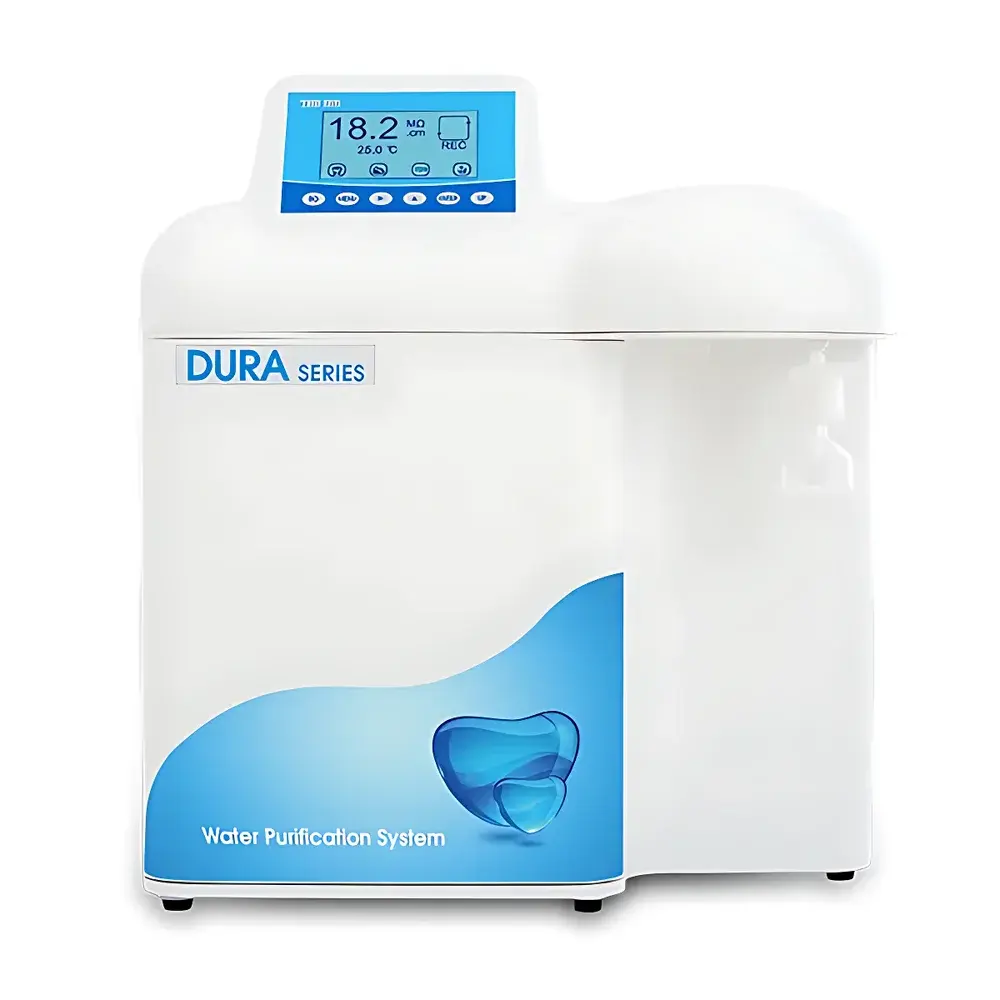
The Lab Dura Ultra-Pure Water System
| [Brand | The Lab |
|---|---|
| Origin | USA |
| Model | Dura |
| Purified Water Grade | Type I (ASTM D1193-20, USP <1231>, CLSI A2-A4, EP 2.2.44, CAP) |
| Resistivity | 18.2 MΩ·cm @ 25 °C |
| Heavy Metals & Soluble Silica | <0.01 ppb |
| Total Organic Carbon (TOC) | <3 ppb |
| Microbial Count | <0.01 CFU/mL |
| Endotoxin | <0.001 EU/mL |
| Particles (>0.1 µm) | <1 particle/mL |
| Flow Rate | Up to 2.0 L/min |
| Dual-Stage RO Output Conductivity | 1–5 µS/cm |
| DI Water Resistivity | >16 MΩ·cm |
| UV Wavelengths | 185 nm & 254 nm |
| UF Membrane MWCO | 5000 Da |
| Terminal Filtration | Dual-layer PES, (0.45 + 0.1) µm] |
Overview
The The Lab Dura Ultra-Pure Water System is an integrated, benchtop-grade purification platform engineered for laboratories requiring consistent, trace-level purity across diverse applications—including molecular biology, cell culture, HPLC, LC-MS, ICP-MS, and clinical diagnostics. It employs a rigorously validated dual-stage reverse osmosis (RO) architecture—featuring independent high-pressure pumps, optimized membrane staging, and an intermediate storage reservoir—to deliver stable pre-purified water even under variable municipal feed conditions (e.g., high hardness, elevated chloride, or fluctuating TDS). This foundational stage feeds a multi-step polishing train comprising dual-wavelength UV oxidation (185/254 nm), ultrafiltration (MWCO 5000 Da), and a high-capacity mixed-bed ion exchange cartridge with Dow resins. The system continuously monitors resistivity, TOC, microbial load, and endotoxin levels in real time, ensuring compliance with ISO 3696:1987, ASTM D1193-20 (Type I), USP , EP 2.2.44, and CLSI A2–A4 standards for ultrapure water.
Key Features
- Dual-Stage RO Architecture: Independent first- and second-stage RO pumps and membranes, coupled with an intermediate PE storage tank, reduce energy consumption by up to 25% and cut wastewater ratio to ≤1:2.5 (vs. conventional single-stage systems), while maintaining RO permeate conductivity between 1–5 µS/cm regardless of source water variability.
- Integrated Triple-Tank System: Includes a 5.8 L air-filtered PE feed tank (with hydrophobic 0.2 µm vent filter), a 12 L pressurized polypropylene storage tank, and optional external reservoir compatibility—minimizing atmospheric recontamination and enabling uninterrupted operation during high-demand protocols.
- Three-Point Real-Time Monitoring: Simultaneous online measurement of feed water conductivity, RO/DI water resistivity, and UP water resistivity + TOC (via integrated sensor module), with programmable alarm thresholds and automatic logging via RS232/USB interface.
- Automated Maintenance Intelligence: Predictive consumables management tracks usage hours and remaining life for pre-filters, RO membranes, UV lamps, and UP cartridges; triggers visual/audio alerts and logs replacement history—supporting GLP-compliant audit trails.
- Full-System Sanitization Protocol: One-touch chemical disinfection cycle using NSF-certified tablets, actuating the recirculation pump and UV lamp to sanitize all wetted surfaces—including tubing, tanks, and the UP cartridge housing—without disassembly.
- NSF-Certified Fluid Path: All tubing, quick-connect fittings, and pressure vessel seals meet NSF/ANSI Standard 61, minimizing organic leachables and ensuring TOC contribution remains below detection limits (<0.5 ppb background).
Sample Compatibility & Compliance
The Dura system is validated for use with municipal tap water meeting EPA drinking water standards (40 CFR Part 141), as well as distilled or single-pass RO feed sources. Its robust pretreatment—comprising 5 µm PP sediment filtration, KDF-55/CuZn alloy media, and coconut-shell activated carbon—effectively removes chlorine, chloramines, heavy metals, and particulates without generating carbon fines. The final purification stage includes a medical-grade 316L stainless steel UV chamber (dual-wavelength), a 5000 Da ultrafiltration membrane certified for endotoxin removal (≤0.001 EU/mL), and terminal sterilizing filtration (dual-layer PES, 0.45 + 0.1 µm). All configurations comply with FDA 21 CFR Part 11 requirements for electronic records when paired with optional data acquisition software, and support full GMP/GLP documentation through timestamped event logs, user-access controls (dual-level password protection), and tamper-evident audit trails.
Software & Data Management
Data integrity is maintained through embedded firmware supporting automated timestamped capture of temperature, resistivity, TOC, and operational status every 10 seconds. Raw datasets export in CSV format via USB or RS232 to compliant LIMS or ELN platforms. The 106 × 57 mm LCD interface displays animated flow diagrams, real-time parameter trends, and maintenance countdowns—enabling rapid visual verification of system health. Optional PC-based software provides advanced analytics, alarm history visualization, and customizable report generation aligned with ISO/IEC 17025 and CAP accreditation requirements. All firmware updates are digitally signed and installed via secure USB handshake to prevent unauthorized modification.
Applications
- Molecular biology workflows requiring RNase/DNase-free water (Dura V/FV models)
- Cell culture and IVF media preparation where endotoxin levels must remain below 0.001 EU/mL
- High-sensitivity analytical techniques including ICP-MS, GF-AAS, and low-background radioassay
- HPLC mobile phase preparation and LC-MS solvent make-up
- Clinical laboratory testing governed by CLIA and CAP guidelines
- Pharmaceutical R&D adhering to USP and EP 2.2.44 specifications
FAQ
What feed water quality is required for optimal Dura system performance?
Municipal tap water meeting EPA standards (TDS ≤ 500 ppm, chlorine ≤ 3 ppm, turbidity ≤ 1 NTU) is recommended. Pre-treatment is not required but advised for sources exceeding 200 ppm hardness or containing iron/manganese above 0.1 ppm.
Can the Dura system be connected to a central lab water network?
Yes—via optional pressure booster kit and loop-compatible distribution manifold; however, standalone operation is recommended to preserve TOC and particle integrity.
How often must consumables be replaced under typical lab usage?
Pre-filters: every 6–12 months; RO membranes: every 24–36 months; UP cartridge: 6–18 months depending on feed water quality and daily volume; UV lamps: annually or after 9000 hours.
Is the system compatible with regulatory audits such as FDA inspections or ISO 17025 assessments?
Yes—the Dura meets design and documentation requirements for 21 CFR Part 11 (electronic signatures), supports ALCOA+ data principles, and provides full traceability for all critical parameters, user actions, and maintenance events.
Does the Dura offer remote monitoring capability?
Not natively; however, analog voltage outputs (0–5 V) for resistivity and TOC are available for integration into building management or SCADA systems.



