
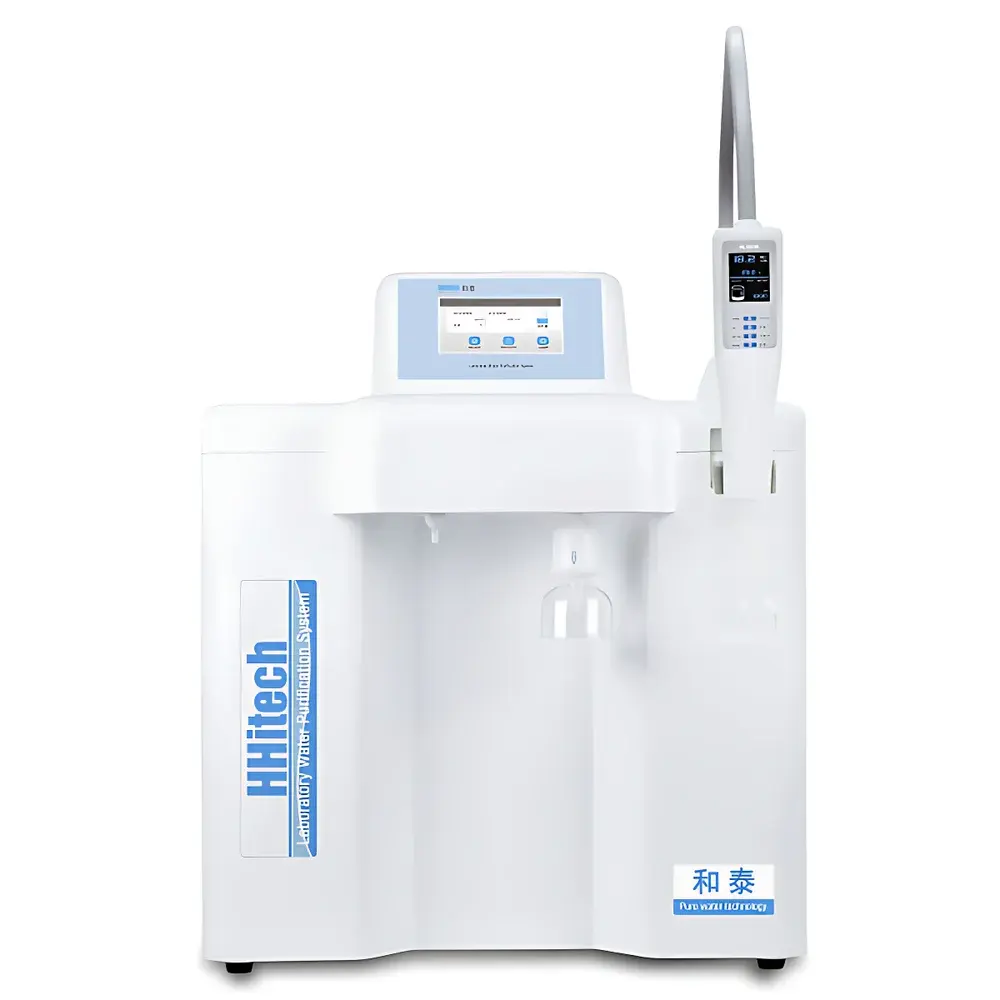
HHitech Master Evo-S Integrated Touchscreen Ultrapure Water System
| Brand | HHitech |
|---|---|
| Origin | Shanghai, China |
| Manufacturer Type | Direct Manufacturer |
| Product Category | Domestic |
| Model | Master Evo-S |
| Price Range | USD 7,000–14,000 (FOB Shanghai) |
| Pure Water Grade | ASTM Type I (ISO 3696 Class 1) |
| Resistivity | 18.2 MΩ·cm @ 25 °C |
| Heavy Metals & Soluble Silica | <0.01 ppb |
| Total Organic Carbon (TOC) | <3 ppb |
| Microbial Count | <0.01 CFU/mL |
| Endotoxin | <0.001 EU/mL |
| Particles (>0.1 µm) | <1 particle/mL |
| RO Feed Water | Municipal tap water (5–45 °C, 0.1–0.4 MPa) |
Overview
The HHitech Master Evo-S is an integrated, touchscreen-controlled ultrapure water system engineered for continuous, on-demand production of both reverse osmosis (RO) pure water and Type I ultrapure water (UPW) directly from municipal tap water. Designed in accordance with ISO 3696:2011, ASTM D1193-20, and CLSI EP23-A guidelines, the system employs a multi-stage purification architecture—including dual-wavelength UV oxidation (185/254 nm), four-column ultra-purification with Dow nuclear-grade ion exchange resin, 5000 Da molecular weight cutoff ultrafiltration (UF), and terminal 0.45 + 0.1 µm PES sterilizing filtration—to deliver consistent, trace-contaminant-free water suitable for critical applications such as HPLC mobile phase preparation, cell culture media formulation, molecular biology assays (including qPCR and CRISPR workflows), and trace metal analysis by ICP-MS.
Key Features
- Integrated 5-inch full-color capacitive touchscreen interface with animated menu navigation, real-time system diagnostics, and intuitive fingertip operation—no external PC required.
- Triple-point water quality monitoring: simultaneous real-time display of feed water conductivity, RO permeate resistivity, and UPW resistivity (0.01–18.25 MΩ·cm range) without manual sampling.
- Dual-mode dispensing: programmable volumetric delivery (10–999,999 mL) and quality-triggered dispensing (setpoint resistivity threshold down to 18.25 MΩ·cm).
- High-flow continuous output: 45 L/h (780 mL/min) UPW at ≥18.2 MΩ·cm, achieved without external storage tanks—eliminating dead-leg contamination risks and conserving bench space.
- Detachable ergonomic dispensing handle with 2.0-inch graphical LCD, integrated recirculation loop, and 0.9 m flexible tubing—enabling precise, pipette-style dispensing across standard lab workbenches.
- Internal pressurized buffer tank (integrated within 500 × 360 × 540 mm footprint) ensures stable flow and pressure during intermittent draw cycles while maintaining TOC <3 ppb and endotoxin <0.001 EU/mL.
- Automated maintenance protocols: scheduled RO membrane antiscalant flush (configurable interval/duration), manual “loop disinfection”, “dispenser port sanitization”, “tank refill”, and “drain” routines.
- Comprehensive consumables management: lifetime tracking and predictive replacement alerts for PP prefilter, KDF/carbon composite, RO membrane, dual DI/UP columns, UV lamps, UF module, and terminal filter—all with user-definable service intervals.
Sample Compatibility & Compliance
The Master Evo-S meets stringent regulatory requirements for analytical and life science laboratories. All wetted components—including NSF/ANSI 61-certified tubing, fittings, and 316L stainless steel UV chamber—are selected to minimize extractables and leachables. The system supports GLP/GMP data integrity through time-stamped, password-protected event logging (dual-level admin/user access), automatic alarm history capture (e.g., low feed pressure, high TOC, endotoxin excursion), and tamper-evident USB-exportable records compliant with FDA 21 CFR Part 11 principles. Terminal filtration with dual-layer PES membranes (0.45 + 0.1 µm) ensures sterility validation per ISO 13408-1; UF module (MWCO 5000 Da) validates endotoxin removal per USP . RNase/DNase levels are verified <1 pg/mL and <5 pg/mL respectively via fluorometric assay.
Software & Data Management
Embedded firmware provides comprehensive audit-trail functionality: all operational parameters (resistivity, TOC, temperature, flow rate), consumables usage (hours elapsed, volume processed), alarm events (timestamped severity level), and user actions (login/logout, configuration changes) are stored internally on a non-volatile SD card for ≥12 months. Data export is performed via USB 2.0 port using CSV format—compatible with LIMS integration and electronic lab notebook (ELN) ingestion. System clock supports NTP synchronization, scheduled standby (0–60 min), and auto-shutdown (0–24 h). Firmware updates are performed locally via USB without cloud dependency.
Applications
This system serves as primary water source for high-sensitivity instrumentation including LC-MS, GC-MS, ICP-OES, and ICP-MS; supports sterile tissue culture (stem cells, primary neurons, IVF), ELISA and western blotting reagent preparation, and nanoparticle synthesis where ionic or organic residue interference must be eliminated. Its low endotoxin and nuclease specifications make it suitable for transfection-grade plasmid dilution, single-cell RNA-seq library prep, and organoid culture media. The absence of external reservoirs mitigates biofilm formation risk—critical for long-term unattended operation in core facilities.
FAQ
What is the maximum permissible feed water hardness for sustained RO membrane performance?
Feed water total dissolved solids (TDS) should not exceed 500 ppm; calcium carbonate saturation index (LSI) must remain <2.5. Integrated KDF/carbon prefiltration extends RO life under typical municipal conditions.
Can the system be validated per IQ/OQ protocols?
Yes—factory-issued DQ/IQ/OQ documentation packages are available upon request, including calibration certificates for resistivity and TOC sensors traceable to NIST standards.
Is remote monitoring supported?
No Ethernet or Wi-Fi interface is included; however, USB-based log extraction enables periodic off-site review and compliance archiving.
How often must the UF module be replaced under normal use?
Typical service life is 12–18 months at 45 L/h average daily throughput; replacement interval is tracked automatically and displayed on the main screen.
Does the system comply with ISO 14644-1 Class 5 cleanroom requirements for water dispensing?
While the unit itself is not classified, its terminal filtration and laminar-flow handpiece design meet ISO 14644-1:2015 Annex B criteria for point-of-use purity in controlled environments when installed with appropriate air handling.



