
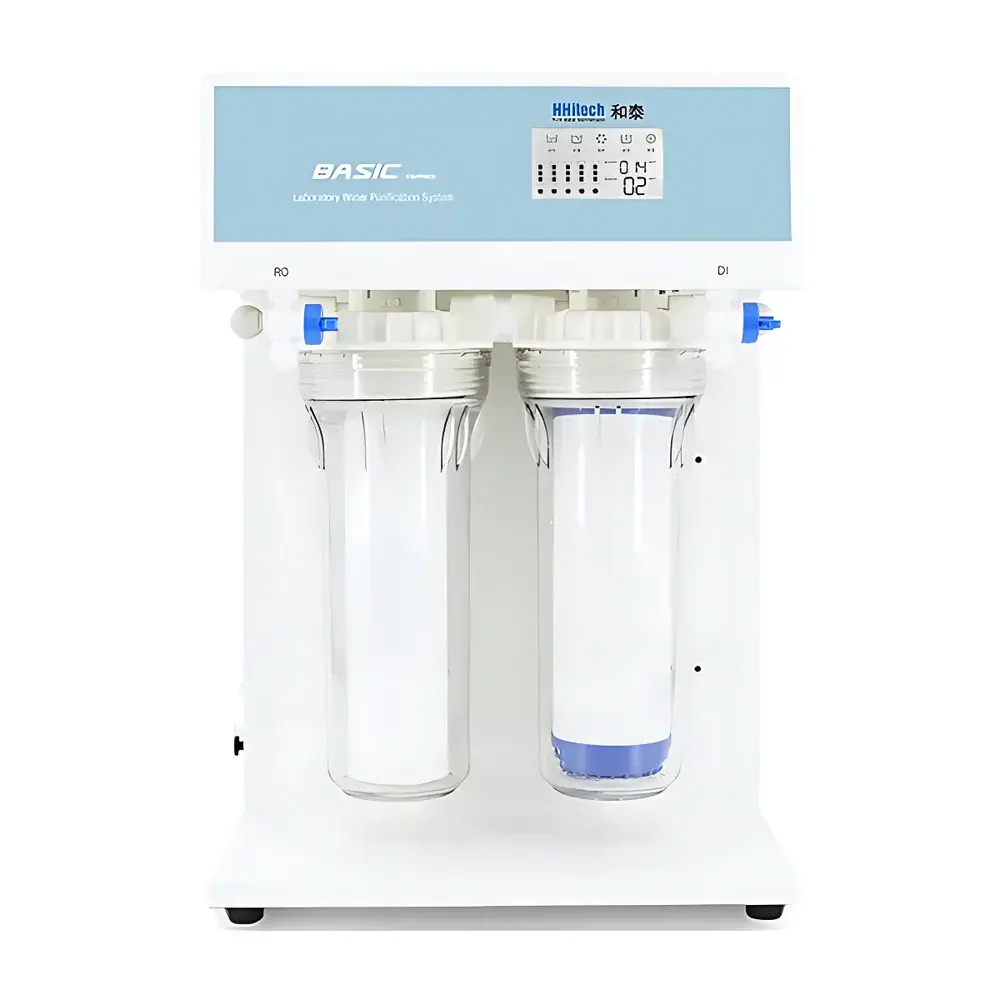
HHitech Basic-RO Reverse Osmosis Pure Water System
| Brand | HHitech |
|---|---|
| Origin | Shanghai, China |
| Manufacturer Type | Direct Manufacturer |
| Regional Classification | Domestic (China) |
| Model | Basic-RO |
| Price Range | USD 700–1,400 (est.) |
| Purified Water Grade | Type I (ASTM D1193-20) |
| Resistivity | 13–17.5 MΩ·cm @ 25°C |
| Heavy Metals & Soluble Silica | <0.1 ppb |
| Total Organic Carbon (TOC) | <3 ppb |
| Microbial Count / Endotoxins | <0.001 EU/mL |
| Particles (>0.1 µm) | <1 particle/mL |
| RO Output Capacity | 15–45 L/h (model-dependent) |
| Ion Rejection Rate | >97% (fresh membrane) |
| Organic Rejection Rate | >99% (MW > 200 Da) |
| Particle & Bacterial Rejection | >99% |
| Feed Water | Municipal tap water (5–45°C, 0.1–0.4 MPa) |
| Electrical Input | AC 100–240 V, 50/60 Hz |
| Power Consumption | 48–120 W (model-dependent) |
| Dimensions (L×W×H) | 410 × 400 × 420 mm |
| Weight | ~20 kg |
| Certifications | NSF-certified tubing & fittings |
| RO Membrane | Dow FilmTec™ branded composite polyamide thin-film composite (TFC) element |
Overview
The HHitech Basic-RO Reverse Osmosis Pure Water System is an entry-tier, laboratory-grade water purification platform engineered for consistent production of Type I reagent-grade water (per ASTM D1193-20) from municipal tap feed water. It employs a two-stage purification architecture: first, cross-flow reverse osmosis (RO) using a certified Dow FilmTec™ thin-film composite membrane to remove ≥97% of dissolved ions, >99% of organic molecules with molecular weight >200 Da, and >99% of particulates and microorganisms; second, optional post-RO deionization (DI) via precision-packed mixed-bed ion exchange resin to elevate resistivity to 13–17.5 MΩ·cm and reduce TOC to <3 ppb. Designed as a direct replacement for energy-intensive single-, double-, and triple-distillation units—whose output typically ranges from 0.2 to 4 MΩ·cm—the Basic-RO delivers higher purity, lower operational cost, and significantly reduced environmental footprint. Its modular, service-oriented layout supports GLP-compliant operation in academic, industrial QC, and routine analytical laboratories where reliable, low-maintenance RO/DI water is required for glassware rinsing, buffer preparation, media formulation, and instrument feed (e.g., HPLC mobile phase reservoirs, LC-MS solvent lines).
Key Features
- Microprocessor-controlled operation with backlit LCD display showing animated real-time status (e.g., flushing, tank full, producing, low feed pressure, maintenance due)
- Dual-channel online conductivity monitoring: simultaneous measurement of feed water TDS and RO permeate conductivity for performance verification and early fouling detection
- Intelligent RO membrane protection: four automated flush cycles—power-on initiation, post-low-pressure recovery, tank-full shutdown, and time-based (every 2 hours of cumulative operation)—to inhibit scale formation and extend membrane service life
- Comprehensive consumables lifecycle management: digital tracking of prefilter, RO membrane, and polishing cartridge remaining service time with visual and audible alerts at end-of-life
- Multi-layer safety architecture: self-diagnostic startup sequence, power-loss recovery, over-run protection (6-hour max continuous operation), low/high inlet pressure cutoff, and integrated audiovisual alarms for critical faults
- NSF-certified fluid path components (tubing, quick-connect fittings, valves) ensure material compatibility and leachate control per USP and ISO 3696
- Ergonomic, powder-coated steel chassis with electrical/water compartment separation; compliant with GLP physical layout requirements for traceability and contamination control
- Flexible installation: benchtop or wall-mount configuration (Q45-series and built-in tank models excluded); optional 12 L pressurized internal storage tank or external large-volume reservoir integration
Sample Compatibility & Compliance
The Basic-RO is validated for use with standard municipal potable water meeting WHO Guidelines for Drinking-water Quality and local regulatory limits (e.g., GB 5749–2022 in China). It is not intended for brackish, well, or wastewater sources without prior pretreatment. Output water meets or exceeds Type I specifications per ASTM D1193-20, ISO 3696:1987, and CLSI EP23-A guidelines for non-critical applications. While the system itself does not carry FDA 21 CFR Part 11 certification, its audit-ready design—including timestamped event logs, consumables tracking, and alarm history—supports GMP/GLP documentation workflows. Endotoxin and microbial retention data (<0.001 EU/mL and <1 CFU/100 mL) are verified per USP and , respectively, under controlled operating conditions.
Software & Data Management
The Basic-RO operates via embedded firmware without external PC dependency. All operational parameters—including runtime hours, total volume produced, conductivity readings, alarm events, and consumables usage—are stored in non-volatile memory with automatic timestamping. Event logs retain up to 500 entries and can be reviewed directly on the LCD interface. No proprietary software or cloud connectivity is included; however, the system supports manual data export via periodic TDS meter calibration checks and logbook documentation—fully compatible with paper-based or electronic lab notebook (ELN) systems used in regulated environments. The absence of network interfaces eliminates cybersecurity risks while preserving data integrity through deterministic hardware logic.
Applications
- Routine laboratory cleaning and final rinse of volumetric glassware, pipettes, and autoclave trays
- Preparation of non-critical buffers, saline solutions, and cell culture media diluents
- Feed water for high-purity downstream systems (e.g., ultrapure water polishers, EDI units)
- Solvent makeup for HPLC, IC, and GC mobile phases where TOC and ionic residue must remain below method-defined thresholds
- Calibration standards preparation requiring low-background electrolyte content
- General-purpose analytical chemistry workflows where resistivity ≥13 MΩ·cm and TOC <5 ppb are sufficient
FAQ
What feed water quality is required for optimal RO membrane performance?
Municipal tap water meeting local drinking water standards is required. Ideal feed conditions include temperature between 5–45°C, pressure of 0.1–0.4 MPa (1–4 bar), and turbidity 200 ppm CaCO₃ or free chlorine >0.5 mg/L necessitates additional pretreatment.
Can the Basic-RO produce water suitable for cell culture or molecular biology?
The RO/DI output meets Type I specifications but lacks integrated ultrafiltration or UV oxidation; therefore, it is not recommended for endotoxin-sensitive applications such as primary cell culture or transfection-grade reagent preparation without supplemental polishing.
How often must consumables be replaced?
Prefilters: every 3–6 months depending on feed water quality. RO membrane: 2–3 years under normal use. Polishing cartridge: 6–12 months or after 1,000–2,000 L of DI water, whichever occurs first. System alerts provide advance notice.
Is the unit compliant with international regulatory standards?
Yes—fluid path materials comply with NSF/ANSI Standard 58 and 61; output water meets ASTM D1193-20 Type I and ISO 3696 Class 1. Full 21 CFR Part 11 compliance requires third-party validation of user-specific SOPs and ELN integration.
Does the system support remote monitoring or IoT integration?
No. The Basic-RO is a standalone, closed-loop system designed for reliability and regulatory simplicity. All diagnostics and status information are accessible locally via the front-panel interface.



