
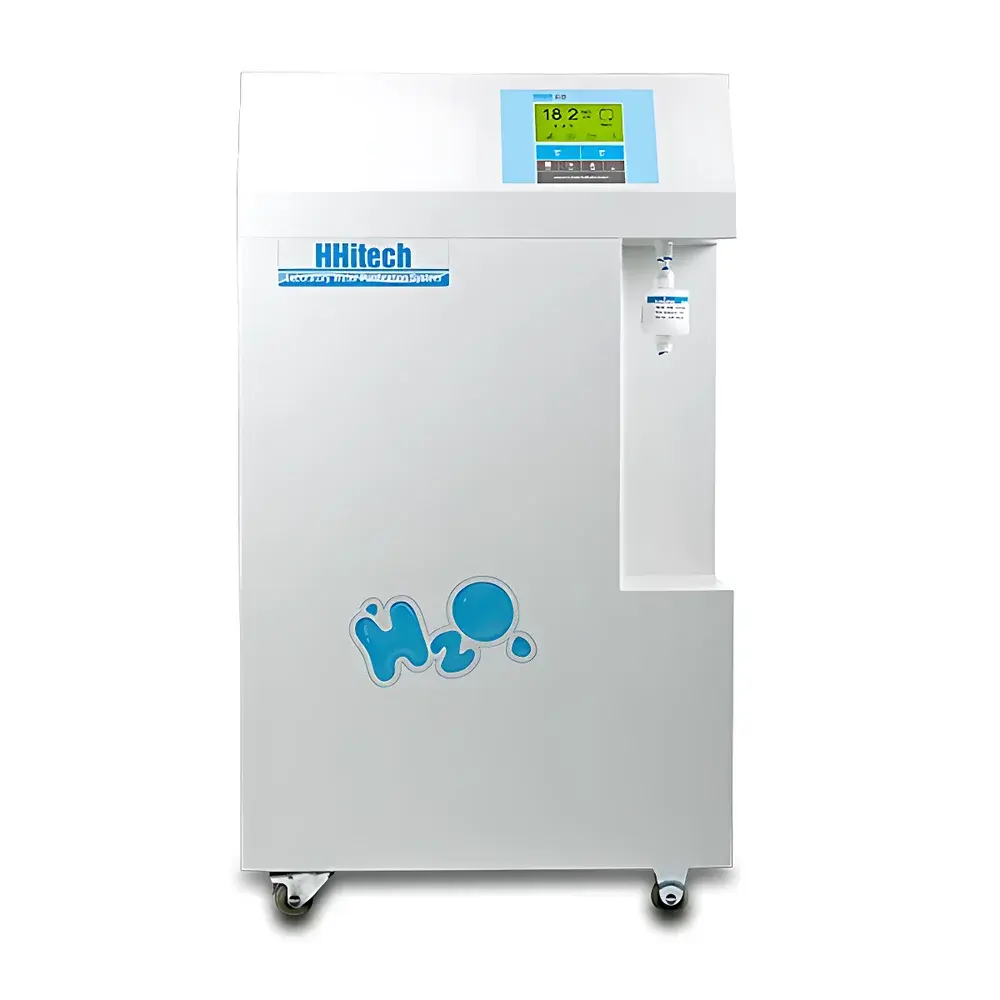
HHitech Pilot-R Dual-Stage Reverse Osmosis Ultra-Pure Water System
| Brand | HHitech |
|---|---|
| Origin | Shanghai, China |
| Manufacturer Type | Direct Manufacturer |
| Product Category | Domestic |
| Model | Pilot-R |
| Price Range | USD 4,200–7,000 (est.) |
| Pure Water Grade | ASTM Type I |
| Resistivity | 18.2 MΩ·cm @ 25 °C |
| Heavy Metals & Soluble Silica | <0.1 ppb |
| Total Organic Carbon (TOC) | <3 ppb |
| Microbial Count | <0.01 CFU/mL |
| Endotoxin | <0.001 EU/mL |
| Particles (>0.1 µm) | <1 particle/mL |
Overview
The HHitech Pilot-R is a dual-stage reverse osmosis (RO) ultra-pure water system engineered for demanding laboratory applications requiring continuous, high-reliability feedwater and final ultrapure water (UPW) compliant with ASTM D1193 Type I, ISO 3696 Grade 1, and CLSI EP21-A standards. Unlike single-stage RO or simplified dual-pump configurations lacking intermediate storage, the Pilot-R implements a rigorously validated process architecture: prefiltration → primary RO → intermediate PE storage tank → secondary RO → post-treatment (UV/UF/DI) → point-of-use delivery. This staged design ensures consistent rejection of ionic contaminants (≥99.9% salt rejection), organic molecules (MW >200 Da), colloids, microorganisms, and endotoxins—even under variable municipal feedwater conditions (TDS ≤200 ppm). The system delivers stable secondary RO permeate at 1–5 µS/cm conductivity, significantly reducing downstream ion exchange resin loading and extending consumable service life by up to 40% compared to single-stage equivalents.
Key Features
- Engineered dual-pump, dual-membrane architecture with dedicated 20 L polyethylene intermediate storage tank—eliminates hydraulic instability and enables precise pressure control across both RO stages
- Integrated dual-wavelength UV oxidation module (185 nm + 254 nm) using imported low-pressure mercury lamps, achieving ≥99.9% microbial inactivation and TOC reduction to <3 ppb
- High-rejection MWCO 5000 Da ultrafiltration (UF) cartridge (imported) certified for endotoxin removal (<0.001 EU/mL), validated for cell culture, IVF, and molecular biology workflows
- Final 0.2 µm PES membrane terminal filter (NSF-certified) providing sterile-grade output with <0.01 CFU/mL bioburden
- Full-cycle automated RO membrane antiscalant flush sequence—programmable interval, duration, and flow rate—to mitigate fouling and extend membrane service life beyond 36 months
- Industrial-grade stainless steel powder-coated chassis with adjustable leveling feet; fully compliant with GLP environmental controls and cleanroom-compatible material specifications
Sample Compatibility & Compliance
The Pilot-R is validated for compatibility with analytical instrumentation requiring ultrapure feedwater, including HPLC, LC-MS, ICP-MS, AAS, and trace elemental analysis systems. Its output meets or exceeds critical regulatory thresholds: USP purified water specifications, FDA 21 CFR Part 11 data integrity requirements (via optional RS232/USB logging), and ISO/IEC 17025 calibration traceability frameworks. All wetted components—including NSF/ANSI 61-certified tubing, fittings, and pressure vessels—are chemically inert and extractables-tested per USP . Endotoxin and nuclease specifications (<0.001 EU/mL, RNase <1 pg/mL, DNase <5 pg/mL) satisfy stringent requirements for primary cell isolation, CRISPR-based editing, and monoclonal antibody production.
Software & Data Management
A 240×128 pixel backlit LCD interface provides real-time animated process visualization and multi-level menu navigation. Three independent conductivity/resistivity sensors continuously monitor feedwater, secondary RO permeate, and final UPW quality—with configurable alarm thresholds for conductivity, resistivity, TOC, and endotoxin proxy indicators. The embedded controller logs timestamped water quality data (resistivity, temperature, flow, alarm events) for ≥12 months via RS232 or USB (optional). Audit trails include user login history, parameter modifications, and consumable replacement records—fully aligned with GLP/GMP electronic record retention mandates. Factory and user password protection (dual-level access) prevents unauthorized configuration changes.
Applications
The Pilot-R serves as a primary water source for life science core facilities, pharmaceutical QC labs, semiconductor metrology cleanrooms, and academic research centers. Specific use cases include: preparation of electrophysiology buffers (e.g., ACSF, Ringer’s solution); dilution standards for ICP-MS trace metal analysis; mobile phase formulation for gradient HPLC; media preparation for stem cell expansion; and reagent-grade water for NGS library construction. Its modular internal footprint supports optional integration of recirculation loops and external distribution manifolds—enabling centralized deployment across multi-station lab environments without compromising point-of-use purity.
FAQ
What feedwater specifications are required for optimal Pilot-R performance?
Municipal tap water with TDS ≤200 ppm, temperature 5–45 °C, and inlet pressure 1.0–4.0 kgf/cm² is recommended. For TDS >200 ppm, an external softener is advised to prevent RO scaling.
How does the intermediate storage tank improve system stability?
It decouples primary and secondary RO stages, enabling constant inlet pressure to the second membrane—critical for maintaining consistent rejection rates and minimizing flux decline during peak demand cycles.
Is the system compatible with external water distribution networks?
Yes. Internal mounting rails and预留 space accommodate optional circulation pumps, UV recirculation modules, and 316L stainless steel loop manifolds—validated for Class 100 cleanroom integration.
What validation documentation is provided?
Factory test reports include conductivity/resistivity calibration certificates, TOC baseline verification, endotoxin challenge data, and NSF component compliance summaries—all traceable to NIST standards.
Can consumable lifetimes be customized based on local water quality?
Absolutely. The controller allows user-defined service intervals for pre-filters, RO membranes, UV lamps, UF cartridges, and mixed-bed resins—based on actual usage hours, volume throughput, or real-time water quality trends.



