
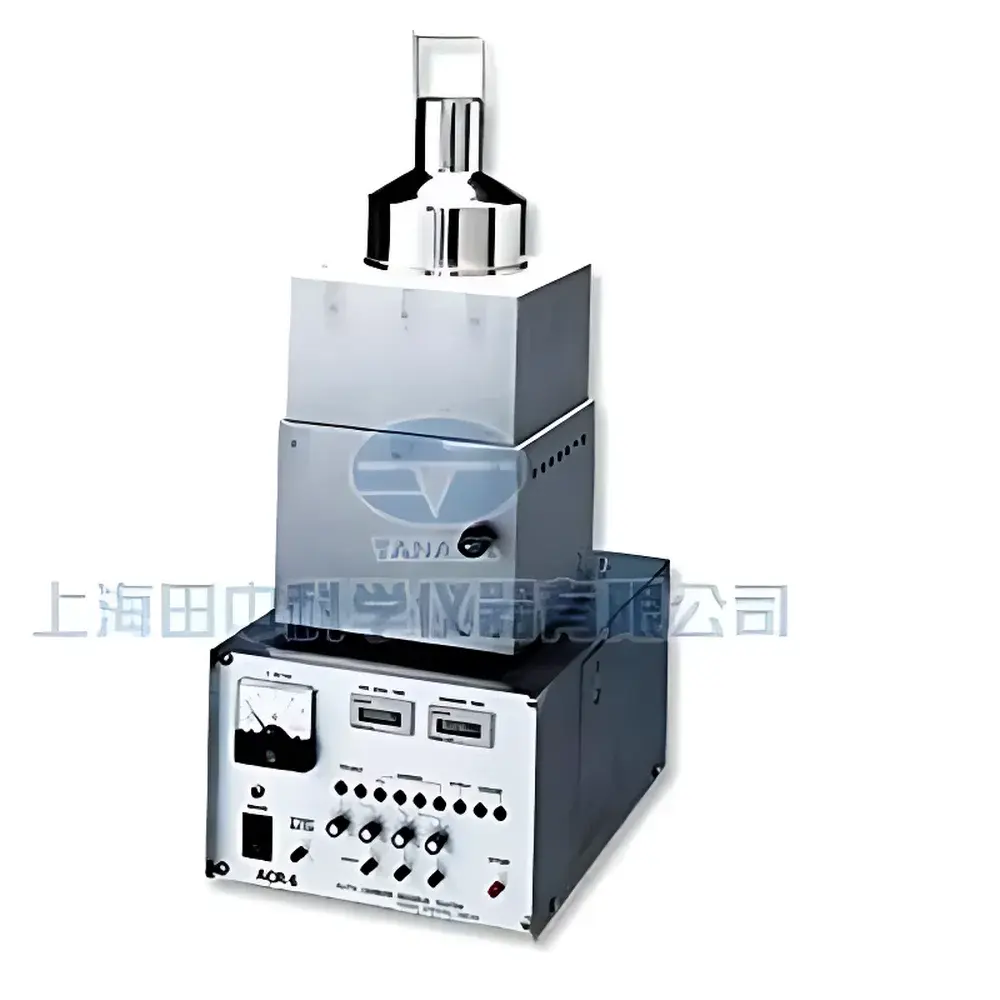
Tanaka ACR-6 Automatic Conradson Carbon Residue Tester
| Brand | Tanaka |
|---|---|
| Origin | Japan |
| Manufacturer Type | Authorized Distributor |
| Origin Category | Imported |
| Model | ACR-6 |
| Pricing | Available Upon Request |
Overview
The Tanaka ACR-6 Automatic Conradson Carbon Residue Tester is a precision-engineered laboratory instrument designed to determine the carbon residue content of petroleum products in strict accordance with ASTM D189 and IP 13 (formerly IP 13/76) standard test methods. Based on the classical Conradson carbon residue (CCR) principle, the instrument replicates the controlled thermal decomposition process under defined atmospheric conditions—first preheating the sample in an open crucible, followed by ignition, sustained combustion, high-temperature pyrolysis (at approximately 500 °C), and final cooling—to quantify the non-volatile carbonaceous deposit remaining after volatilization. This gravimetric measurement serves as a critical indicator of coke-forming tendency in crude oils, distillates, fuel oils, and lubricants, directly informing refining process optimization, catalyst life prediction, and product stability assessment.
Key Features
- Programmable sequence control via solid-state electronic time relays, ensuring precise timing for each phase: preheating, ignition, combustion, high-temperature heating (500 ± 5 °C), and forced cooling.
- Integrated thermocouple-based flame detection system for real-time monitoring of crucible temperature during combustion and pyrolysis stages, enabling reliable endpoint recognition and thermal safety interlocks.
- High-stability electric heating system rated at 1.3 kW, compatible with dual-voltage input (100/220 V AC, 50/60 Hz); total power consumption is 1.4 kW including control circuitry and fan operation.
- Manual pilot ignition via guided combustion tube—designed to initiate consistent, repeatable flame propagation across sample surfaces while maintaining operator safety and procedural fidelity to ASTM/IP protocols.
- Forced-air cooling system employing a dedicated axial fan, reducing post-pyrolysis cooling time to meet standardized cooldown intervals prior to gravimetric weighing.
- Dual digital time displays: one indicating elapsed time from instrument startup to ignition initiation; the other tracking duration from ignition to commencement of high-temperature heating phase—both traceable for audit and method validation purposes.
Sample Compatibility & Compliance
The ACR-6 accommodates standard Conradson crucibles (outer and inner metal crucibles with ceramic liners) and is validated for use with liquid petroleum samples having initial boiling points above 100 °C and flash points exceeding 60 °C—including gas oils, residual fuel oils, cracked stocks, and heavy lubricant base stocks. All operational parameters—including ramp rates, hold times, and temperature profiles—are aligned with ASTM D189 Section 7 (Apparatus Requirements) and IP 13 Clause 5 (Test Procedure). The system supports GLP-compliant documentation when paired with calibrated analytical balances and certified reference materials; its deterministic timing architecture facilitates full traceability required for internal quality audits and third-party accreditation (e.g., ISO/IEC 17025).
Software & Data Management
The ACR-6 operates as a standalone hardware platform without embedded microprocessor-based data logging or PC connectivity. However, its dual digital timers provide objective, operator-readable timestamps that can be manually recorded into laboratory notebooks or LIMS-compatible spreadsheets. For regulated environments requiring electronic records, users may integrate external timestamped video recording or connect optional RS-232-enabled data loggers (via custom cabling) to capture time-event sequences. While the unit does not natively support FDA 21 CFR Part 11 compliance features such as electronic signatures or audit trails, its mechanical-electrical architecture ensures reproducible, user-independent execution—making it suitable for routine QC laboratories operating under GMP-aligned SOPs where manual data transcription is permitted and validated.
Applications
- Refinery QC labs assessing carbon residue in vacuum gas oils and coker feedstocks to predict coke drum fouling rates.
- Fuel specification verification for marine residual fuels (ISO 8217 RMG/RMD grades) where CCR values impact combustion efficiency and exhaust particulate formation.
- Lubricant formulation R&D evaluating oxidative stability and sludge-forming potential of base oil blends and additive packages.
- Independent testing laboratories performing contract analyses for regulatory submission (e.g., EPA Tier 3 reporting, IMO MARPOL Annex VI compliance).
- Educational institutions teaching standardized petroleum testing methodologies per ASTM and IP syllabi.
FAQ
What standards does the ACR-6 comply with?
ASTM D189 and IP 13 (Conradson Carbon Residue test method) — fully implemented through hardware-controlled timing, temperature profiling, and crucible configuration.
Is the instrument supplied with calibration certificates?
No factory calibration certificate is included; users must perform periodic verification using NIST-traceable thermocouple calibrators and certified reference oils per ASTM D189 Annex A1.
Can the ACR-6 be used for Ramsbottom carbon residue (RCR) testing?
No — the ACR-6 is specifically engineered for Conradson methodology only; RCR requires distinct apparatus geometry, pressure control, and heating dynamics per ASTM D524.
What maintenance is required for long-term reliability?
Routine inspection of thermocouple integrity, cleaning of crucible holders and smoke hood interior, verification of fan airflow, and replacement of fuses (control and main circuit) as needed.
Are spare ceramic crucibles available as consumables?
Yes — Tanaka-certified porcelain crucibles (10-piece set) are listed as standard accessories and available through authorized distributors with batch-specific dimensional and thermal stability certification.






