
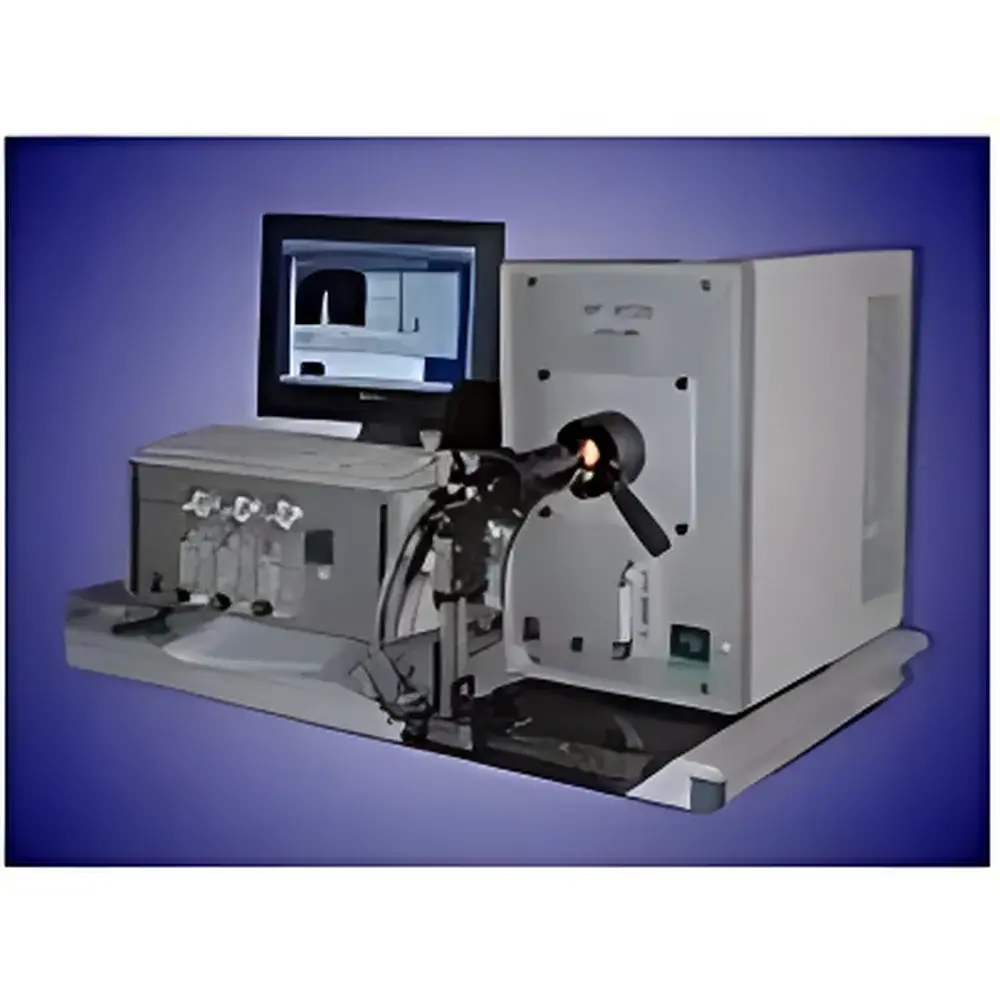
Sylab IF2000G Ash Fusion Temperature Tester
| Brand | Sylab |
|---|---|
| Origin | France |
| Model | IF2000G |
| Max Furnace Temperature | 1600 °C (Peak 1650 °C) |
| Operating Temp Range | 200–1550 °C |
| Atmosphere Control | Oxidizing/Reducing (Software-Regulated) |
| Sample Capacity | 2 molds (simultaneous) or 4 ASTM/ISO-compliant cones (6×6×19 mm) or 4 cylinders (3×3 mm) |
| Imaging System | CCD camera with RS232C interface, 5 °C interval image capture |
| Temp Resolution | 1 °C (S-type thermocouple at furnace base) |
| Temp Accuracy | ±20 °C of setpoint |
| Image Analysis Resolution | ±2% of full field |
| Data Output | Digital fusion curves, annotated stills (initial deformation, shrinkage, hemisphere, sphere, fluid), dimensional metrics (width, height, roundness), thermal ramp profiles |
| Compliance | ASTM D1857, ISO 540, DIN 51730, AFNOR M03-007, AS 1038.19, CEN/TS 15148 |
Overview
The Sylab IF2000G Ash Fusion Temperature Tester is a fully automated, image-based analytical instrument engineered for precise determination of ash fusion temperatures (AFT) in solid fuels and industrial mineral residues. It operates on the principle of high-resolution thermal imaging coupled with real-time morphological analysis of ash cones under controlled atmospheric conditions—either oxidizing (air/O₂) or reducing (CO/CO₂/N₂)—within a vertically oriented tubular furnace. Designed to meet stringent international standard requirements—including ASTM D1857 (Coal and Coke), ISO 540 (Solid Mineral Fuels), DIN 51730 (German Coal Standards), and CEN/TS 15148 (Biomass Ash)—the IF2000G delivers traceable, repeatable AFT measurements across four characteristic transition points: Initial Deformation Temperature (IDT), Softening Temperature (ST), Hemisphere Temperature (HT), and Flow Temperature (FT). Its dual-sample mold configuration and optional quad-cone holder support high-throughput laboratory workflows without compromising measurement integrity.
Key Features
- Fully automated thermal ramping and image acquisition from 200 °C to 1550 °C, with furnace capable of reaching 1600 °C continuously and peaking at 1650 °C
- Integrated CCD imaging system with RS232C interface, capturing high-fidelity grayscale images at user-defined intervals (default: every 5 °C)
- PID-controlled furnace with static relay and S-type thermocouple mounted at furnace base for direct sample-zone temperature referencing (±20 °C accuracy, 1 °C resolution)
- Atmosphere regulation via software-controlled gas flow (0–60 L/hr; recommended 12 L/hr), supporting both oxidizing and reducing environments per ASTM/ISO protocols
- Advanced image analysis engine quantifying geometric parameters—width, height, roundness, angularity, apex displacement—relative to initial cone geometry
- Automated classification of fusion stages: columnar growth, pyramidal expansion, pyramidal collapse, filament formation, and full fluidization
- Comprehensive digital output: time-stamped fusion curve, annotated still frames for IDT/ST/HT/FT, dimensional evolution plots, and thermal ramp profile
- Ceramic-tube furnace (40 mm internal diameter, 3 kW power) with asbestos-free, high-purity alumina insulation rated to 1700 °C
Sample Compatibility & Compliance
The IF2000G accommodates standardized ash cones per multiple global specifications: ASTM D1857 (6×6×19 mm pyramids), British Standard BS 1016-105, Australian AS 1038.19, ISO 540, AFNOR M03-007, and EDF R&D protocols. It also supports cylindrical specimens (3×3 mm) for biomass ash characterization per CEN/TS 15148 and ISO 18122. The system validates compliance through built-in calibration routines, audit-trail-enabled operation logs, and traceable temperature reporting aligned with ISO/IEC 17025 documentation practices. All fusion determinations are performed under documented atmospheric conditions, satisfying GLP requirements for regulatory submissions related to coal quality control, slagging/fouling prediction in combustion systems, and biomass co-firing feasibility studies.
Software & Data Management
The proprietary IF2000G acquisition and analysis software runs on Windows-based workstations and provides full 21 CFR Part 11–compatible functionality—including electronic signatures, role-based access control, and immutable audit trails for all method parameters, image captures, and final AFT assignments. Raw images, processed fusion curves, and metadata (temperature, time, atmosphere, operator ID, calibration status) are stored in a relational database with configurable backup policies. Export options include PDF reports (with embedded images and curves), CSV time-series data, and AVI-format fusion animations generated from sequential 5 °C interval frames. Software modules support batch processing, inter-laboratory comparison tools, and customizable report templates compliant with internal QA/QC or third-party accreditation frameworks.
Applications
The IF2000G serves critical functions across energy, metallurgy, and environmental research domains. In coal-fired power generation, it predicts slagging propensity by correlating AFT values with boiler tube deposition behavior. For cement and glass manufacturing, it evaluates fluxing agent performance and refractory compatibility. In biomass conversion R&D, it supports feedstock selection by characterizing ash sintering onset in pyrolysis and gasification reactors. Waste-to-energy facilities use IF2000G data to assess bottom ash fusibility and optimize grate design. Academic laboratories employ its high-resolution morphological tracking to model ash phase transformations using thermodynamic databases such as FactSage or Thermo-Calc.
FAQ
What standards does the IF2000G support for ash fusion testing?
ASTM D1857, ISO 540, DIN 51730, AFNOR M03-007, AS 1038.19, CEN/TS 15148, and BS 1016-105.
Can the instrument operate under reducing atmospheres?
Yes—gas composition and flow rate (0–60 L/hr) are programmable via software, enabling CO/CO₂/N₂ mixtures per ASTM D1857 Annex A3.
How many samples can be analyzed simultaneously?
Two standard molds (each holding three cones) or up to four individual ASTM/ISO cones—or four 3×3 mm cylinders—in a single run.
Is image resolution sufficient to detect subtle morphological transitions?
Yes—the system achieves ±2% geometric measurement uncertainty, validated against NIST-traceable reference cones, with sub-pixel edge detection for IDT and HT identification.
Does the software comply with FDA 21 CFR Part 11 requirements?
Yes—electronic records include time-stamped audit trails, operator authentication, and write-protection for raw data and analysis parameters.





