
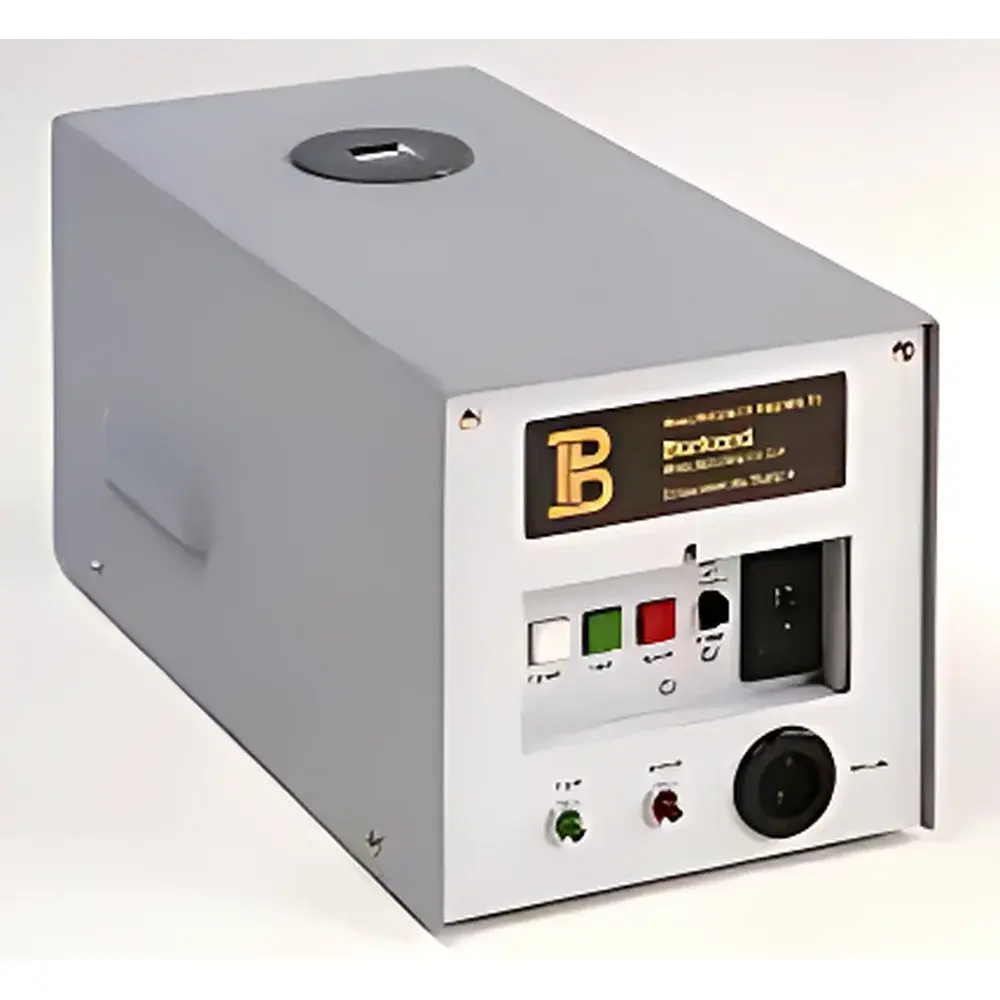
Brookfield 9100 Continuous Air Sampler
| Origin | UK |
|---|---|
| Manufacturer Type | Authorized Distributor |
| Origin Category | Imported |
| Model | 9100 |
| Quotation | Available Upon Request |
| Air Flow Rate | 10 L/min |
| Slide Dimensions | 26 mm × 76 mm (thickness 0.9–1.0 mm) |
| Slide Travel Speed Options | 2 mm/h (≥24 h), 4 mm/h (≥12 h), 8 mm/h (≥6 h) |
| Total Slide Length | 48 mm |
| Operating Voltage | 12 V AC (via external power converter) |
| Compliance | BS EN 60079-0 (Explosion-Protected Design per BS3836) |
| Height | 115 mm |
| Width | 118 mm |
| Depth | 215 mm |
| Weight | 2.6 kg |
Overview
The Brookfield 9100 Continuous Air Sampler is a precision-engineered, vertically oriented inertial impactor designed for unattended, time-resolved collection of airborne particulate matter over extended durations—up to and exceeding 24 hours. It operates on the principle of inertial impaction: ambient air is drawn vertically upward through a calibrated orifice at a constant volumetric flow rate of 10 L/min. Particles with aerodynamic diameters ≥5 µm possess sufficient inertia to deviate from the airstream and impact onto a continuously advancing microscope slide positioned directly beneath the orifice. This physical separation mechanism delivers a collection efficiency of up to 90% for coarse-mode particles, enabling quantitative morphological and compositional analysis via light microscopy, SEM-EDS, or culture-based microbiological assessment. The instrument’s compact footprint, low-power 12 V AC operation (via isolated external converter), and intrinsic safety certification per BS EN 60079-0 make it suitable for deployment in standard laboratories as well as classified hazardous areas where flammable vapors or dusts may be present.
Key Features
- Inertial impaction design optimized for ≥5 µm particle capture with documented ≥90% collection efficiency at 10 L/min flow
- Programmable slide advancement: three user-selectable linear speeds—2 mm/h (for 24+ h sampling), 4 mm/h (for 12+ h), and 8 mm/h (for 6+ h)—enabling precise temporal resolution across variable exposure durations
- Standard 26 mm × 76 mm glass microscope slides (0.9–1.0 mm thickness) compatible with all major histological and analytical workflows; total usable slide length of 48 mm ensures full utilization without manual intervention
- Integrated low-noise diaphragm pump delivering smooth, pulse-free airflow—critical for minimizing particle re-entrainment and preserving spatial deposition integrity
- BS3836-compliant construction with explosion-protected enclosure, certified to BS EN 60079-0 for safe operation in Zone 2/22 hazardous locations
- Robust aluminum alloy housing (H 115 mm × W 118 mm × D 215 mm); net weight 2.6 kg for stable benchtop mounting and field portability
- Interlocked access panel and tool-free slide loading—designed to prevent inadvertent operational errors by non-specialist personnel while maintaining GLP-aligned procedural control
Sample Compatibility & Compliance
The 9100 is validated for use with standard borosilicate glass microscope slides meeting ISO 8037-1 specifications. Its impactor geometry and flow calibration are traceable to NPL (National Physical Laboratory, UK) reference protocols. The system conforms to key regulatory frameworks governing environmental and occupational hygiene monitoring: it supports compliance with ISO 14644-1 (cleanroom particulate classification), ISO 8573-1 (compressed air purity), and OSHA Method ID-253 (airborne viable and non-viable particulate sampling). When paired with validated culture media or filter substrates, it satisfies requirements for EU GMP Annex 1 environmental monitoring and USP sterile compounding area qualification. All electrical interfaces meet IEC 61000-6-3 (EMC emissions) and IEC 61000-6-2 (immunity) standards.
Software & Data Management
The 9100 operates as a standalone hardware platform without embedded firmware or proprietary software dependencies. Sample timing, slide speed selection, and operational status are controlled via front-panel mechanical dials and LED indicators—ensuring deterministic behavior, long-term reliability, and audit-trail simplicity. For integrated data governance, users may log start/stop times, slide batch IDs, and environmental conditions (e.g., temperature, RH) in laboratory notebooks or LIMS-compatible spreadsheets. The absence of digital controllers eliminates cybersecurity vulnerabilities and simplifies 21 CFR Part 11 compliance: all raw data reside solely on the physical slide, with metadata recorded manually under documented SOPs. Optional accessories—including calibrated flow meters (traceable to UKAS) and humidity-compensated thermobarometric sensors—enable full metrological traceability per ISO/IEC 17025.
Applications
- Long-term ambient air quality monitoring in urban, industrial, and indoor environments
- Occupational exposure assessment for respirable dust, mold spores, pollen, and bioaerosols in pharmaceutical manufacturing, food processing, and healthcare facilities
- Validation of HVAC filtration efficiency and cleanroom integrity testing per ISO 14644 series
- Time-series characterization of aerosol generation events (e.g., powder handling, grinding, spray drying)
- Baseline environmental monitoring during facility commissioning and periodic requalification
- Research applications in atmospheric science, microbial ecology, and inhalation toxicology requiring spatially resolved particle deposition records
FAQ
What particle size range does the 9100 effectively collect?
The 9100 is optimized for inertial impaction of particles with aerodynamic diameters ≥5 µm. Collection efficiency rises with increasing particle mass and decreases below this threshold; it is not intended for fine (<2.5 µm) or ultrafine (<0.1 µm) aerosol fractionation.
Can the 9100 be used in explosive atmospheres?
Yes. Certified to BS EN 60079-0 and compliant with BS3836, the unit is approved for use in Zone 2 (gas) and Zone 22 (combustible dust) hazardous locations when installed per manufacturer-specified grounding and cable routing guidelines.
Is calibration required before each use?
A pre-use flow verification using a NIST-traceable primary standard (e.g., dry calibrator or bubble meter) is recommended per ISO 21501-4 and internal QA protocols. Factory calibration is performed at 10 L/min ±2.5% and remains stable under normal operating conditions for 12 months.
Does the instrument support automated data export?
No. The 9100 is an analog, mechanically regulated sampler. All operational parameters are set manually, and results are derived from direct microscopic or analytical examination of the collected slide—ensuring transparency, reproducibility, and minimal validation overhead.
What maintenance is required?
Routine maintenance consists of orifice cleaning with isopropyl alcohol and lint-free swabs every 10 sampling cycles, pump diaphragm inspection annually, and slide drive mechanism lubrication per 500 operating hours—documented in the supplied Maintenance Log Template (GLP-compliant format).



