
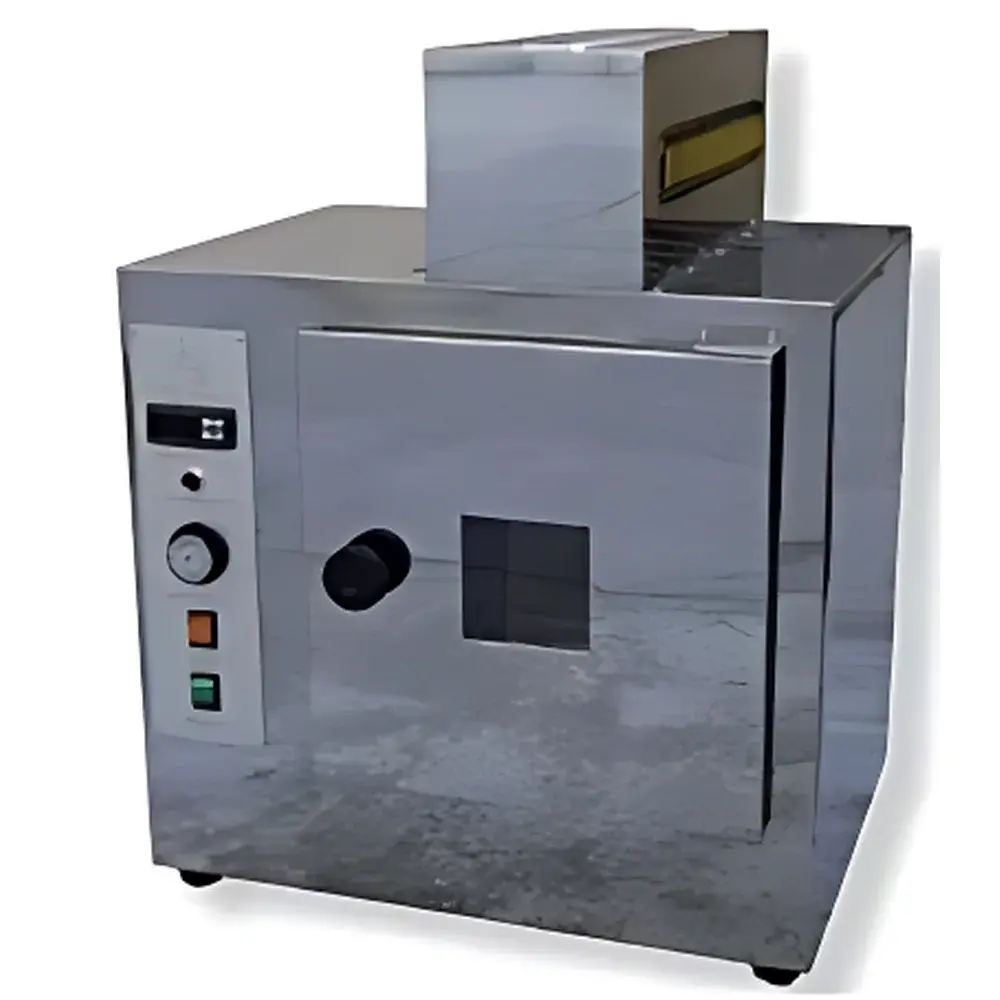
SDM 2560 Asphalt Heating Loss Tester
| Brand | SDM |
|---|---|
| Origin | Italy |
| Model | 2560 |
| Temperature Range | Ambient to 180 °C (±1 °C stability) |
| Power Supply | 220 V, 50/60 Hz |
| Power Consumption | 1200 W |
| Chamber Dimensions | 59 × 51 × 77 cm (W × D × H) |
| Net Weight | 24 kg |
| Construction | Full stainless steel cabinet with natural convection airflow |
| Rotational Sample Support | Optional internal turntable (5–6 rpm), gearmotor-driven from top panel |
| Temperature Control | Digital PID controller with PT100A sensor and independent overtemperature cutoff |
| Safety Enclosure | Double-walled insulated door with tempered safety glass viewport |
Overview
The SDM 2560 Asphalt Heating Loss Tester is a precision-engineered thermal aging apparatus designed specifically for the quantitative determination of volatile loss in bituminous binders under controlled, standardized heating conditions. It operates on the principle of gravimetric mass loss measurement: asphalt samples are exposed to elevated temperatures in a thermally stable, naturally ventilated chamber for a defined duration (typically 5 hours per ASTM D6 or EN 12607-2), after which the percentage mass loss is calculated to assess thermal stability and volatility characteristics. This test is foundational in pavement material qualification, binder specification compliance (e.g., polymer-modified asphalt), and long-term performance prediction. The instrument’s design strictly adheres to the mechanical and environmental requirements of ASTM D6, ASTM D1754, IP 45, EN 13303, and EN 12607-2 — ensuring data integrity across international regulatory and contractual frameworks used by highway agencies, refineries, and independent testing laboratories.
Key Features
- Full stainless steel construction ensures corrosion resistance, long-term dimensional stability, and compatibility with aggressive hydrocarbon vapors generated during asphalt thermal decomposition.
- Natural convection airflow system eliminates forced-air turbulence that could disturb sample geometry or induce non-uniform heating — critical for reproducible mass-loss results per ASTM methodology.
- Digital PID temperature controller with Class A PT100A platinum resistance thermometer provides real-time feedback and maintains thermal stability within ±1 °C across the full operating range (ambient to 180 °C).
- Independent overtemperature protection circuit interrupts power if the chamber exceeds user-defined safety thresholds — a mandatory requirement for unattended operation in GLP-compliant labs.
- Double-walled insulated door with laminated safety glass enables continuous visual monitoring without thermal disruption or operator exposure to hot surfaces.
- Optional rotating sample support (5–6 rpm) mounted on a top-accessible gearmotor facilitates uniform surface exposure and mitigates localized oxidation gradients in thick or viscous binder films.
Sample Compatibility & Compliance
The SDM 2560 accommodates standard asphalt sample pans (e.g., 100 g capacity, 120 mm diameter) as specified in ASTM D6 and EN 12607-2. Its chamber volume and airflow profile are validated to ensure consistent thermal profiles across multiple pans simultaneously. The unit is CE-marked and manufactured in accordance with ISO 9001-certified processes. Test reports generated using this instrument satisfy traceability requirements for ISO/IEC 17025-accredited laboratories when paired with calibrated analytical balances and documented SOPs. It supports audit readiness for transportation infrastructure projects requiring compliance with AASHTO R 30, Eurocode 7 Annex D, and national specifications referencing EN 13303.
Software & Data Management
The SDM 2560 operates as a standalone benchtop instrument with no embedded software or digital data logging. Temperature setpoint, elapsed time, and status indicators are displayed via front-panel LED interface. For full data governance, integration with external LIMS or ELN systems is achieved through manual entry of validated temperature logs and gravimetric measurements. When used in regulated environments (e.g., DOT-certified QA/QC labs), users implement procedural controls including daily temperature verification using NIST-traceable reference thermometers and calibration of supporting balances per ISO 17025 Clause 6.5. The absence of proprietary firmware simplifies 21 CFR Part 11 compliance — eliminating electronic record validation overhead while retaining full auditability of raw test records.
Applications
- Evaluation of short-term aging behavior of paving-grade asphalts and polymer-modified binders (PMBs) prior to mixing with aggregates.
- Quality control of reclaimed asphalt pavement (RAP) binder volatility during stockpile storage and processing.
- Comparative assessment of antioxidant efficacy in stabilized binder formulations.
- Supporting specification development for warm-mix asphalt (WMA) technologies where reduced volatilization is a key performance criterion.
- Pre-screening of bitumen feedstocks for refinery blending operations to minimize coking potential in downstream units.
FAQ
Does the SDM 2560 comply with ASTM D6 and EN 12607-2 simultaneously?
Yes — its thermal uniformity profile, ventilation rate, and sample exposure geometry have been verified against both standards’ physical test chamber requirements.
Is the rotating sample support standard or optional?
It is an optional accessory, configurable at time of order; rotation is not required for ASTM D6 but recommended for EN 12607-2 and heterogeneous binder matrices.
Can the unit be operated continuously for extended validation studies?
Yes — the robust stainless steel housing, thermal cutoff redundancy, and sealed gearmotor enable safe 24-hour operation when installed in a ventilated laboratory environment meeting local electrical and fire codes.
What maintenance is required to maintain calibration integrity?
Annual verification of temperature uniformity (per ASTM E220) and periodic validation of PT100A sensor accuracy using a calibrated dry-block calibrator are recommended.
Is technical documentation available in English with traceable calibration certificates?
Yes — factory-supplied operating manual, conformity declaration, and optional UKAS-accredited calibration certificate for the PT100A sensor are provided upon request.




