
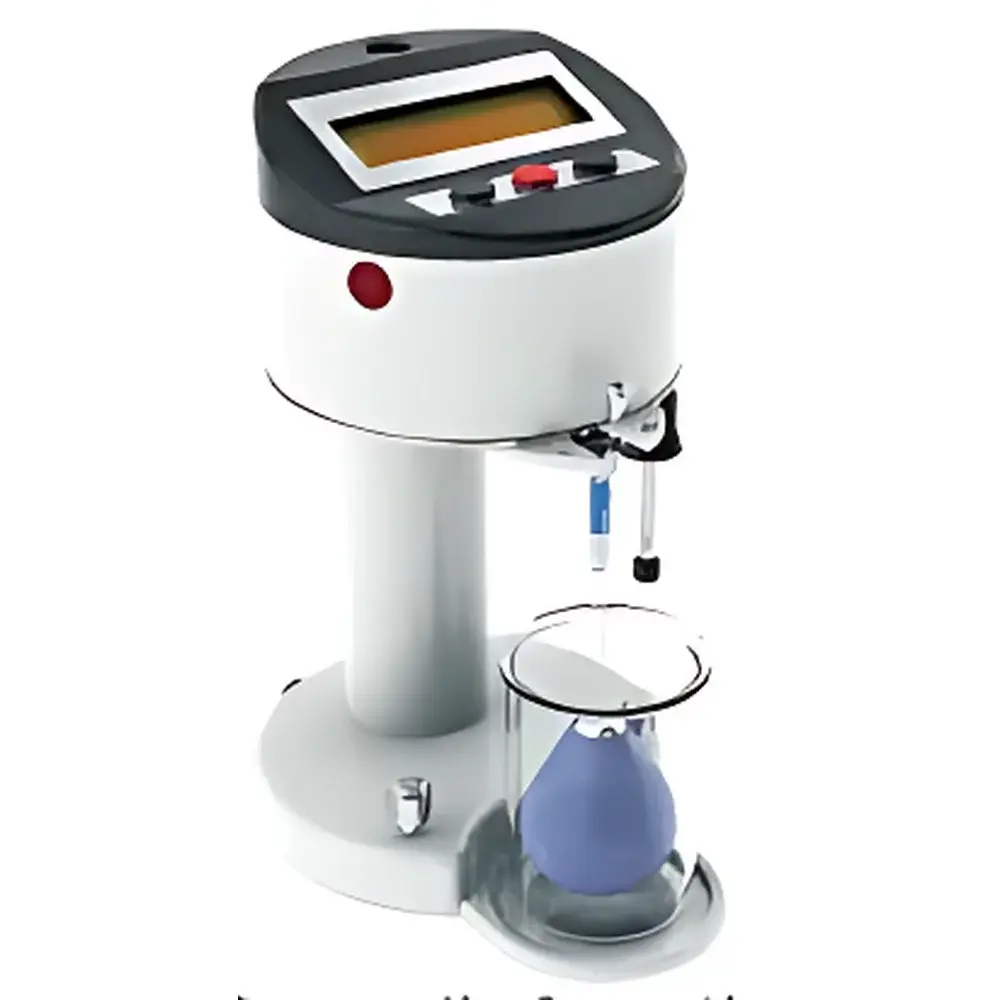
DenDi Portable Petroleum Densimeter
| Origin | USA |
|---|---|
| Manufacturer Type | Distributor |
| Origin Category | Imported |
| Model | DenDi |
| Price Range | USD 21,000–28,000 (FOB) |
| Application | Petroleum Product Density Measurement |
| Instrument Type | Buoyancy-Based Densimeter |
| Form Factor | Portable |
| Sample Type | Liquid |
| Density Range | 0–3 g/cm³ (0–3000 kg/m³) |
| Density Accuracy | ±0.0005 g/cm³ (±0.5 kg/m³) or ±0.001 g/cm³ (±1.0 kg/m³) |
| Temperature Range | +15 to +30 °C (+59 to +86 °F) |
| Temperature Accuracy | ±0.2 °C (±0.4 °F) |
| Minimum Sample Volume | < 2 mL |
| Calibration Medium | Distilled water only |
| Compliance | ASTM D1298, ASTM D1250, ISO 3675, ISO 12185 |
Overview
The DenDi Portable Petroleum Densimeter is a precision buoyancy-based densimeter engineered for field-deployable and laboratory-grade density measurement of liquid hydrocarbons and related industrial fluids. It operates on the fundamental principle of Archimedean buoyancy: a temperature-stabilized, calibrated glass hydrometer (removable float) is fully immersed in the sample, and its apparent weight—modified by the upward buoyant force—is measured via a high-resolution electromagnetic force compensation transducer. The instrument’s embedded microprocessor applies real-time corrections for ambient air density, thermal expansion of the float, and reference water density (per EN 1250 and ISO 649-1 standard tables), enabling direct calculation of density at 15 °C or 20 °C (user-selectable) without manual interpolation. Designed specifically for petroleum product testing, it delivers traceable, repeatable results compliant with ASTM D1298 (Standard Test Method for Density, Relative Density (Specific Gravity), or API Gravity of Crude Petroleum and Liquid Petroleum Products by Hydrometer Method) and ASTM D1250 (Petroleum Measurements Tables). Its solid-state architecture eliminates moving mechanical linkages, ensuring long-term stability and minimal drift over extended operational cycles.
Key Features
- True portable operation: integrated rechargeable Li-ion battery supports >12 hours of continuous use per charge; no external power supply required in field or refinery environments.
- Removable, borosilicate glass float with chemically inert surface—designed for rapid cleaning and resistance to hydrocarbon solvents, alcohols, and acidic/basic formulations.
- Auto-compensated temperature sensing: dual-sensor array (sample + ambient) ensures accurate thermal correction across the full operating range (+15 to +30 °C).
- Backlit monochrome LCD with intuitive icon-driven interface—fully functional in low-light conditions common in tank farms, offshore platforms, and mobile labs.
- Onboard memory stores up to 998 test records with full metadata: date, time, operator ID (optional), temperature, raw density, corrected density, and calibration status.
- Infrared data port compliant with IrDA 1.1 standards—enables wireless transfer to certified thermal printers or Windows-based PCs without cables or drivers.
Sample Compatibility & Compliance
The DenDi densimeter accommodates a broad spectrum of Newtonian and mildly non-Newtonian liquids, including crude oil, diesel, gasoline, jet fuel (Jet A-1, JP-8), lubricating oils, biodiesel blends (B5–B20), ethanol/water mixtures, methanol solutions, and refined petrochemical intermediates. It is not intended for highly viscous (>1000 mPa·s) or suspended-particle-laden samples without prior filtration. All measurements conform to internationally recognized metrological frameworks: traceability to NIST-traceable water standards, adherence to ISO/IEC 17025–compliant calibration protocols, and full alignment with API MPMS Chapter 11.1 (Density/Relative Density Measurements) and Chapter 11.2.2 (Temperature Measurement). For regulated environments—including refineries under EPA 40 CFR Part 60 or facilities subject to API Q1 quality management—the device supports audit-ready data export with immutable timestamps and operator tagging (when paired with optional Windows software).
Software & Data Management
The optional DenDi PC Suite (Windows 10/11, 64-bit) provides full data lifecycle management: secure import of IR-transmitted records, batch report generation (PDF/CSV/XLSX), statistical trend analysis (mean, SD, RSD, control charts), and electronic signature-enabled certificate of analysis (CoA) templates. Software enforces 21 CFR Part 11 compliance through role-based access control, electronic audit trails, and cryptographic hash verification of all stored datasets. Raw measurement logs include sensor diagnostics (float stability index, thermal equilibrium flag, air density deviation), supporting GLP/GMP documentation requirements. Exported files are structured to integrate seamlessly with LIMS platforms via ODBC or RESTful API adapters (available as licensed add-ons).
Applications
- Petroleum refining: real-time density verification during blending, custody transfer, and pipeline batch tracking.
- Fuel quality assurance: on-site screening for adulteration, water contamination, or incorrect distillation fraction composition.
- Contractor field services: mobile lab support for upstream well testing, produced fluid characterization, and storage tank inventory reconciliation.
- Regulatory compliance: preparation of ASTM-conforming reports for customs clearance, environmental reporting (e.g., EPA Tier II), and tax classification (e.g., excise duty based on API gravity).
- R&D laboratories: formulation development for biofuels, specialty solvents, and emulsion-based additives where density serves as a primary process indicator.
FAQ
What calibration standards are required?
Only certified distilled water (conductivity < 1 µS/cm) is needed for daily verification and full recalibration. No certified density standards or secondary reference fluids are required.
Can the DenDi measure density at temperatures outside +15…+30 °C?
No. The instrument is thermally optimized for this range; measurements outside this window violate ASTM D1298 validity criteria and invalidate traceability.
Is the float interchangeable between instruments?
No. Each float is serialized and factory-matched to its host unit’s transducer and thermal model. Swapping floats invalidates calibration and voids regulatory compliance.
Does the device meet explosion-proof requirements for Zone 1 hazardous areas?
The base unit is non-certified for hazardous locations. An ATEX/IECEx-certified enclosure kit (model DEN-DI-EX-KIT) is available as an accessory for Class I, Division 2 / Zone 2 deployment.
How is measurement uncertainty determined?
Combined standard uncertainty is calculated per GUM (JCGM 100:2008) using contributions from transducer resolution (±0.0001 g), temperature sensor error (±0.2 °C), air density model deviation (±0.00002 g/cm³), and water reference uncertainty (±0.00005 g/cm³ at 20 °C). Total expanded uncertainty (k=2) is ≤ ±0.001 g/cm³ across the 0.6–1.2 g/cm³ range.



