
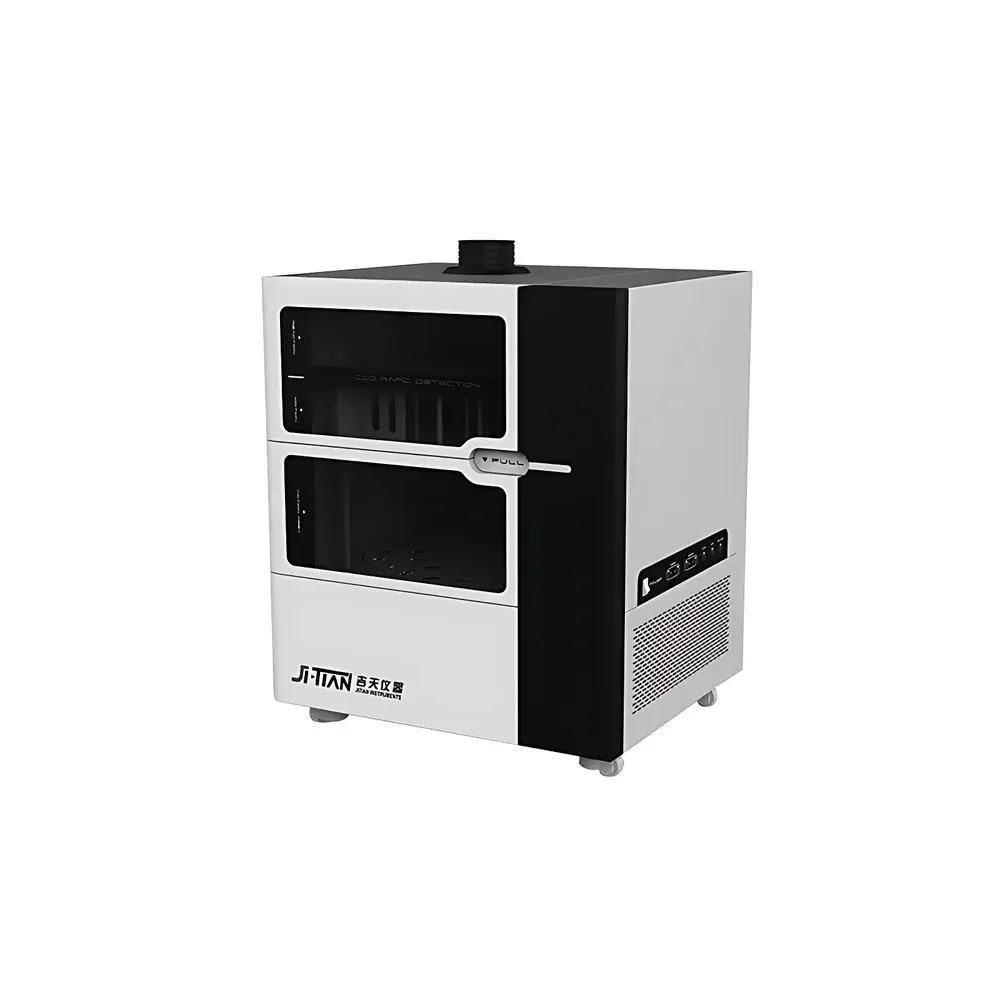
Titan Instruments ACOD-30 Fully Automated Chemical Oxygen Demand Analyzer
| Brand | Titan Instruments |
|---|---|
| Origin | Beijing, China |
| Manufacturer Type | Manufacturer |
| Origin Category | Domestic |
| Model | ACOD-30 |
| Pricing | Upon Request |
| Instrument Type | Laboratory Benchtop |
| Measurement Principle | Dichromate Oxidation with Automated Potentiometric/Colorimetric Endpoint Detection (Compliant with HJ 828–2017) |
Overview
The Titan Instruments ACOD-30 Fully Automated Chemical Oxygen Demand Analyzer is an integrated laboratory system engineered for precise, reproducible, and operator-safe determination of Chemical Oxygen Demand (COD) in aqueous environmental samples. It implements the standardized dichromate oxidation method per China’s national standard HJ 828–2017 — equivalent in analytical rigor to ISO 6060 and aligned with core principles of ASTM D1252 (Method B). The instrument automates the entire COD workflow: programmable sample aspiration, reagent dispensing (including concentrated sulfuric acid and potassium dichromate), controlled thermal digestion (reflux at 150 °C ± 2 °C), condensate management via auto-aligned reflux condenser coupling, back-titration with ferrous ammonium sulfate (FAS), endpoint detection via high-fidelity colorimetric recognition, and post-analysis waste neutralization and evacuation. By eliminating manual handling of corrosive reagents and thermally hazardous digestion steps, the ACOD-30 significantly reduces occupational exposure risk while ensuring metrological traceability and inter-laboratory comparability.
Key Features
- 9 independent, chemically inert reagent channels with positive-displacement syringe pumps — prevents cross-contamination between oxidants, catalysts, titrants, and masking agents
- Enclosed, temperature-regulated digestion module with real-time thermal monitoring and fail-safe overheat cutoff
- Ring-patterned spray rinse system that uniformly flushes residual sulfuric acid and volatile organics from sample vials and reaction vessels
- Integrated chloride interference assessment: automatically quantifies Cl⁻ concentration via AgNO₃ precipitation kinetics and selects appropriate masking protocol (HgSO₄ addition or alternative Cl⁻-resistant digestion)
- Dual-range titration architecture: one dedicated channel for low-COD samples (3–100 mg/L) and another for high-COD matrices (100–10,000 mg/L), each with calibrated burette and endpoint validation
- Biomimetic full-spectrum RGB photometric sensor array — detects subtle hue shifts across the entire visible spectrum (400–700 nm) to identify the precise Fe²⁺/Fe³⁺ redox transition endpoint without reliance on fixed-wavelength filters
- Self-diagnostic “Run Integrity Check” prior to assay initiation: verifies vial positioning, reagent volume thresholds, condenser alignment, and pump priming status to prevent acid leakage or incomplete reflux
- End-to-end digital audit trail: timestamps every actuator command, sensor reading, reagent dispense event, and colorimetric frame capture — compliant with GLP data integrity requirements
Sample Compatibility & Compliance
The ACOD-30 accepts liquid samples up to 50 mL volume in standard 16 mm × 100 mm borosilicate glass vials. It accommodates raw influent and effluent wastewater, surface water with suspended solids ≤ 100 mg/L, pretreated industrial discharges (e.g., textile, pharmaceutical, food processing), and digested sludge supernatants. All hardware and software workflows conform to HJ 828–2017 verification criteria, including digestion time (120 min ± 1 min), cooling duration (≥ 15 min), and titration precision (RSD ≤ 3.0% for replicate n = 6 at 100 mg/L COD). System validation reports support ISO/IEC 17025 accreditation readiness and are compatible with LIMS integration via ASTM E1384-compliant ASCII export.
Software & Data Management
The embedded Windows-based control software provides role-based access (Operator, Supervisor, Administrator), electronic signature capability, and 21 CFR Part 11–ready audit logging. Raw spectral data, titration curves (absorbance vs. volume), and diagnostic logs are stored in encrypted SQLite databases with automatic daily backup to network drives. Export formats include CSV (for Excel and statistical packages), PDF analytical reports with embedded chromatogram-like titration profiles, and XML files compliant with EPA WQX schema. Method templates are lockable and version-controlled; user-modified parameters require dual authorization.
Applications
The ACOD-30 delivers validated COD data for regulatory reporting under China’s GB 3838–2002 (Surface Water Quality Standards) and GB 8978–1996 (Comprehensive Wastewater Discharge Standard). It supports routine QC/QA in municipal wastewater treatment plants, compliance monitoring for industrial discharge permits, research into biodegradability indices (BOD₅/COD ratio estimation), and method development for emerging contaminants affecting redox stability. Its automated chloride correction and dual-range titration make it especially suitable for complex matrices such as landfill leachate, petrochemical runoff, and antibiotic fermentation broth.
FAQ
Does the ACOD-30 comply with international standards beyond HJ 828–2017?
Yes — its digestion kinetics, reagent stoichiometry, and endpoint detection methodology are technically harmonized with ISO 6060:1989 and ASTM D1252–12 (Method B), enabling cross-border data acceptance where local regulations permit equivalency assessments.
Can the system handle samples with high suspended solids or turbidity?
Samples with TSS > 100 mg/L require optional centrifugation or filtration (0.45 µm membrane) prior to analysis to prevent clogging of injection manifolds and ensure optical clarity for endpoint detection.
Is remote monitoring or unattended overnight operation supported?
Yes — the system supports scheduled batch runs (up to 48 samples), email alerts for completion or fault conditions, and secure VNC-based remote diagnostics via IT-approved firewall configurations.
How is reagent carryover prevented between analyses?
Each reagent channel features air-gap separation, post-dispense purging with inert gas, and sequential wash cycles using deionized water and ethanol — validated by blank titration RSD < 0.8%.
What maintenance intervals are recommended for long-term accuracy?
Syringe pump calibration every 3 months, photometric sensor verification weekly using NIST-traceable color standards, and full system performance qualification (SPQ) per HJ 828–2017 Annex C annually or after major component replacement.







