
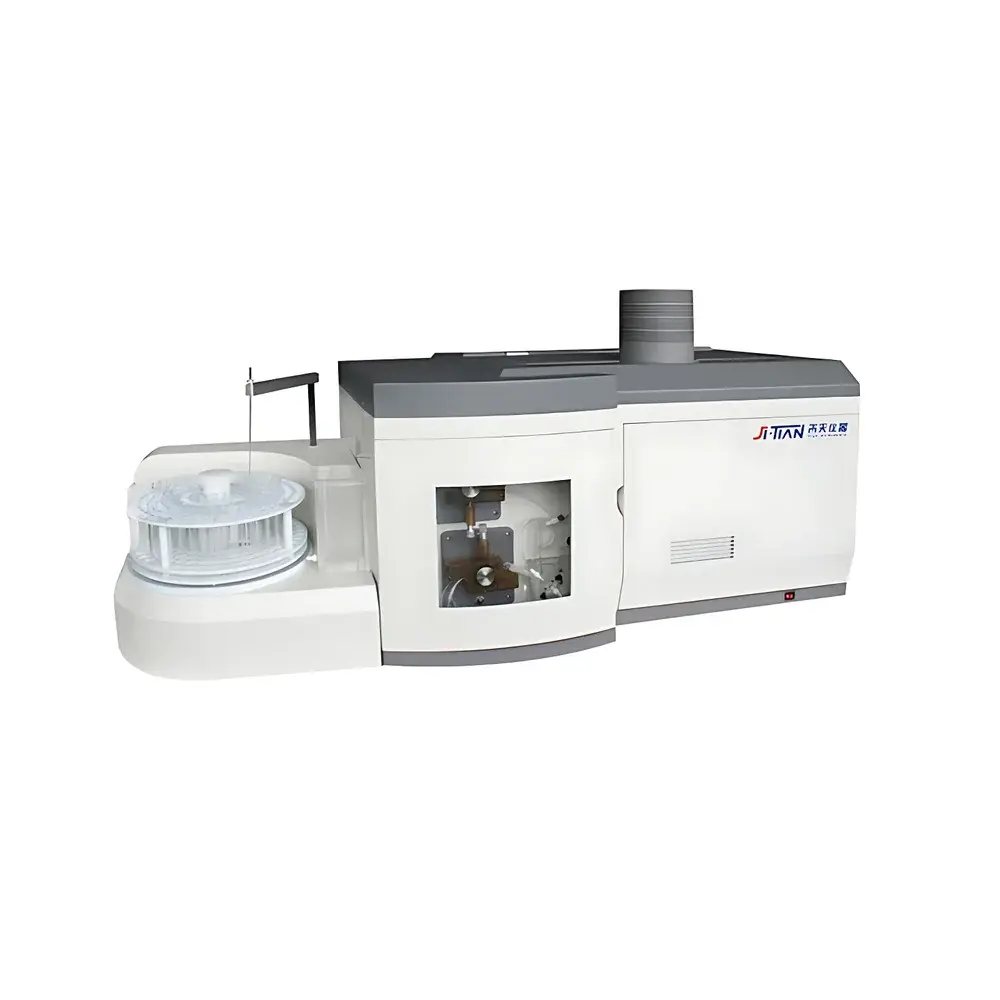
Titan Instruments AFS-8330 Fully Automated Six-Lamp Atomic Fluorescence Spectrometer
| Brand | Titan Instruments |
|---|---|
| Origin | Beijing, China |
| Manufacturer Type | Direct Manufacturer |
| Instrument Type | Multi-channel Atomic Fluorescence Spectrometer |
| Sample Introduction | Peristaltic Pump |
| Waste Liquid Disposal | Peristaltic Pump Extraction |
| Sample Introduction Mode | Vapor Generation / Hydride Generation |
| Gas Flow Control | Valve Island System |
| Detectable Elements | As, Se, Bi, Hg, Te, Sn, Ge, Pb, Zn, Cd, Au |
| Relative Standard Deviation (RSD) | < 0.8% |
| Linear Dynamic Range | > 3 orders of magnitude |
| Detection Limits | As, Bi, Sb < 0.01 µg/L |
| PMT Wavelength Range | 160–320 nm |
| Atomizer Temperature Control Range | Ambient to 1,000 °C (programmable) |
Overview
The Titan Instruments AFS-8330 is a fully automated, multi-channel atomic fluorescence spectrometer engineered for high-sensitivity, trace-level quantification of hydride-forming and cold-vapor elements in complex environmental, biological, food, and industrial matrices. Based on the principle of atomic fluorescence spectroscopy (AFS), the instrument excites ground-state atoms—generated in situ via hydride generation (HG) or cold vapor atomic absorption (CVAA) techniques—with element-specific hollow cathode lamp (HCL) radiation, then measures the intensity of characteristic fluorescent emission at defined wavelengths. Its dual-channel optical path enables simultaneous determination of two elements (e.g., As and Se), significantly improving analytical throughput without compromising precision. The system integrates a six-position automatic lamp turret, programmable temperature-controlled quartz atomizer, and sealed, dispersion-free optical alignment—all optimized to maximize signal-to-noise ratio and minimize spectral interference. Designed for compliance-driven laboratories, the AFS-8330 supports method validation per ISO/IEC 17025, USP , and regulatory frameworks governing heavy metal testing in food (e.g., FDA Food Code), water (EPA Method 1631), and soil (ISO 17294-2).
Key Features
- Six-lamp auto-switching turret with computer-controlled lamp selection and optimized warm-up sequencing
- Dual-channel detection architecture enabling concurrent measurement of two hydride-forming elements (e.g., As/Sb or Se/Te)
- Integrated 160-position polar-coordinate autosampler with programmable rinse cycles and cross-contamination minimization
- Intermittent-flow hydride generation system with built-in gas–liquid separator and argon–hydrogen flame ignition at low temperature (≤300 °C)
- Shielded quartz atomizer with precise thermal control (ambient to 1,000 °C) and real-time feedback regulation
- Sealed, non-dispersive optical path featuring bundled-pulse HCL power supply and photomultiplier tube (PMT) detection (160–320 nm)
- Valve island–based pneumatic control system ensuring repeatable gas flow, pressure stability, and fail-safe shutdown
- Onboard hazardous vapor trap for post-atomization capture of As, Hg, and other toxic effluents
- Self-diagnostic boot sequence with automatic leak check, flame status verification, and pressure validation
- Uninterruptible power support with data retention during transient outages
Sample Compatibility & Compliance
The AFS-8330 accommodates liquid samples—including aqueous extracts, acid digests (HNO₃/HCl), and enzymatic hydrolysates—across diverse matrices: drinking water, wastewater, soil leachates, food homogenates, clinical urine/plasma, pharmaceutical excipients, and agricultural feed. Solid samples require standard microwave-assisted or hot-block digestion prior to HG-AFS analysis. The instrument meets performance criteria outlined in multiple international and national standards, including GB 5009.11–2014 and GB 5009.17–2014 (China), HJ 694–2014 and HJ 542–2010 (China EPA), ISO 17294-2 (water), and ASTM D6722–22 (mercury in coal). All operational parameters—including lamp current, atomizer temperature, carrier gas flow, and reaction coil dwell time—are logged with timestamped audit trails compliant with FDA 21 CFR Part 11 requirements when paired with validated software configurations.
Software & Data Management
The AFS-8330 operates under Titan’s proprietary Windows-based AFS Control Suite—a bilingual (English/Chinese), GLP-compliant platform supporting full method development, calibration management, and QA/QC tracking. Key capabilities include: automated system diagnostics with fault-code reporting; customizable multi-point calibration curves (linear, quadratic, or weighted); dynamic range extension via intelligent dilution factor assignment; batch processing with sample ID inheritance and metadata tagging; export to CSV, PDF, and XML formats; and integrated electronic signature workflows. The software includes an embedded expert assistant offering context-sensitive guidance on optimal digestion protocols, reagent concentrations (KBH₄, HCl), and interference mitigation strategies (e.g., Ni²⁺ masking for Co/Cu). Raw spectral data, peak integration logs, and instrument parameter histories are stored in encrypted, tamper-evident databases with version-controlled backups.
Applications
The AFS-8330 delivers reliable sub-part-per-trillion sensitivity for routine monitoring and research applications requiring regulatory-grade accuracy. It is routinely deployed in municipal water quality labs for compliance with WHO and EU limits for arsenic and mercury in drinking water; in food safety programs verifying rice, seafood, and infant formula against Codex Alimentarius thresholds; in environmental remediation projects quantifying Hg and As speciation in sediment pore water; and in pharmaceutical QC labs validating elemental impurities per ICH Q3D. Its robustness supports high-volume testing in contract laboratories performing EPA 1631 (Hg), ISO 17294-2 (multi-element water screening), and GB/T 22105–2008 (soil total As/Hg/Pb). Academic users leverage its modular architecture for method development in bioinorganic chemistry, geochemical cycling studies, and nanomaterial toxicity assessment.
FAQ
What elements can be quantified using the AFS-8330, and what are typical detection limits?
The instrument detects As, Sb, Bi, Hg, Se, Te, Sn, Ge, Pb, Zn, Cd, and Au. Typical detection limits are ≤0.01 µg/L for As, Sb, Bi; ≤0.001 µg/L for Hg (cold vapor mode); and ≤0.02 µg/L for Se and Te under optimized HG conditions.
Does the system support hyphenated techniques such as species-specific analysis?
Yes—optional HPLC-AFS coupling modules enable As(III)/As(V), methylmercury/ethylmercury, and SeMet/SeCys speciation per EPA Method 1638 and ISO 17294-3.
Can the AFS-8330 analyze solid samples directly without digestion?
With optional direct mercury/cadmium introduction accessories, solid and liquid samples may be analyzed without wet digestion—achieving detection limits of ≤0.0002 µg/L for Hg in seawater and ≤0.05 ng/g for Cd in soils.
Is the software compliant with 21 CFR Part 11 for regulated environments?
When configured with user role management, electronic signatures, and audit trail archiving, the AFS Control Suite meets core technical requirements of 21 CFR Part 11 for pharmaceutical and clinical applications.
What maintenance routines are recommended for long-term stability?
Daily: rinse lines with 5% HNO₃ and deionized water; weekly: inspect quartz atomizer integrity and clean reaction coils; quarterly: calibrate PMT gain and verify lamp intensity drift; annually: replace peristaltic pump tubing and validate gas regulator response.





