
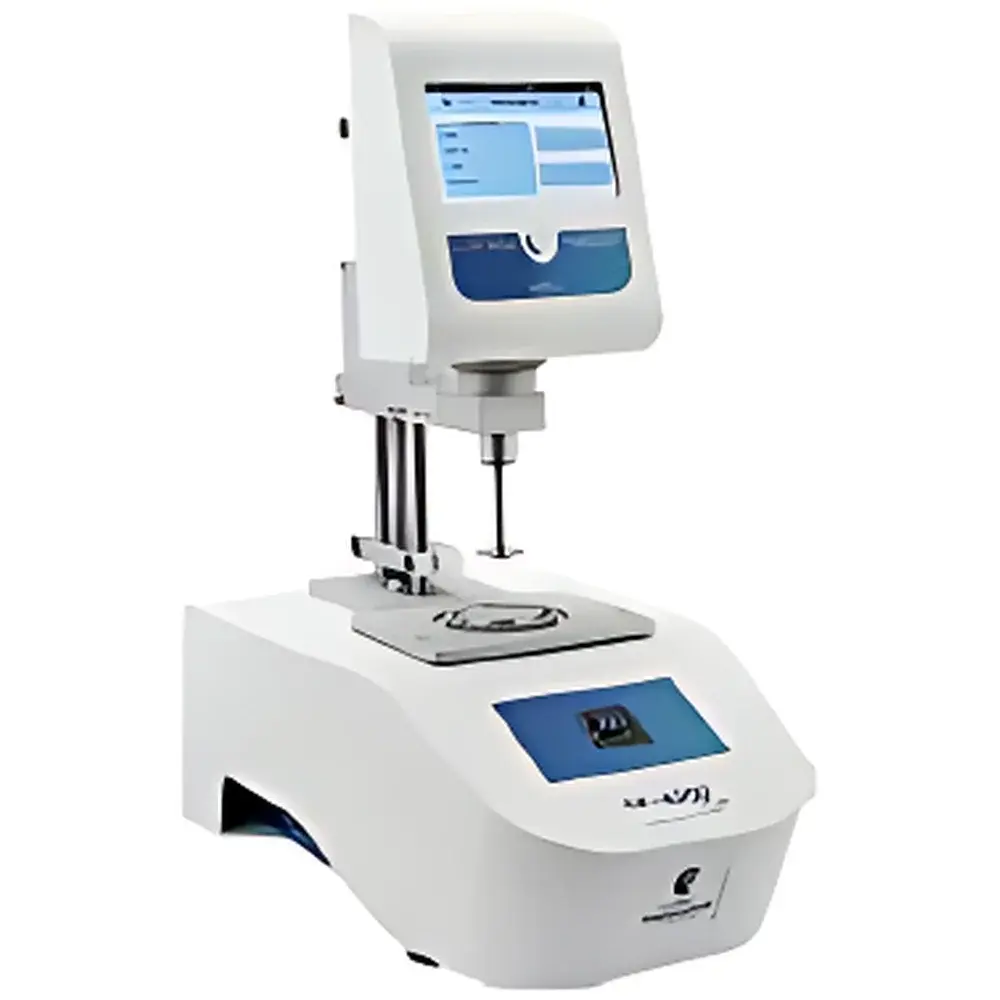
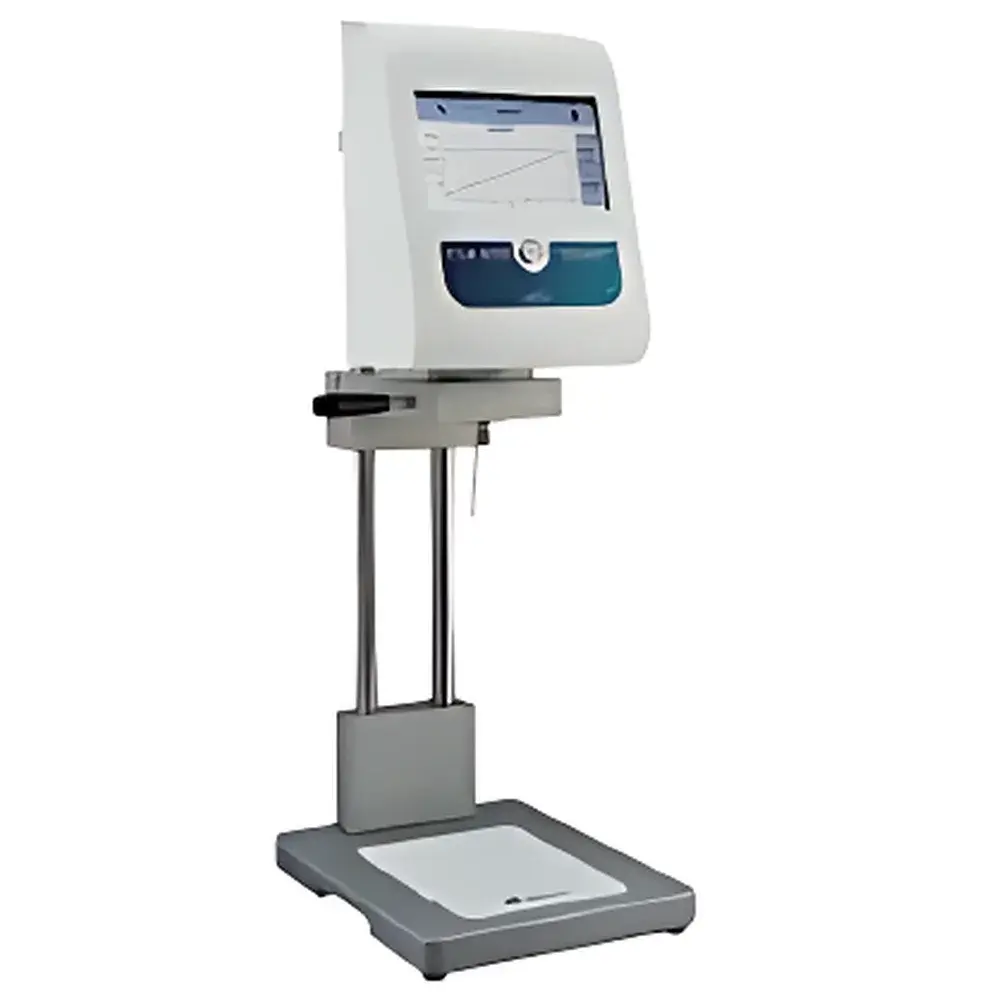
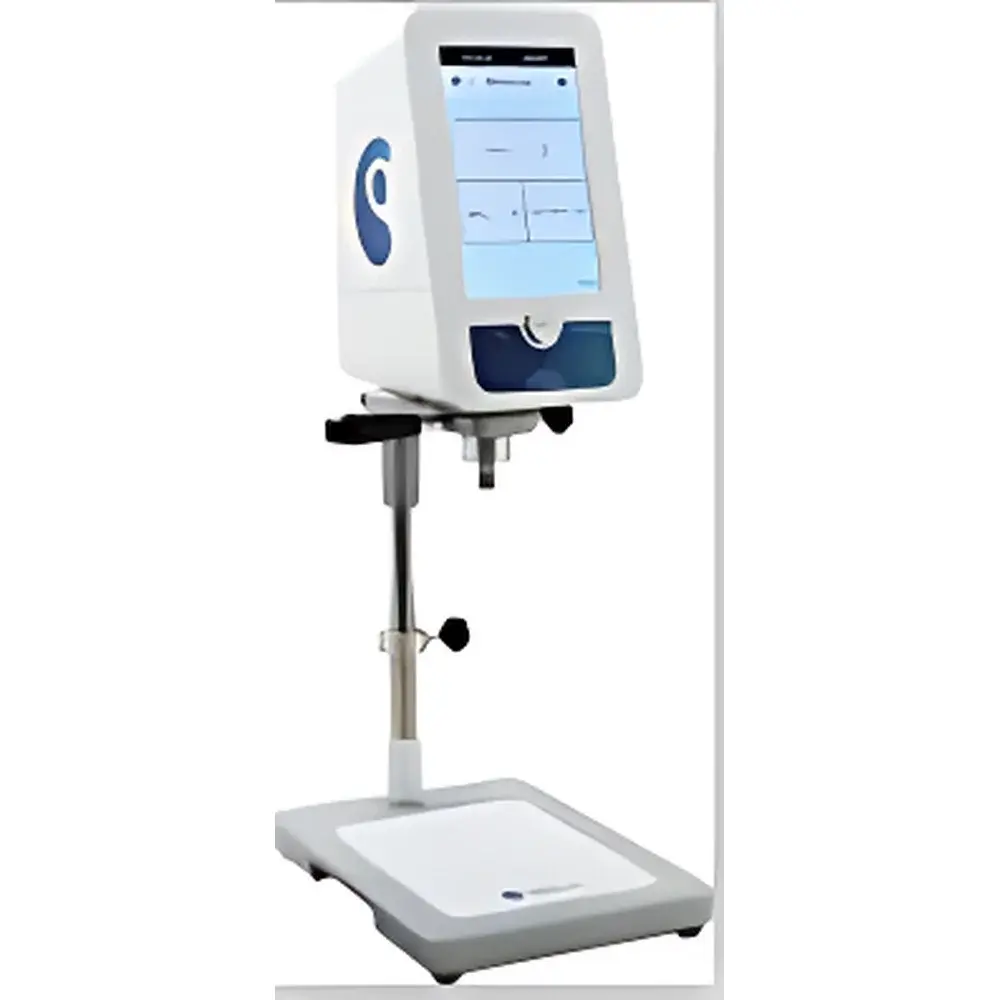
Lamy DSR 500 CP4000 PLUS Advanced Cone-Plate Rotational Rheometer
| Origin | France |
|---|---|
| Manufacturer Type | Authorized Distributor |
| Origin Category | Imported Instrument |
| Model | DSR 500 CP4000 PLUS |
| Price | Upon Request |
| Display | 7″ Touchscreen Interface |
| Rotational Speed Range | 0.3 – 1500 rpm |
| Torque Range | 0.05 – 30 mN·m |
| Temperature Control Range | −50 °C to +300 °C |
| Accuracy | ±1% of full scale |
| Repeatability | ±0.2% |
| Viscosity Range | 1 – 5.4 × 10⁸ mPa·s (dependent on geometry) |
| Shear Rate Control | Direct, programmable |
| Data Output | USB, RS232, 4–20 mA analog |
| Compliance | ASTM D2196, ISO 3219, ISO 6721-10, USP <911>, GLP-ready audit trail in RheoTex software |
| Dimensions (Measurement Head) | 180 × 135 × 250 mm (L×W×H) |
| CP4000 Base Unit | Ø600 × W300 mm |
| Weight | Approx. 22 kg (head + base) |
| Integrated Temperature Probe | Pt100 Class A |
| Language Support | English, French, Spanish, Russian |
| Power Supply | 90–240 VAC, 50/60 Hz |
Overview
The Lamy DSR 500 CP4000 PLUS is a high-precision, benchtop cone-plate rotational rheometer engineered for rigorous viscoelastic and shear-dependent characterization of complex fluids under controlled thermal conditions. Based on Couette flow principles, it employs a motorized, actively controlled cone-and-plate geometry to deliver highly reproducible shear rate sweeps, steady-state viscosity profiles, and time-resolved thixotropic recovery tests. Unlike conventional viscometers, the DSR 500 CP4000 PLUS operates as a true rheometer—capable of quantifying both viscous (η) and elastic (G′, G″) moduli when paired with oscillatory protocols via RheoTex software. Its integrated Peltier-based temperature control unit enables rapid, stable thermal conditioning across an exceptionally wide range (−50 °C to +300 °C), making it suitable for low-Tg polymer melts, high-temperature bitumen, cryogenic suspensions, and thermosensitive biopharmaceutical formulations.
Key Features
- Motorized auto-gap adjustment (AC265 coupling) ensures micron-level gap reproducibility (< ±2 µm) without manual calibration—critical for yield stress and normal force measurements.
- Dedicated 7″ capacitive touchscreen interface supports fully autonomous operation: real-time plotting of viscosity vs. shear rate, torque vs. time, and temperature history—no PC required for routine QC testing.
- Programmable shear rate ramps with linear or logarithmic profiles; slope calculation and regression analysis (Newtonian, Bingham, Casson, Ostwald–de Waele, Herschel–Bulkley) executed onboard.
- Integrated Pt100 Class A temperature probe embedded in the lower plate delivers direct, contact-based thermal feedback with ±0.1 °C stability over 30 min at setpoint.
- USB and RS232 ports enable seamless data export, remote instrument control, and integration into LIMS environments; 4–20 mA analog output supports industrial process monitoring interfaces.
- Comprehensive geometry library—including CP40, CP20, CP10, and custom cone angles—optimized for low-viscosity solvents, high-shear coatings, and particulate-laden suspensions.
Sample Compatibility & Compliance
The DSR 500 CP4000 PLUS accommodates samples from dilute aqueous surfactant solutions (1 mPa·s) to thermally stabilized elastomer melts (>500 MPa·s), with minimal sample volume requirements (0.05–0.5 mL depending on cone angle). Its design conforms to international standard test methods including ASTM D2196 (non-Newtonian fluids), ISO 3219 (rotational viscosity), ISO 6721-10 (dynamic mechanical analysis), and USP (rheological evaluation of semisolid dosage forms). All firmware and RheoTex software modules support ALCOA+ data integrity principles, with electronic signatures, user access levels, and FDA 21 CFR Part 11–compliant audit trails available upon configuration.
Software & Data Management
RheoTex software provides advanced post-processing capabilities—including time–temperature superposition (TTS), creep compliance modeling, and frequency sweep extrapolation—while maintaining full backward compatibility with legacy DSR 500 datasets. Raw torque, angular displacement, temperature, and normal force streams are recorded at ≥100 Hz sampling rates and stored in vendor-neutral CSV or HDF5 formats. The software includes built-in report templates aligned with ISO/IEC 17025 laboratory accreditation requirements, supporting automated pass/fail flagging against user-defined specification limits. Data encryption, role-based permissions, and optional network deployment ensure secure multi-user collaboration in regulated environments.
Applications
- Pharmaceutical R&D: Yield stress mapping of topical gels, injectable suspensions, and mucoadhesive polymers; temperature-dependent gelation kinetics of thermoresponsive hydrogels.
- Food Science: Structural breakdown of starch pastes during cooking, fat crystallization profiling in margarines, and mouthfeel prediction via thixotropic loop area analysis.
- Coatings & Inks: Shear-thinning behavior of pigment dispersions, sag resistance assessment, and roller-splitting simulation under high-shear startup conditions.
- Petroleum & Lubricants: Low-temperature pumping performance of engine oils, wax crystallization onset in waxy crudes, and emulsion stability under pipeline shear.
- Academic Research: Linear viscoelastic region (LVER) identification, Cox–Merz superposition validation, and constitutive model fitting for novel soft matter systems.
FAQ
Does the DSR 500 CP4000 PLUS support oscillatory rheology?
Yes—when operated with RheoTex software and appropriate firmware, it performs controlled-strain and controlled-stress oscillatory tests (amplitude sweeps, frequency sweeps, time sweeps) to determine storage modulus (G′), loss modulus (G″), and tan δ.
Can I perform yield stress measurements without a computer?
Yes—the onboard touchscreen supports direct yield stress determination using stress ramp or vane protocols, with immediate display of flow curves and Herschel–Bulkley parameter extraction.
Is the temperature control system validated per IQ/OQ protocols?
The system includes factory-provided IQ/OQ documentation templates and supports third-party validation using calibrated external thermocouples traceable to NIST standards.
What maintenance is required for long-term accuracy?
Annual torque sensor calibration and cone-plate geometry verification using certified gauge blocks are recommended; no routine lubrication or alignment is needed due to the sealed, brushless DC motor architecture.
How does the AC265 auto-gap system improve measurement robustness?
It eliminates operator-induced gap variability by dynamically compensating for thermal expansion and mechanical drift during temperature ramps—ensuring consistent normal force and shear rate definition across the entire test window.



