
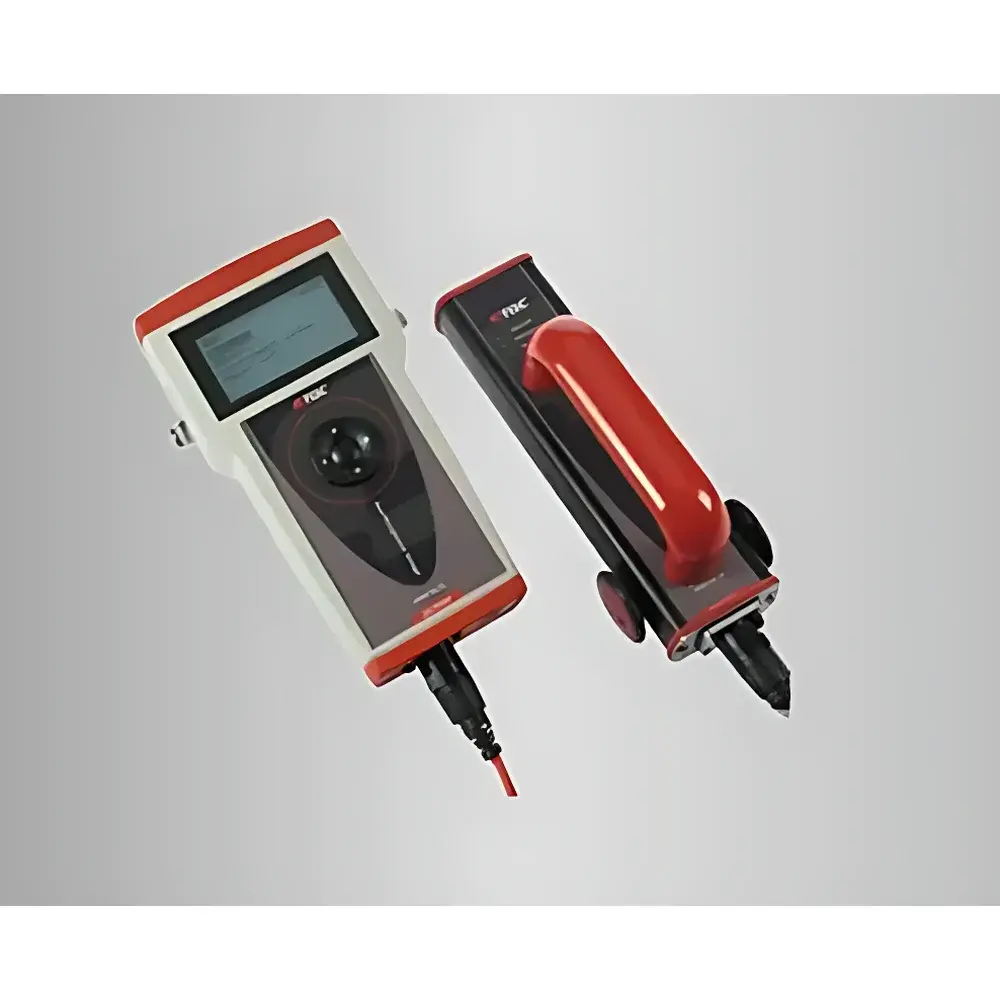
TQC DC9000 Hull Roughness Profilometer
| Brand | TQC |
|---|---|
| Origin | Netherlands |
| Model | DC9000 |
| Measurement Principle | Contact-type inductive profilometry |
| Probe Tip | Tungsten carbide stylus |
| Wheel Configuration | 3 non-slip precision wheels |
| Data Output | USB interface |
| Display | Backlit graphical LCD |
| Power Supply | Rechargeable Li-ion battery |
| Operating Temperature | 0–40 °C |
| Storage Capacity | Internal memory for ≥1,000 measurement series (each with 12 readings, timestamped and geotagged via optional GPS module) |
| Compliance | Meets ISO 4287, ISO 4288, and ASTM E1056-22 requirements for ship hull roughness assessment |
Overview
The TQC DC9000 Hull Roughness Profilometer is a field-deployable, contact-based surface profilometer engineered specifically for quantitative assessment of marine hull surface topography under operational conditions. It operates on the principle of inductive stylus profilometry: a tungsten carbide tip traverses the hull surface at constant velocity, translating vertical displacement into proportional analog voltage signals via a high-stability inductive transducer. These signals are digitized, filtered using Gaussian bandwidth-limited algorithms per ISO 11562, and processed to compute arithmetic mean roughness (Ra), root-mean-square roughness (Rq), and maximum peak-to-valley height (Rz) — all aligned with ISO 4287 and ASTM E1056-22 standards for maritime hull condition evaluation. Unlike optical or laser-based systems, the DC9000 delivers traceable, repeatable measurements on wet, fouled, or abrasive-coated surfaces where optical interference or reflectivity limitations preclude non-contact methods.
Key Features
- Three-point rolling chassis with precision-machined non-slip polymer wheels ensures stable, low-friction linear motion across curved, inclined, or vertically oriented hull sections — including bulbous bows and stern frames.
- Tungsten carbide stylus (tip radius: 5 µm, included angle: 90°) maintains dimensional integrity after >10,000 measurement cycles; certified to ISO 3274 tolerance class N.
- Onboard statistical engine automatically calculates Ra, Rq, Rz, and Rp values per ISO 4288; stores full profile data (128 points/mm resolution) and summary metrics for each of up to 1,000 test series.
- Backlit graphical LCD provides real-time waveform visualization, pass/fail thresholds (configurable per IMO MEPC.227(64) guidelines), and intuitive menu navigation — operable with gloved hands in offshore environments.
- Integrated USB 2.0 interface enables direct data export to TQC HullCheck™ desktop software (Windows 10/11 compatible); supports CSV, XML, and PDF report generation with embedded timestamps, operator ID, and location metadata (when paired with external GNSS receiver).
- Ergonomic handheld design (weight: 1.2 kg), wrist strap, and emergency sensor tether allow safe single-operator use on gangways, staging, or underwater inspection platforms (IP65-rated housing).
Sample Compatibility & Compliance
The DC9000 is validated for direct measurement on antifouling coatings (e.g., self-polishing copolymer, foul-release silicone), epoxy primers, steel substrates, and fiberglass-reinforced polyester hulls — including surfaces contaminated with barnacle residue, slime films, or light rust scaling. It complies with the measurement methodology specified in IMO Resolution MEPC.227(64) for hull performance monitoring and satisfies Class Society requirements (DNV-RP-B401, ABS Guide for Hull Performance Monitoring) for dry-dock and in-service roughness verification. All firmware and calibration routines adhere to GLP principles, with audit-trail-enabled calibration logs traceable to NIST-traceable reference standards (TQC SR-1000 series).
Software & Data Management
TQC HullCheck™ desktop software provides full traceability for regulatory reporting and fleet benchmarking. It supports multi-vessel database management, trend analysis across time-series measurements (e.g., post-docking vs. mid-voyage), and automated comparison against baseline profiles stored in ISO-compliant archives. Data exports include digital signatures compliant with FDA 21 CFR Part 11 when configured with user authentication and electronic signature modules. Audit logs record all parameter changes, measurement deletions, and calibration events — essential for classification society audits and ISO 50001 energy management system documentation.
Applications
- Pre- and post-docking hull roughness verification to validate antifouling coating performance and justify dry-dock scheduling decisions.
- In-service monitoring during port stays to quantify biofouling progression and support just-in-time hull cleaning interventions.
- Fuel efficiency modeling: integration of Ra values into CFD-based resistance prediction tools (e.g., ShipFlow, ANSYS Fluent) to estimate added resistance and CO₂ emission penalties.
- Coating manufacturer qualification: objective quantification of surface texture retention over service life per SSPC-PA 2 and ISO 19840 test protocols.
- Third-party inspection reports for charter parties, P&I club claims, and environmental compliance declarations (e.g., EU MRV, IMO DCS).
FAQ
What roughness parameters does the DC9000 measure?
It computes Ra, Rq, Rz, Rp, and profile wavelength distribution per ISO 4287 and ASTM E1056-22, with raw profile data exportable for advanced spectral analysis.
Can it measure submerged hull sections?
No — the instrument is rated IP65 (dust-tight and water-jet resistant), not submersible; measurements require accessible, above-water hull areas during port calls or dry-dock.
Is calibration traceable to international standards?
Yes — factory calibration uses NIST-traceable step-height standards (TQC SR-1000 series); users may perform field verification with portable check standards (SR-200 kit).
Does it support GPS geotagging?
GPS functionality is available via optional external GNSS receiver (e.g., u-blox M8T); position metadata syncs automatically with each measurement series.
How is data integrity ensured during transfer?
USB transfers use CRC-32 checksum validation; HullCheck™ software enforces write-once archival mode and generates SHA-256 hash reports for forensic audit readiness.





