
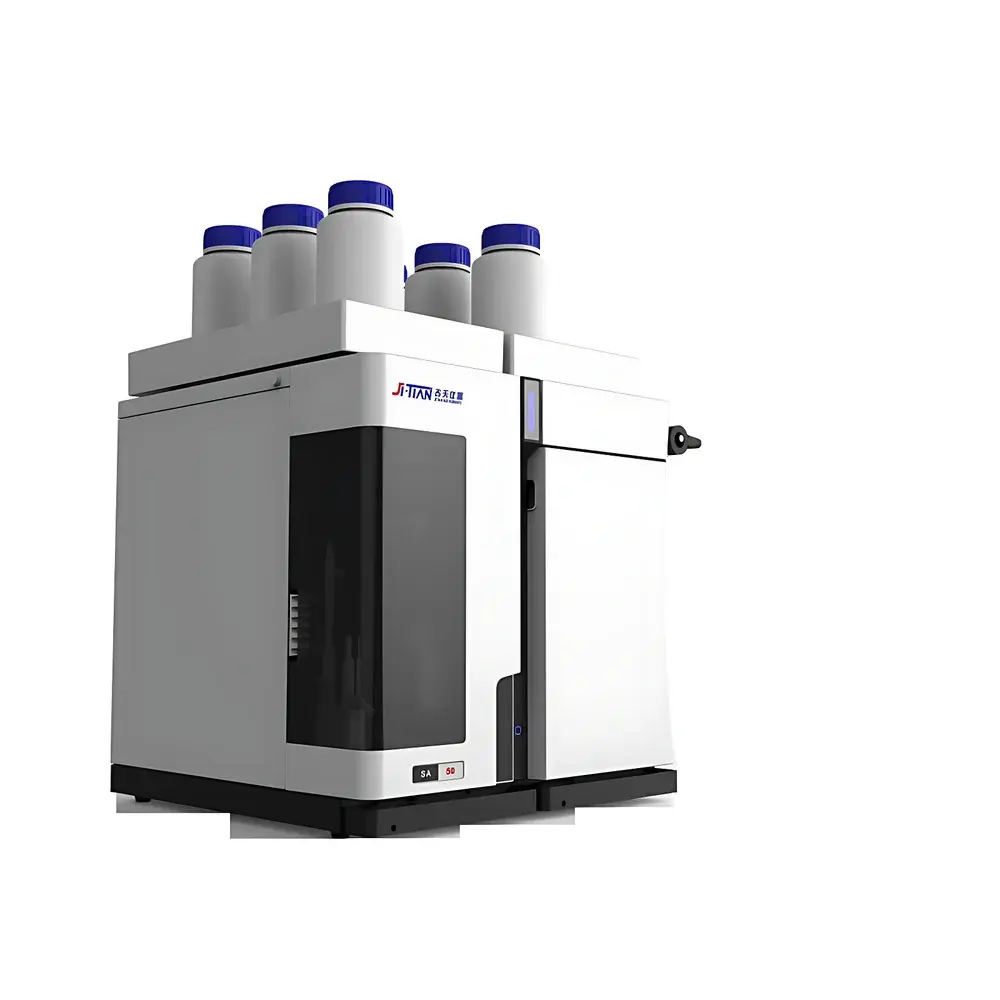
Titan Instruments SAP-50 Liquid Chromatography–Atomic Fluorescence Spectrometry (LC-AFS) Hyphenated System with Integrated Pre-treatment Module
| Brand | Titan Instruments |
|---|---|
| Origin | Beijing, China |
| Manufacturer | Titan Instruments |
| Model | SAP-50 |
| Instrument Type | LC–AFS Hyphenated System for Elemental Speciation |
| Sample Introduction | Peristaltic Pump |
| Waste Disposal | Rear Exhaust Configuration |
| Hydride/Vapor Generation Mode | On-line Hydride Generation (HG) and Cold Vapor Generation (CVG) |
| Gas Flow Control | Mass Flow Controller (MFC) |
| Detectable Species | As(V), As(III), MMA(V), DMA(V), AsB, AsC, p-ASA, Roxarsone |
| RSD | <4% |
| Linear Dynamic Range | >3 orders of magnitude |
| Detection Limits | As(III) ≤0.04 µg/L, DMA ≤0.08 µg/L, MMA ≤0.08 µg/L, As(V) ≤0.2 µg/L, SeCys ≤0.3 µg/L, SeMeCys ≤1 µg/L, Se(IV) ≤0.3 µg/L, SeMet ≤2 µg/L |
| PMT Wavelength Range | Not specified |
| Atomizer Temperature Control Range | Not specified |
Overview
The Titan Instruments SAP-50 is a fully integrated liquid chromatography–atomic fluorescence spectrometry (LC–AFS) hyphenated system engineered for high-sensitivity, high-resolution elemental speciation analysis. It combines on-line high-performance liquid chromatography (HPLC) separation with post-column hydride generation (HG) or cold vapor generation (CVG), followed by atomic fluorescence detection—enabling quantitative determination of redox and organometallic species of arsenic, selenium, mercury, and antimony in complex matrices. Unlike standalone AFS or ICP-MS platforms, the SAP-50 implements a closed-loop, low-dead-volume interface between the LC column and the atomizer, minimizing band broadening and preserving chromatographic integrity. Its core architecture adheres to the fundamental principles of speciation analysis defined in ISO/IEC 17025 and aligned with regulatory frameworks such as USP /, FDA Guidance for Elemental Impurities, and EU Commission Regulation (EU) No 2023/2006. The system is validated for compliance with GB 5009.11–2014 (inorganic arsenic in food) and GB 5009.17–2014 (methylmercury in seafood), supporting GLP-compliant laboratories in food safety, environmental monitoring, and clinical toxicology applications.
Key Features
- Integrated Dual-Column LC Module: Built-in dual HPLC pumps and a dual-column thermostatted oven enable simultaneous pre-heating and automatic column switching—reducing method development time and improving inter-run reproducibility.
- Intelligent Vapor Generation Unit: Fully automated switching between total-element and speciation modes; programmable UV/non-UV reaction path selection; auto-controlled UV lamp ignition and duty-cycle modulation for optimized oxidative digestion of refractory organometallics (e.g., AsB, SeMet).
- Compact On-line Post-Column Digestion: Minimizes transfer line length (<15 cm) between column outlet and gas–liquid separator—suppressing peak dispersion and maintaining resolution for co-eluting species (e.g., As(III)/DMA(V) separation in <12 min per GB 5009.11–2014).
- High-Efficiency Gas–Liquid Separator: Uses a membrane-based water-removal design functionally equivalent to Nafion™ tubing—reducing moisture load to the quartz atomizer, lowering background noise, and enhancing signal stability without cryogenic trapping.
- Optimized Excitation Source: Custom-designed, current-modulated hollow cathode lamps with pulsed, focused power delivery—extending lamp lifetime (>5,000 h), improving photon flux density, and delivering superior signal-to-noise ratio (SNR) across trace-level speciation workloads.
- Unified Software Architecture: TitanSpec Control Suite provides end-to-end sequence management—including mixed-method runs (e.g., As-speciation + Se-speciation in one batch), real-time hardware diagnostics, audit-trail-enabled method versioning, and customizable report templates compliant with 21 CFR Part 11 requirements.
Sample Compatibility & Compliance
The SAP-50 accommodates aqueous extracts from solid and semi-solid matrices following standardized preparation protocols (e.g., enzymatic hydrolysis for SeMet in animal feed, mild acid leaching for soil-bound Sb species). It accepts samples introduced via standard 10–100 µL loop injection and supports mobile phases compatible with anion-exchange (e.g., ammonium carbonate/bicarbonate gradients), cation-exchange, and reversed-phase HPLC columns. The system meets performance criteria outlined in ISO 17294-2:2016 (water analysis), EN 16802:2016 (food speciation), and ASTM D6722–22 (mercury speciation in coal-derived materials). All calibration and QC procedures follow internal SOPs traceable to NIST SRM 3104a (As species), SRM 3110c (Se species), and ERM-BB422 (Hg species).
Software & Data Management
TitanSpec Control Suite operates under Windows 10/11 (64-bit) and supports method-driven acquisition, real-time baseline correction, peak deconvolution for partially resolved species (e.g., MMA(III)/DMA(III)), and integrated uncertainty propagation per EURACHEM/CITAC Guide. Raw data files are stored in vendor-neutral .csv and .dx formats; audit trails record user actions, parameter changes, and instrument status timestamps with SHA-256 hashing. The software includes built-in compliance modules for electronic signatures, role-based access control (RBAC), and automated backup to network-attached storage (NAS) or cloud repositories meeting HIPAA/FDA Annex 11 requirements.
Applications
- Food & Feed Safety: Quantification of inorganic vs. organic arsenic in rice, seaweed, and poultry feed; differentiation of toxic MeHg from non-toxic SeMet in fish tissue and infant formula.
- Environmental Monitoring: Speciation of Sb(III)/Sb(V) in landfill leachate and drinking water; monitoring Se(IV)/Se(VI) transformation in wetland sediments.
- Clinical & Toxicological Research: Profiling AsB/AsC excretion patterns in human urine after seafood consumption; tracking SeCys metabolism in controlled dietary intervention studies.
- Regulatory Testing Labs: Routine compliance testing per Chinese National Standards (GB), EU Maximum Levels (EC No 1881/2006), and US FDA Import Alert 16-125 (arsenic in apple juice).
FAQ
What sample types are compatible with the SAP-50 for routine speciation analysis?
Aqueous extracts from food, biological tissues, soils, sediments, and water samples—prepared using EPA Method 1638, GB/T 5009.11, or laboratory-validated hydrolysis protocols.
Does the SAP-50 support method validation per ICH Q2(R2)?
Yes—the system enables full validation of specificity, linearity, accuracy, precision (intra-day/inter-day RSD <4%), LOD/LOQ, and robustness per ICH guidelines when coupled with TitanSpec’s validation toolkit.
Can the SAP-50 be interfaced with third-party HPLC systems?
No—it is a fully integrated platform with proprietary pump control, timing synchronization, and trigger logic optimized for HG/CVG–AFS coupling; external LC integration is not supported.
Is the software 21 CFR Part 11 compliant out-of-the-box?
Yes—electronic signatures, audit trail logging, and user permission tiers are enabled by default and configurable during initial setup.
What maintenance intervals are recommended for the gas–liquid separator and UV digestion unit?
Gas–liquid membrane replacement every 6 months under continuous operation; UV lamp output verification quarterly; full system performance check (including detector baseline stability and HG efficiency) every 90 days.




