
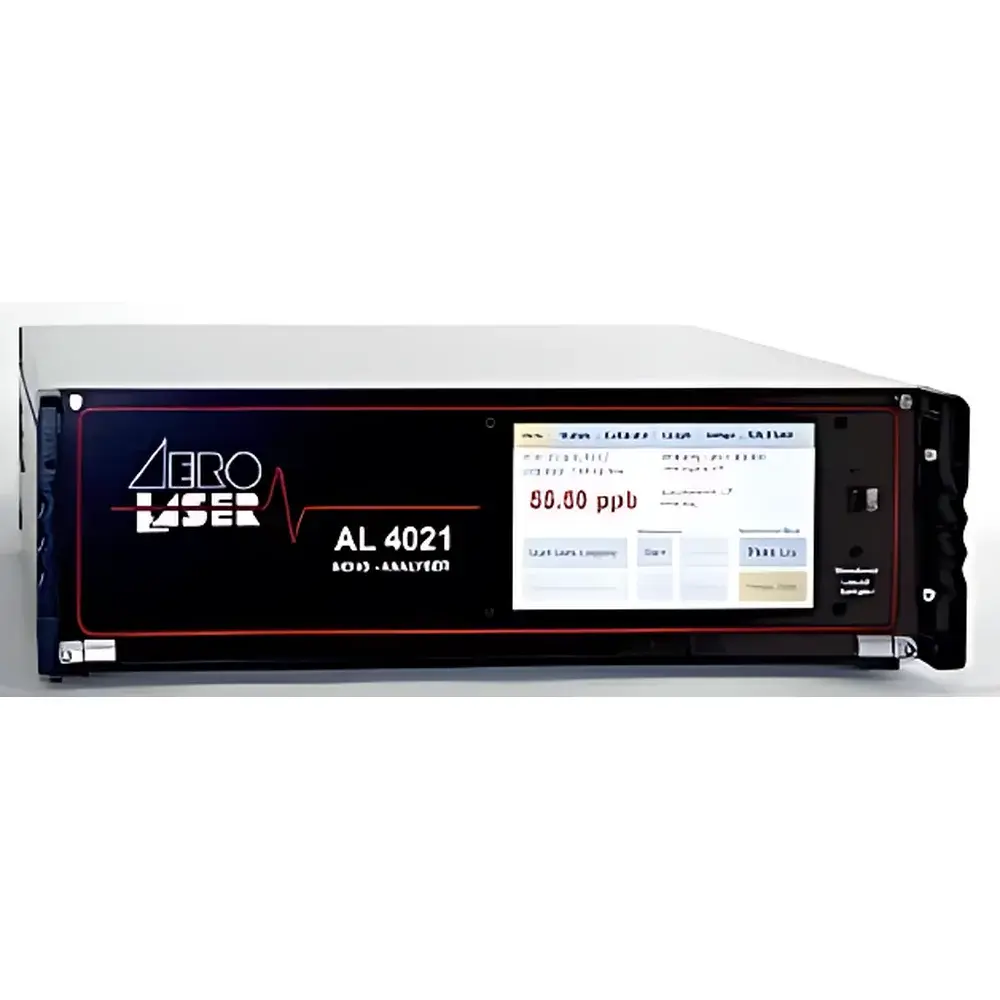
Aero Laser AL4021 Formaldehyde Analyzer
| Brand | Aero Laser |
|---|---|
| Origin | Germany |
| Model | AL4021 |
| Principle | Photometric Detection via Hantzsch Reaction |
| Measurement Range | 0.1 ppb – 3000 ppb (gas phase), 150 ng/L – 5 mg/L (aqueous phase) |
| Resolution | 0.1 ppb |
| Repeatability | <3% |
| Sampling Method | Pump-aspirated |
| Response Time | 90 s (10–90%) |
| Operating Temperature | 0 °C – 120 °C |
| Humidity Range | 15–95% RH |
| Detection Limit | <100 ppt (gas), <150 ng/L (liquid) |
| Calibration Options | Automated gas-phase calibration (integrated permeation tube generator), semi-automated liquid-phase standard injection |
| Data Storage | USB flash drive (8 GB) |
| Interface | RS232 |
| Dimensions (W×H×D) | 45 × 15 × 56 cm |
| Mounting | 19″ rack-compatible |
| Power Supply | 110/220 VAC, 110 W (24 VDC optional) |
Overview
The Aero Laser AL4021 Formaldehyde Analyzer is a high-sensitivity, laboratory-grade trace gas analyzer engineered for continuous, quantitative measurement of formaldehyde (HCHO) in both gaseous and aqueous matrices. It operates on the well-established Hantzsch condensation reaction—where formaldehyde reacts with acetylacetone and ammonium acetate under acidic conditions to form a fluorescent 3,5-diacetyl-1,4-dihydrolutidine (DDL) derivative—followed by highly selective fluorimetric detection. This dual-phase capability enables direct analysis of ambient air, chamber effluent gases, and leachates or extraction solutions from solid materials without requiring external derivatization or sample pre-concentration. Designed for compliance-driven industrial emission testing and environmental research, the AL4021 delivers sub-ppt-level detection limits (<100 ppt in gas phase; <150 ng/L in liquid phase), making it suitable for regulatory applications aligned with ISO 16000-3, ASTM D6007, EN 717-1, and JIS A 1460.
Key Features
- Integrated photometric fluorescence detection system optimized for Hantzsch-derived DDL, minimizing spectral interference from common VOCs and carbonyl compounds
- Onboard chemical processing module—including thermal desorption, reagent delivery, reaction chamber, and optical cell—ensuring full analytical autonomy
- Dual-mode operation: simultaneous support for pump-aspirated gas sampling and automated liquid injection via calibrated syringe pump
- Modular multi-chamber interface enabling concurrent monitoring of up to 16 emission test chambers (e.g., climate chambers per EN 16516 or ISO 12460-3)
- Automated calibration architecture featuring an integrated permeation tube-based formaldehyde gas generator (optional) and standardized aqueous reference solution protocol
- Front-panel touchscreen interface with real-time concentration plots, alarm thresholds, and event logging; data export via USB 2.0 (8 GB preloaded)
- Rack-mountable 19″ chassis (45 × 15 × 56 cm) with robust thermal management for stable operation across 0–120 °C sample temperature range
Sample Compatibility & Compliance
The AL4021 accommodates heterogeneous sample streams encountered in product emissions testing, including humidified chamber exhaust (15–95% RH), heated off-gas from wood-based panels or composite resins, and aqueous extracts from textiles or adhesives. Its validated linear dynamic range—0.1–3000 ppb (gas) and 150 ng/L–5 mg/L (liquid)—covers requirements specified in ISO 12460-5 (wood-based panels), EN 717-2 (formaldehyde release from particleboard), and EPA TO-11A (indoor air). All internal wetted components are chemically inert (e.g., PTFE, quartz, borosilicate glass), ensuring no adsorption or catalytic degradation of formaldehyde during transit. The instrument meets CE marking requirements and supports audit-ready documentation for GLP and ISO/IEC 17025-accredited laboratories.
Software & Data Management
Data acquisition and instrument control are managed through embedded firmware supporting configurable sampling cycles, automatic zero/span validation, and drift correction algorithms. Raw fluorescence intensity values, calculated concentrations, timestamps, and system diagnostics are logged at user-defined intervals (1 s to 60 min resolution) and stored on removable USB media in CSV format. RS232 serial output enables integration into centralized building management systems (BMS) or LIMS platforms. While the AL4021 does not include FDA 21 CFR Part 11-compliant electronic signature functionality out-of-the-box, its deterministic calibration traceability (NIST-traceable permeation tubes and certified reference standards) and immutable timestamped logs meet core data integrity expectations for ISO 17025 Clause 7.7 and EU GMP Annex 11 assessments.
Applications
- Regulatory emissions testing of furniture, flooring, insulation, and laminated wood products per EN 16516 and ISO 12460 series
- Indoor air quality (IAQ) monitoring in schools, hospitals, and office buildings under WHO and national guideline frameworks
- Climate chamber studies evaluating formaldehyde release kinetics as a function of temperature, humidity, and aging time
- Quality control in resin manufacturing and adhesive formulation where residual monomer content must be verified
- Research on atmospheric formaldehyde budgets in urban and forested environments using long-term unattended deployment
FAQ
What formaldehyde detection principle does the AL4021 employ?
It uses photometric fluorescence detection following the Hantzsch reaction, generating a stable fluorescent adduct quantified at 415 nm excitation / 515 nm emission.
Can the AL4021 measure formaldehyde directly in water samples?
Yes—it accepts liquid-phase samples via calibrated micro-injection and performs in-situ derivatization and detection without offline preparation.
Is the instrument suitable for field deployment?
While primarily designed for lab and chamber-based use, its 19″ rack format, wide operating temperature range, and pump-aspirated sampling support semi-permanent installation in controlled environments such as test facilities or cleanrooms.
How is calibration traceability ensured?
Calibration relies on NIST-traceable formaldehyde permeation tubes (gas mode) and certified aqueous standards (liquid mode), with documented uncertainty budgets available upon request.
Does the AL4021 support remote monitoring or network connectivity?
It provides RS232 serial output for integration with SCADA or custom data loggers; Ethernet or Wi-Fi interfaces are not natively supported but may be added via third-party protocol converters.
Related Products







