
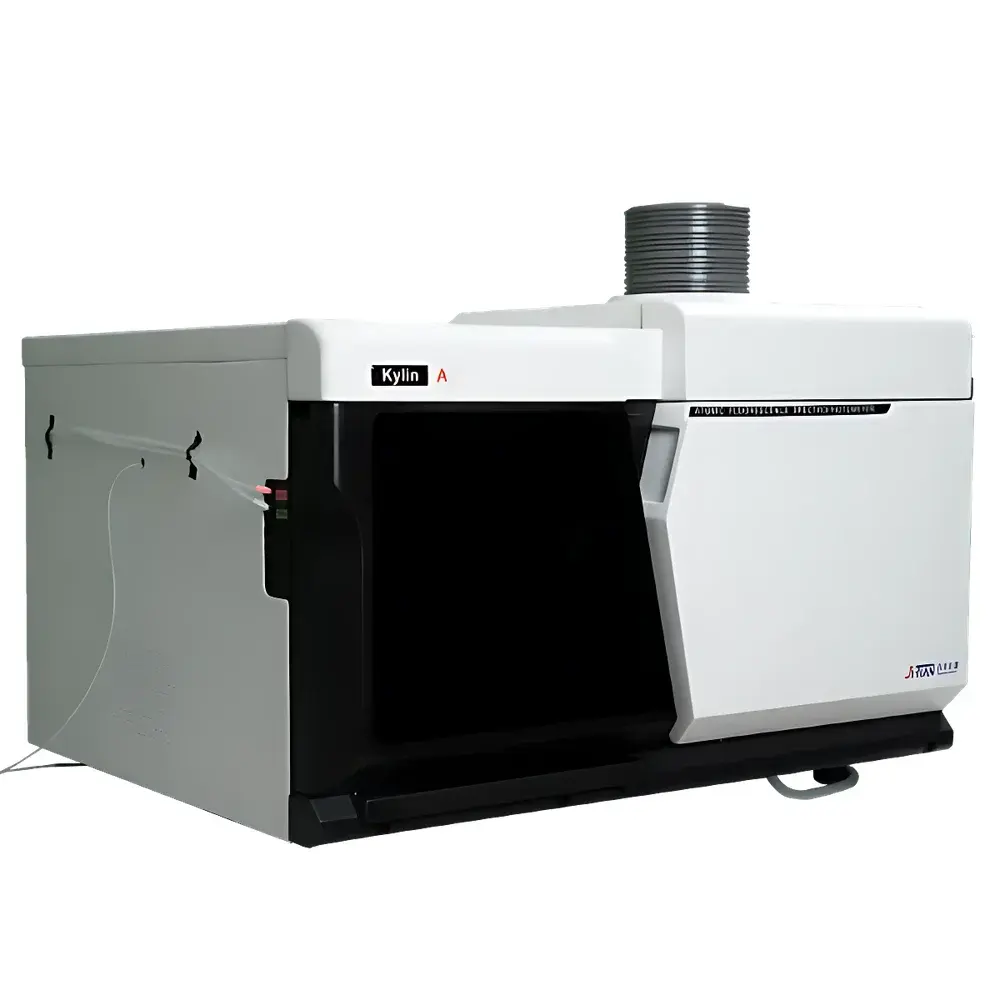
Titan Instruments Kylin A18 Quadruple-Channel Atomic Fluorescence Spectrometer
| Brand | Titan Instruments |
|---|---|
| Origin | Beijing, China |
| Manufacturer Type | Original Equipment Manufacturer (OEM) |
| Instrument Type | Multi-channel Atomic Fluorescence Spectrometer |
| Sample Introduction | Dual Sequential Injection Pumps |
| Waste Disposal | Rear Exhaust Configuration |
| Hydride Generation Mode | Vapor Generation / Hydride Generation |
| Gas Flow Control | Mass Flow Controller (MFC) |
| Detectable Elements | As, Sb, Bi, Sn, Se, Te, Pb, Ge, Hg, Cd, Zn |
| Relative Standard Deviation (RSD) | <0.6% |
| Linear Dynamic Range | >3 orders of magnitude |
| Detection Limits | As, Sb, Se, Bi, Te, Hg, Sn, Pb < 0.01 µg/L |
| Photomultiplier Tube Wavelength Range | 160–320 nm |
| Atomizer Temperature Control Range | 100–350 °C |
Overview
The Titan Instruments Kylin A18 Quadruple-Channel Atomic Fluorescence Spectrometer is a high-performance, multi-element analytical instrument engineered for trace-level quantification of hydride-forming and cold-vapor elements in complex environmental, food, clinical, and industrial matrices. It operates on the principle of atomic fluorescence spectroscopy (AFS), where analyte atoms—generated in situ via chemical vapor generation (CVG) or hydride generation (HG)—are atomized in a quartz tube furnace and excited by a line-source hollow cathode lamp (HCL). The resulting element-specific fluorescence emission is collected at right angles to the excitation beam, minimizing background scatter and enabling exceptional signal-to-noise ratios. Designed for regulatory compliance and routine laboratory throughput, the Kylin A18 integrates four fully independent optical detection channels with real-time inter-channel correction, supporting simultaneous or sequential measurement of up to 12 elements—including As, Sb, Bi, Se, Te, Sn, Pb, Hg, Cd, Ge, Zn, and Au—without cross-talk or spectral interference.
Key Features
- Quadruple-channel optical architecture with full-channel dual-beam symmetry, enabling real-time reference beam correction for drift compensation and enhanced long-term stability.
- Orthogonal double-beam optical design with optimized light path geometry to suppress stray light and improve detection sensitivity.
- Intelligent plug-and-play hollow cathode lamps featuring auto-alignment, integrated current monitoring, and cumulative usage time logging—eliminating manual lamp positioning and enabling predictive maintenance.
- High-precision mass flow controller (MFC)-based gas regulation system with continuous pressure and flow rate monitoring, automatic fault alerting, and programmable gas delivery profiles per method.
- Temperature-controlled quartz tube atomizer (100–350 °C), dynamically adjusted per element to optimize atomization efficiency and minimize memory effects.
- Dual sequential injection pumps with pneumatic-assisted syringe actuation, ensuring precise, reproducible reagent metering and rapid cycle times (≤25 s/sample).
- PTFE-coated carbon-fiber sampling probes replace traditional quartz needles—improving mechanical durability, chemical resistance, and service life in aggressive acid media.
- Comprehensive self-diagnostic suite covering optical alignment, hydride generation kinetics, atomizer thermal profile, gas integrity, liquid level status, and lamp health—reporting actionable fault codes and remediation guidance.
Sample Compatibility & Compliance
The Kylin A18 is validated for use across diverse sample types following standardized digestion and pre-reduction protocols. It meets performance criteria specified in major international and national methods, including ISO 17294-2 (water analysis), ASTM D5673 (mercury in water), and USP / (elemental impurities in pharmaceuticals). In regulatory laboratories, it supports full compliance with GLP and GMP requirements through audit-trail-enabled software, role-based access control, electronic signature support, and 21 CFR Part 11–compliant data handling. Method validation documentation aligns with ICH Q2(R2) guidelines for specificity, linearity, accuracy, precision, LOD/LOQ, and robustness. Routine applications include analysis of drinking water (EPA 1631E), soil and sediment (HJ 680-2013), foodstuffs (GB 5009.11/17-2014), biological tissues (clinical blood/urine), and petroleum products (ASTM D7622).
Software & Data Management
The Kylin A18 is operated via Titan’s proprietary AFS-Studio software—a dual-language (English/Chinese), modular platform built on a relational database architecture. Core modules include Method Editor (with stepwise CVG/HG parameter programming), Real-Time Instrument Monitor (graphical dashboard with live sensor telemetry), Audit Trail Manager (immutable timestamped logs of all user actions and parameter changes), and Report Generator (customizable templates compliant with ISO/IEC 17025 reporting requirements). All raw spectra, calibration curves, QC results, and sample metadata are stored with SHA-256 hash integrity verification. Data export supports CSV, PDF, XML, and LIMS-compatible ASTM E1384 formats. Remote diagnostics and firmware updates are supported over secure TLS-encrypted connections.
Applications
- Environmental Monitoring: Quantification of As, Hg, Se, Sb, and Pb in wastewater, groundwater, surface water, soil extracts, and airborne particulate filters per EPA, ISO, and Chinese HJ standards.
- Food & Agriculture Safety: Screening of total and inorganic arsenic in rice, mercury in fish tissue, cadmium in cereals, and selenium in fortified dairy—aligned with Codex Alimentarius and GB 5009 series.
- Clinical & Toxicological Testing: Trace metal profiling in whole blood, urine, hair, and nail samples for occupational exposure assessment and nutritional status evaluation.
- Pharmaceutical Quality Control: Elemental impurity testing of active pharmaceutical ingredients (APIs), excipients, and parenteral formulations per ICH Q3D and USP .
- Geological & Metallurgical Analysis: Determination of Ge, Te, Au, and Bi in rock digests, ore concentrates, and alloy leachates using microwave-assisted digestion coupled with HG-AFS.
- Petrochemical Testing: Ultra-trace Hg and Pb determination in crude oil, lubricants, and refined fuels—meeting ASTM D7622 and ISO 8217 specifications.
FAQ
What hydride-forming elements can the Kylin A18 detect at sub-part-per-trillion levels?
The instrument achieves detection limits <0.01 µg/L for As, Sb, Se, Bi, Te, Hg, Sn, and Pb when paired with optimized HG-CVG chemistry and low-blank reagents.
Does the system support automated method switching between different elements during a single run?
Yes—multi-lamp turret and channel-specific parameter scheduling allow unattended sequential analysis of up to 12 elements with auto-optimized atomizer temperature, lamp current, and gas flow settings.
Is the software qualified for regulated environments requiring 21 CFR Part 11 compliance?
Yes—AFS-Studio includes electronic signatures, audit trail archiving, user privilege tiers, and data encryption meeting FDA requirements for electronic records and signatures.
How does the dual sequential injection system improve precision compared to single-pump designs?
Independent control of carrier and reductant streams eliminates pulsation-induced mixing variability, yielding RSD values consistently <0.6% across replicate injections.
Can the Kylin A18 be integrated into an existing LIMS infrastructure?
Yes—it supports ASTM E1384-compliant data export, ODBC connectivity, and HL7 messaging for seamless bidirectional integration with enterprise laboratory information management systems.
Related Products





