
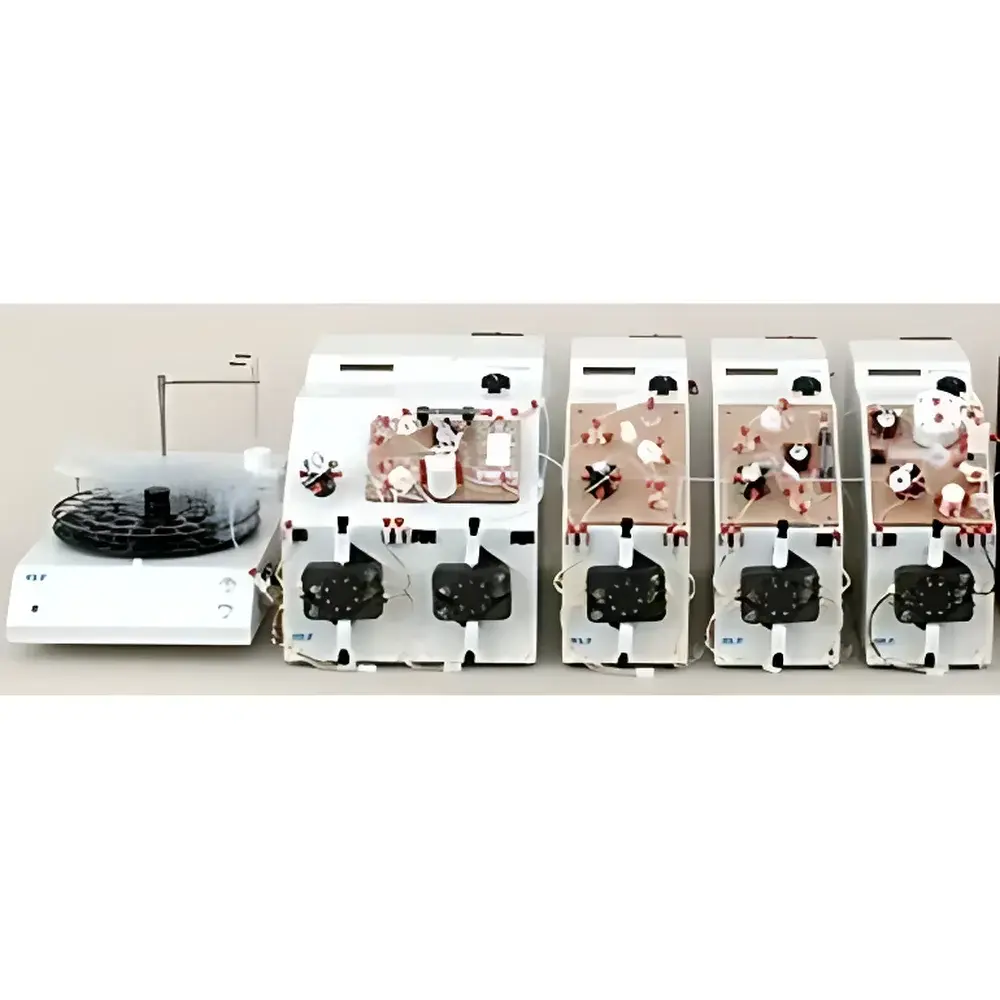
MLE FIAmodula Flow Injection Analyzer
| Brand | MLE |
|---|---|
| Origin | Germany |
| Model | FIAmodula |
| Sample Capacity | 100 positions |
| Reagent Positions | 36 |
| Optical Path Length | 20 mm |
| Wavelength Range | 400–1000 nm |
| Light Source | Halogen lamp |
| Detection Principle | Dual-chip photometric detection |
| Injector | 8-port selection valve with dual-loop configuration (Vmin = 18 µL) |
| Peristaltic Pump | 6-channel, stepper motor-driven |
| Flow Rate | 0.2–3 mL/min (9-step adjustable) |
| Absorbance Range | 0–1.5 AU (including blank compensation up to 0.5 AU) |
| Turbidity & Color Compensation | Compliant with DIN EN 1189 |
| Precision | ≤1% RSD |
| Power Supply | 110/230 VAC ±10%, 50/60 Hz |
| Power Consumption | 80 W |
| Dimensions (H×W×D) | 300 × 140 × 450 mm |
| Weight | 7.5 kg |
Overview
The MLE FIAmodula Flow Injection Analyzer is a modular, laboratory-grade flow injection analysis (FIA) system engineered for high-throughput, standardized environmental water quality testing. Based on the classical FIA principle—where discrete sample zones are injected into a continuous, carrier-stream flow and transported through reaction coils to a detector—the FIAmodula enables reproducible, reagent-efficient quantification of physicochemical parameters such as nitrate, phosphate, ammonia, silicate, and cyanide in drinking water, wastewater, surface water, and groundwater. Designed and manufactured in Germany, the system complies with internationally recognized standard methods including ISO 15681-1/-2, EN ISO 11923, DIN 38405-15, and EPA-approved protocols. Its core architecture integrates fluidic precision, optical stability, and software-controlled method flexibility—making it suitable for routine compliance monitoring, regulatory reporting, and GLP-aligned environmental laboratories.
Key Features
- Modular, ISO/EN/DIN-compliant FIA platform supporting both single- and multi-channel configurations for parallel parameter determination
- 8-port selection valve with dual-loop injection (minimum injection volume: 18 µL), enabling precise sample/reagent segmentation and improved carryover control
- 6-channel stepper-motor-driven peristaltic pump with 9-step flow rate adjustment (0.2–3 mL/min), optimized for long-term operational stability and low maintenance
- Dual-chip photometric detector providing enhanced signal-to-noise ratio and exceptional baseline stability over extended run times
- Integrated turbidity and color compensation algorithm compliant with DIN EN 1189, ensuring accurate absorbance measurement in non-ideal matrices
- Compact footprint (300 × 140 × 450 mm) and bubble-free liquid handling system enabling rapid system priming and walk-away operation
- Optional modules include online UV or thermal digestion, solid-phase extraction (SPE) preconcentration, and automated dilution units for dynamic range extension
Sample Compatibility & Compliance
The FIAmodula accommodates up to 100 sample positions with programmable tray mapping and supports up to 36 independent reagent reservoirs. It handles aqueous samples across a broad matrix range—including clarified, filtered, or centrifuged environmental waters—with built-in compensation for natural coloration and suspended solids. All analytical methods implemented on the platform are traceable to validated reference standards and certified reference materials (CRMs). The system meets requirements for ISO/IEC 17025-accredited laboratories and supports audit-ready documentation under GLP and GMP frameworks. Optional 21 CFR Part 11-compliant user access controls and electronic signature functionality are available via FIAcontrol software configuration.
Software & Data Management
Control, acquisition, and reporting are managed exclusively through FIAcontrol—a Windows-based, instrument-specific software suite developed by MLE. FIAcontrol provides real-time method editor, sequence scheduler, calibration curve generation (linear, quadratic, or spline fitting), and automatic QC flagging based on replicate tolerance and drift thresholds. Raw absorbance data, peak integration parameters, and diagnostic logs are stored in structured binary format with metadata tagging (operator ID, timestamp, method version, instrument serial number). Export options include CSV, PDF analytical reports, and LIMS-compatible XML templates. Audit trail functionality records all user actions, method modifications, and result overrides—ensuring full traceability for regulatory submissions.
Applications
- Routine monitoring of nutrients (NO₃⁻-N, PO₄³⁻-P, NH₄⁺-N) in municipal wastewater treatment plants
- Compliance testing for drinking water per EU Directive 98/83/EC and US EPA Method 353.2
- High-volume screening of agricultural runoff and river basin surveillance programs
- Method development and validation studies requiring precise reagent/sample timing and low reagent consumption
- Integration into automated environmental monitoring labs operating under ISO 17025 quality management systems
FAQ
What standard methods does the FIAmodula support?
The system natively implements ISO 15681-1 (phosphate), ISO 15681-2 (nitrate/nitrite), EN ISO 11923 (ammonia), and DIN 38405-15 (silicate), with additional methods validated upon request.
Can the FIAmodula perform online digestion or preconcentration?
Yes—optional UV or thermal digestion modules and solid-phase extraction (SPE) cartridges can be integrated directly into the fluidic path for phosphorus or trace metal speciation workflows.
Is method switching time minimized between different analytes?
Method conversion requires less than 10 minutes for compact configurations; full reconfiguration (e.g., changing coils, filters, or detectors) is supported via hot-swappable modules without system shutdown.
How is data integrity ensured during long unattended runs?
FIAcontrol maintains continuous checksum-verified logging, automatic QC checkpointing every 20 samples, and hardware-level flow pressure monitoring to detect blockages or air ingress in real time.
Does the system support remote diagnostics or service connectivity?
Remote support is enabled via secure TLS-encrypted VNC tunneling; firmware updates and method library synchronization are performed through MLE’s authorized update portal.



