
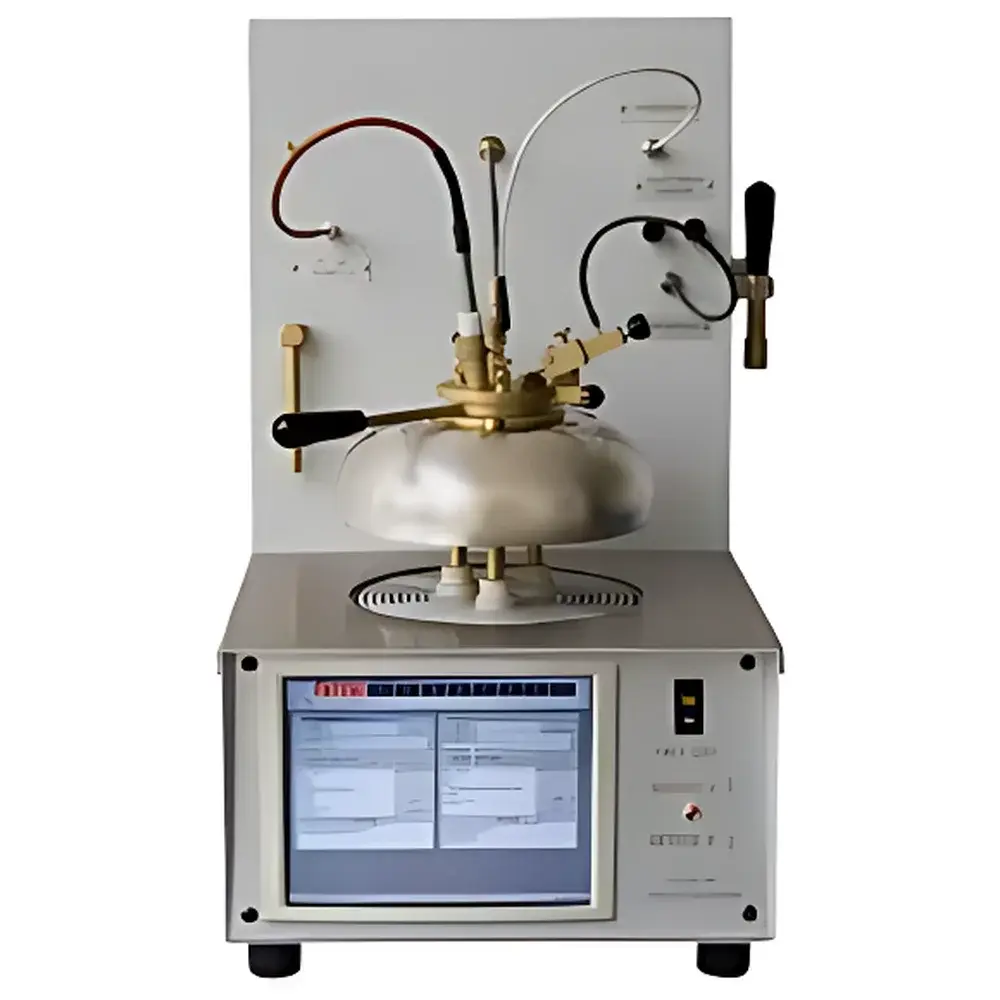
SDM 750AUT Fully Automated Pensky-Martens Closed-Cup Flash Point Tester
| Brand | SDM |
|---|---|
| Origin | Italy |
| Model | 750AUT |
| Detection Method | Closed-Cup (Pensky-Martens) |
| Temperature Range | +40 °C to +360 °C |
| Temperature Accuracy | ±0.1 °C |
| Temperature Sensor | PT100 |
| Sample Cup Material | Copper |
| Heating System | Electronic Heater with Over-Temperature Protection |
| Cooling System | Forced-Air Fan |
| Stirring Mechanism | Motor-Driven Magnetic Stirrer (Compliant with ASTM D93 Methods A & B) |
| Ignition System | Dual-Mode Automatic Igniter (Pilot Flame & Electric Spark) |
| Detection Principle | Ionization Detector |
| Display | 800×480 Touchscreen LCD |
| Power Supply | 220 V, 50 Hz |
| Dimensions | 33 × 46 × 57 cm |
| Weight | 26 kg |
| Compliance Standards | ASTM D93, D3941, E502 |
Overview
The SDM 750AUT Fully Automated Pensky-Martens Closed-Cup Flash Point Tester is an internationally certified analytical instrument engineered for precise, repeatable flash point determination in petroleum-based and organic liquid samples. It implements the standardized Pensky-Martens closed-cup method—a thermodynamic measurement principle where a sample is heated incrementally under controlled atmospheric conditions while a defined ignition source is periodically introduced. Flash point is identified as the lowest temperature at which vapors above the sample ignite momentarily upon exposure to flame or spark, detected via a high-sensitivity ionization sensor. Designed for laboratories requiring regulatory-grade data integrity, the 750AUT delivers traceable results aligned with global refinery, quality control, and safety compliance workflows—particularly in upstream, midstream, and downstream petroleum operations.
Key Features
- Fully automated test sequence from sample loading to final report generation, minimizing operator intervention and human error.
- Dual-mode ignition system supporting both pilot flame and electric spark ignition per ASTM D93 Method A and Method B requirements.
- PT100 platinum resistance thermometer integrated into the copper sample cup assembly, ensuring high thermal stability and metrological traceability.
- Electronic heating module with real-time PID temperature control and redundant over-temperature cutoff circuitry for operational safety.
- Motor-driven magnetic stirrer compliant with ASTM D93 stirring speed specifications (90–120 rpm), maintaining uniform thermal distribution during ramping.
- Integrated forced-air cooling system enabling rapid cooldown between tests, reducing cycle time without compromising thermal equilibrium accuracy.
- 800×480 high-contrast touchscreen interface with intuitive navigation, multilingual support (English, Italian, Spanish, German), and on-device method storage.
Sample Compatibility & Compliance
The 750AUT accommodates a broad range of flammable and combustible liquids—including gasoline, diesel fuel, kerosene, lubricating oils, biodiesel blends, solvents, and industrial waste streams—within its validated temperature span of +40 °C to +360 °C. Its mechanical design strictly conforms to the dimensional, material, and procedural specifications outlined in ASTM D93, ISO 2719, EN 22719, IP 34, and DIN 51578. All critical hardware components—including the copper test cup, air bath enclosure, lid assembly, and ignition positioning mechanism—are manufactured to original Pensky-Martens geometric tolerances. The system supports GLP-compliant operation through audit-trail-enabled software logging, user-access levels, and electronic signature capability (when paired with validated networked environments).
Software & Data Management
The embedded Windows-based control software (compatible with Windows 2000 through Windows 10 LTSB) provides modular functionality across four core menus: Analysis, Diagnostics, Calibration, and Data Processing. Users define custom test protocols—including ramp rate, ignition interval, hold time, and pass/fail criteria—and assign them to sample IDs or batch codes. Real-time temperature curves, ionization current traces, and event timestamps are recorded with millisecond resolution. Reports export in PDF or CSV format, featuring configurable headers, statistical summaries (mean, SD, RSD), and compliance statements referencing applicable standards. Data files are digitally signed and timestamped, satisfying basic FDA 21 CFR Part 11 requirements when deployed within validated IT infrastructure.
Applications
- Refinery QC/QA labs performing routine flash point verification on crude fractions and finished fuels per ASTM D93.
- Independent testing laboratories accredited to ISO/IEC 17025, conducting third-party certification for transport classification (UN TDG, ADR, IMDG).
- Lubricant formulation centers assessing thermal stability and volatility profiles during product development.
- Environmental testing facilities analyzing hazardous waste streams for RCRA D001 ignitability characterization.
- Aviation fuel inspection units verifying Jet A/A-1 conformity to ASTM D1655 Annex A2 requirements.
- Academic research groups studying vapor pressure–temperature relationships in novel bio-derived hydrocarbons.
FAQ
What standards does the SDM 750AUT fully comply with?
ASTM D93 (Methods A and B), ASTM D3941, ASTM E502, IP 34, ISO 2719, EN 22719, and DIN 51578.
Can the instrument be used for non-petroleum samples such as paints or cleaning agents?
Yes—provided the sample falls within the +40 °C to +360 °C flash point range and does not corrode copper or interfere with ionization detection.
Is external calibration required before first use?
The unit ships with factory calibration certificates for temperature and ignition timing; field verification using NIST-traceable reference standards is recommended prior to initial deployment.
Does the software support LIMS integration?
Raw data exports (CSV) and structured PDF reports are compatible with most LIMS platforms; direct OPC UA or ASTM F2119-01 connectivity requires optional middleware configuration.
How is maintenance performed on the ionization detector?
The detector assembly is field-serviceable; cleaning protocols and replacement part numbers are documented in the technical manual, and no special tools are required.
Related Products





