
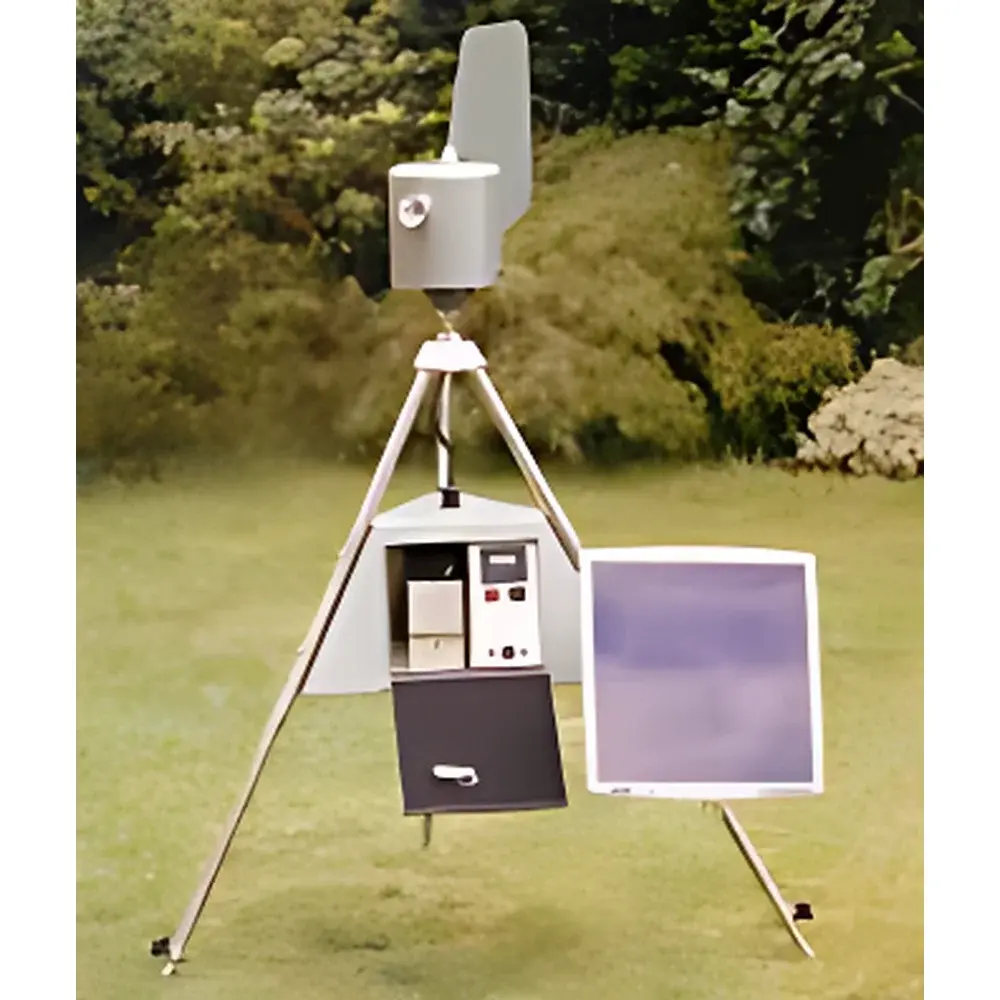
Burkard Cyclonic Spore Trap
| Brand | Burkard |
|---|---|
| Origin | United Kingdom |
| Model | Burkard Cyclonic Spore Trap |
| Airflow Rate | 16.5 L/min |
| Sampling Vessel Capacity | 8 × 1.5 mL Eppendorf tubes |
| Power Supply | Integrated solar panel + rechargeable battery (17 h runtime) |
| Timer Range | Up to 999 hours |
| Height | 125 cm |
| Base Dimensions | 87 × 77 cm |
| Weight (incl. battery) | 24 kg |
| Particle Capture Efficiency | >90% for particles <1 µm |
| Operating Environment | Outdoor, weatherproof enclosure |
Overview
The Burkard Cyclonic Spore Trap is a field-deployable, solar-powered environmental monitoring instrument engineered for the quantitative and time-resolved collection of airborne biological particulates—primarily fungal spores, pollen, bacteria, and other respirable bioaerosols—under real-world meteorological conditions. Its core sampling principle relies on cyclonic inertial separation: incoming air is accelerated tangentially into a rotating vortex chamber, where centrifugal forces drive submicron and micron-sized particles toward the outer wall and downward into individual 1.5 mL Eppendorf collection tubes. This design eliminates reliance on filter membranes or impaction surfaces that may compromise downstream molecular integrity, ensuring preserved nucleic acid and antigenic structure for subsequent ELISA, qPCR, RT-PCR, or immunoassay analysis. Unlike passive or gravitational samplers, the Burkard Cyclonic Spore Trap maintains consistent volumetric flow (16.5 L/min) independent of ambient wind speed, delivering high reproducibility across extended unattended deployments—critical for epidemiological modeling and early-warning disease surveillance in agricultural and public health contexts.
Key Features
- Solar-rechargeable power architecture: Integrated photovoltaic panel charges an internal sealed-lead-acid or lithium-iron-phosphate battery, enabling continuous 24/7 operation without grid dependency—ideal for remote orchards, vineyards, and biosurveillance perimeters.
- Automated multi-sample sequencing: An 8-position rotating carousel accommodates standard 1.5 mL microcentrifuge tubes, supporting programmable sequential sampling intervals (configurable up to 999 hours), minimizing manual intervention and cross-contamination risk.
- Weather-integrated control logic: Optional interface with third-party meteorological stations (e.g., Vaisala WXT530, Campbell Scientific CR1000) enables conditional triggering—e.g., initiating sampling only during RH >75%, wind speed >2 m/s, or temperature >12°C—to align collection with pathogen dispersal windows.
- Robust outdoor enclosure: IP65-rated aluminum housing with UV-stabilized polymer components ensures structural integrity and thermal stability across -20°C to +50°C operating range; designed for tripod mounting (standard ⅜″-16 thread) or permanent pole installation.
- Cyclonic head with precision bearing assembly: Fan-driven rotor spins the cyclone inlet at constant angular velocity, maintaining laminar-to-turbulent transition at the sampling orifice to maximize particle inertia and minimize re-entrainment losses.
Sample Compatibility & Compliance
The system collects dry-deposited or liquid-suspended bioaerosols directly into sterile, low-binding Eppendorf tubes—compatible with standard laboratory workflows including DNA/RNA extraction kits (QIAGEN, Zymo Research), commercial ELISA plates, and automated liquid handlers. Collected samples meet pre-analytical requirements for ISO 14644-1 (cleanroom air monitoring), EN 13098 (pollen quantification), and USDA APHIS protocols for regulated pathogen surveillance. When deployed in GLP-compliant agricultural research trials or FDA-regulated environmental monitoring programs, the device supports audit-ready metadata logging—including timestamped start/stop events, battery voltage history, and solar charge cycles—via optional RS-485 or SD card data export.
Software & Data Management
The embedded controller logs all operational parameters—including elapsed sampling time per tube, cumulative airflow volume, battery state-of-charge, and ambient temperature (via integrated thermistor)—to non-volatile memory. Data exports via USB-C or microSD (FAT32 formatted) in CSV format, compatible with R, Python (pandas), or commercial analytics platforms (JMP, SAS). Optional Burkard Connect firmware enables remote configuration and status polling over LoRaWAN or cellular NB-IoT networks, satisfying traceability requirements under 21 CFR Part 11 when paired with electronic signature-enabled LIMS integration.
Applications
- Agricultural disease forecasting: Real-time monitoring of Puccinia striiformis, Botrytis cinerea, and Fusarium graminearum spore loads to inform fungicide application timing and reduce chemical inputs.
- Phytosanitary border surveillance: Detection of quarantine pathogens (e.g., Xylella fastidiosa vectors, Mycosphaerella fijiensis) at ports and nurseries per ISPM No. 27 guidelines.
- Indoor air quality assessment: Quantification of Aspergillus, Penicillium, and Stachybotrys spores in hospitals, archives, and HVAC systems per ASHRAE Standard 160.
- Climate-biology interaction studies: Long-term correlation of spore flux dynamics with diurnal temperature gradients, dew point depression, and boundary layer turbulence metrics.
- Biothreat detection readiness: Rapid deployment for baseline aerosol bioburden characterization prior to facility decontamination or post-event forensic air sampling.
FAQ
Does the Burkard Cyclonic Spore Trap require external power or grid connection?
No—it operates autonomously using its integrated solar panel and onboard rechargeable battery, delivering up to 17 hours of continuous operation on full charge and indefinite duty cycle under adequate insolation.
Can sampling be synchronized with weather parameters such as relative humidity or wind speed?
Yes—via optional analog/digital input interface, the controller can initiate or suspend sampling based on real-time signals from certified meteorological sensors.
What is the minimum detectable particle size, and how is collection efficiency validated?
The cyclonic design achieves >90% collection efficiency for particles <1 µm aerodynamic diameter, verified per ISO 21501-4 using polystyrene latex (PSL) monodisperse aerosols and cascade impactor calibration.
Are the Eppendorf tubes supplied with the instrument, or must they be sourced separately?
Tubes are not included; users supply certified DNase/RNase-free 1.5 mL microcentrifuge tubes compliant with ISO 10993-5 for biological safety.
Is firmware update capability available, and what security protocols apply to remote data access?
Firmware updates are performed via signed binary upload through USB; remote telemetry (LoRaWAN/NB-IoT) employs TLS 1.2 encryption and device-specific X.509 certificate authentication.
Related Products







