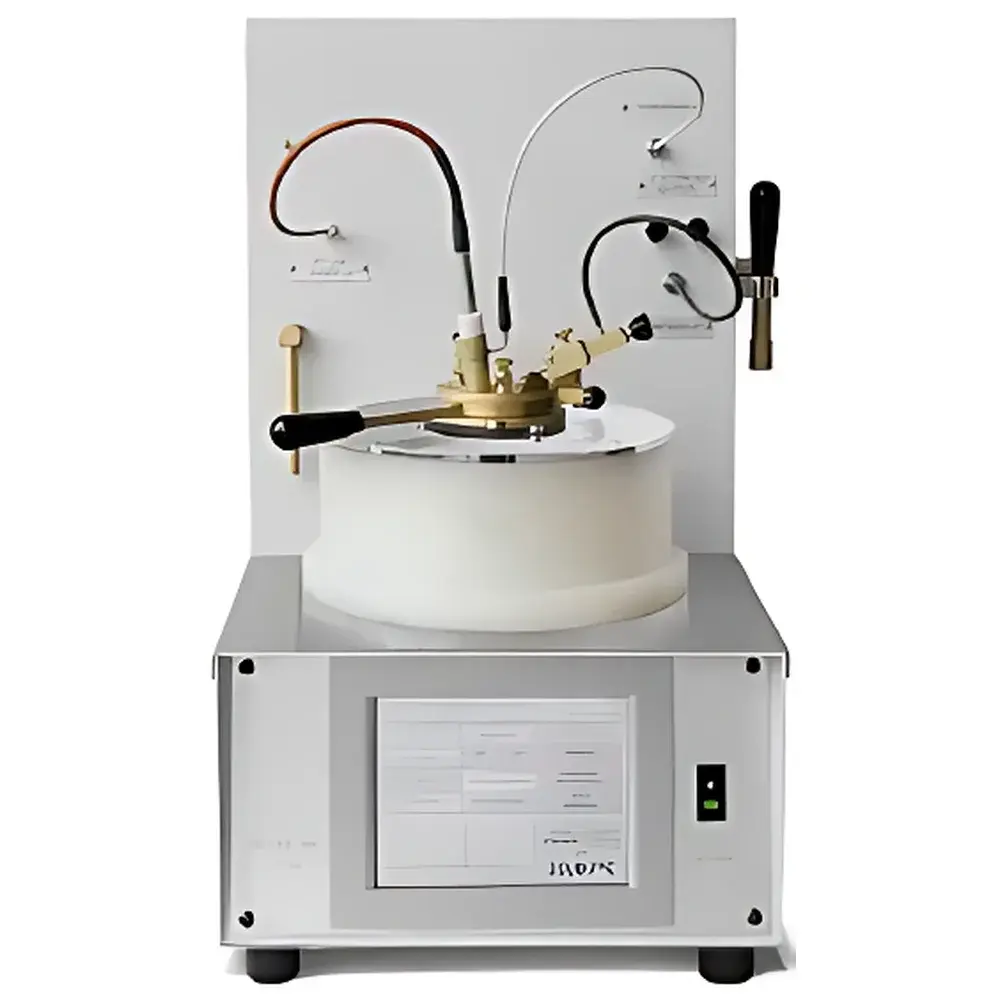
SDM 930AUT Fully Automated Closed-Cup Flash Point Tester (TAG Method)
| Brand | SDM |
|---|---|
| Origin | Italy |
| Model | 930AUT |
| Test Method | Closed-Cup (TAG) |
| Standards Compliance | ASTM D56, D3278, D3934, D3941 |
| Temperature Sensor | PT100 |
| Temperature Accuracy | ±0.1 °C |
| Display | 800×480 Touchscreen |
| Power Supply | 220 V, 50 Hz, 600 W |
| Sample Cup | Copper |
| Heating System | Electronic Regulated Heater |
| Cooling System | Integrated Internal Cooling Coil |
| Ignition | Dual-Mode (Gas Flame or Electric Spark), Auto-Triggered per Standard Protocol |
| Enclosure | Acid-Resistant Epoxy-Coated Cabinet |
| Bath & Holder Material | Brass |
| Software Platform | Windows 2000/XP/Vista Compatible |
Overview
The SDM 930AUT Fully Automated Closed-Cup Flash Point Tester is an engineered solution for precise, repeatable flash point determination of petroleum products, solvents, industrial chemicals, and waste streams in accordance with internationally recognized closed-cup test methodologies—specifically the TAG (Tagliabue) method. Designed and manufactured in Italy, this instrument implements a controlled heating ramp on a copper test cup immersed in a brass constant-temperature bath, followed by automated ignition at predetermined temperature intervals. Detection relies on ionization sensing technology to identify the lowest temperature at which vapors above the sample ignite momentarily under standardized atmospheric conditions. Its architecture adheres strictly to thermodynamic and kinetic requirements defined in ASTM D56 (for low-viscosity liquids), ASTM D3278 (for coatings and related materials), ASTM D3934 and D3941 (for viscous and high-boiling substances), as well as corresponding IP and ISO standards. The system operates without manual intervention from cup loading through result validation and reporting, ensuring operator safety, method integrity, and regulatory traceability.
Key Features
- Fully automated TAG-method execution: temperature ramping, timed ignition sequencing, ionization-based flame detection, and endpoint confirmation—all governed by preloaded standard protocols.
- Dual ignition capability: selectable gas flame or electric spark ignition, both activated automatically per test step requirements specified in ASTM/IP/ISO methods.
- High-stability thermal environment: brass-made bath and support fixtures ensure uniform heat distribution; integrated internal cooling coil enables rapid cooldown between tests and maintains thermal equilibrium during ramping.
- Precision temperature control: PT100 platinum resistance thermometer with ±0.1 °C accuracy and repeatability verified against certified reference standards.
- Robust mechanical design: copper sample cup mounted on linear slide mechanism for consistent positioning; acid-resistant epoxy-coated steel enclosure for long-term laboratory durability.
- Intuitive human-machine interface: 800×480 touchscreen display with context-sensitive navigation, real-time status indicators, and on-screen diagnostic feedback.
Sample Compatibility & Compliance
The 930AUT accommodates a broad range of volatile liquid samples including gasoline, diesel fuel, kerosene, lubricating oils, paint thinners, cleaning solvents, and regulated waste streams. It supports testing of both transparent and opaque liquids, provided they meet viscosity and volatility limits defined in applicable standards. All operational parameters—including heating rate, soak time, ignition frequency, and pass/fail criteria—are programmable within the constraints of ASTM D56, D3278, D3934, D3941, IP 491/492/304, and ISO 1516/1523/3679. The system’s firmware and software architecture are structured to support GLP-compliant data handling, including user access control, electronic signatures (where enabled via OS-level authentication), and audit-trail generation for method changes and result exports.
Software & Data Management
The embedded Windows-compatible software suite provides four functional modules: Analysis (method selection, run initiation, live curve visualization), Diagnostics (sensor calibration status, heater/cooler performance logs, ignition cycle verification), Calibration (PT100 offset adjustment, cup alignment validation), and Data Processing (statistical summary, trend analysis, customizable report templates). Raw data—including temperature vs. time profiles, ignition event timestamps, and ionization current traces—are stored in proprietary binary format with ASCII export capability (.csv, .txt). Reports include full metadata: operator ID, sample ID, method version, environmental conditions (if external sensor connected), and compliance statement referencing applicable standard clauses. Print outputs support graphical flash point curves alongside tabular results and pass/fail annotations.
Applications
This instrument serves quality control laboratories in refineries, petrochemical plants, paint and coating manufacturers, solvent distributors, and environmental testing facilities. Typical use cases include batch release testing of finished fuels per refinery specifications, stability assessment of formulated products during R&D, regulatory submission support for REACH or TSCA documentation, and hazardous waste classification under EPA 40 CFR Part 261. Its ability to handle diverse sample matrices—ranging from low-flash naphthas to higher-boiling cutback asphalt binders—makes it suitable for multi-product facilities requiring method flexibility without hardware reconfiguration.
FAQ
Which international standards does the 930AUT fully support?
ASTM D56, D3278, D3934, D3941; IP 491, 492, 304; and ISO 1516, 1523, 3679 — all implemented with parameter fidelity and automated sequence logic.
Is the instrument compliant with FDA 21 CFR Part 11 requirements?
While the base software does not include Part 11–certified electronic signature or audit trail modules out-of-the-box, its architecture supports integration with validated third-party LIMS or ELN platforms that provide such functionality.
Can the 930AUT be used for samples with suspended solids or high viscosity?
Yes, provided the sample remains homogeneous during heating and does not coat or obstruct the copper cup surface; ASTM D3941 defines procedural adaptations for viscous materials, which the instrument executes automatically when selected.
What maintenance is required for long-term accuracy?
Routine verification using certified flash point reference standards (e.g., n-decane, n-dodecane) every 30 days; annual PT100 calibration; biannual inspection of ignition electrodes and cup alignment.
Does the system support remote monitoring or network connectivity?
It features Ethernet and RS-232 ports for local network integration and can transmit results to lab information systems via TCP/IP or serial protocol—configuration requires site-specific IT validation.