
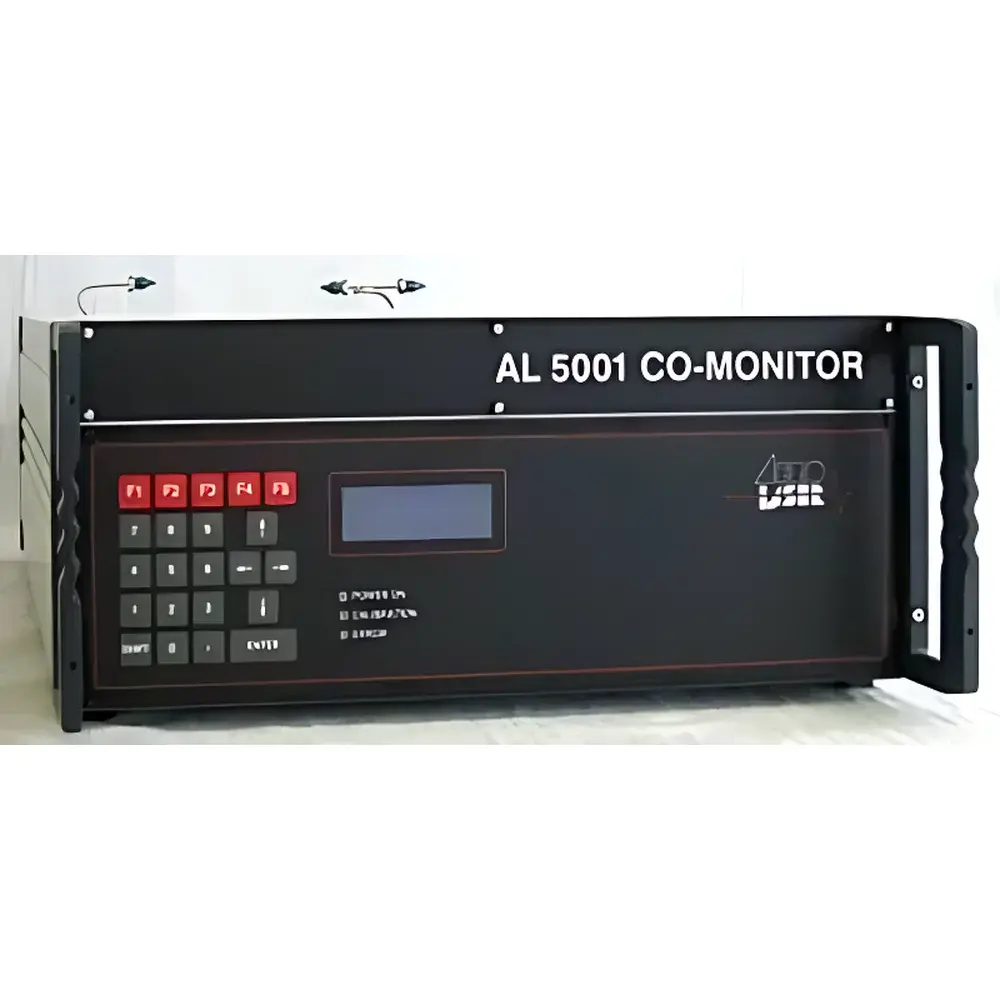
Aero Laser AL5001 Ultra-Trace Carbon Monoxide Analyzer
| Brand | Aero Laser |
|---|---|
| Origin | Germany |
| Model | AL5001 |
| Detection Principle | Vacuum Ultraviolet Fluorescence (VUV-F) at 150 nm |
| Detection Limit | <0.8 ppb (10 s integration) |
| Linear Range | 0–100 ppm (pulse counting mode) |
| Response Time (10–90%) | 2 s |
| Pump Type | Diaphragm Vacuum Pump |
| Interface | RS232 |
| Power Supply | 110/220 VAC or 24 VDC |
| Weight | 22 kg |
| Automation | Fully Automated Zero/Span Calibration |
| Application Scope | Ultra-trace CO monitoring in ambient air, cleanrooms, high-purity specialty gas streams, and remote atmospheric research stations |
Overview
The Aero Laser AL5001 Ultra-Trace Carbon Monoxide Analyzer is a laboratory- and field-deployable instrument engineered for continuous, real-time quantification of carbon monoxide (CO) at sub-part-per-trillion levels. It employs vacuum ultraviolet fluorescence (VUV-F) detection—a physical optical method wherein CO molecules are excited by monochromatic 150 nm radiation in a low-pressure reaction chamber, emitting characteristic fluorescence photons proportional to concentration. This principle delivers inherent selectivity against common interferents (e.g., CO₂, CH₄, NOₓ, hydrocarbons), eliminating cross-sensitivity issues prevalent in electrochemical or NDIR-based systems. Designed specifically for environments demanding ultra-low detection limits and rapid temporal resolution—such as polar research stations, stratospheric balloon payloads, semiconductor fab ambient monitoring, and high-purity specialty gas certification—the AL5001 operates without consumables or catalytic converters, ensuring long-term stability and minimal maintenance.
Key Features
- Sub-ppb detection capability: <0.8 ppb (10-second integration), validated per ISO 12039 and EPA Method TO-11A protocols for trace gas analysis
- Real-time response: 2-second rise/fall time (10–90%), enabling dynamic profiling of transient CO events in ambient or process streams
- Fully automated calibration architecture: Onboard zero-air generator and certified span gas delivery enable unattended daily zero/span verification within <3 minutes
- Robust vacuum system: Integrated diaphragm pump maintains stable 1–5 mbar operating pressure in the fluorescence cell, independent of ambient barometric fluctuations
- Dual power compatibility: Operates seamlessly on 110/220 VAC (50/60 Hz) or 24 VDC, supporting deployment in off-grid or mobile laboratories
- RS232 serial interface with ASCII protocol: Enables direct integration into SCADA, data loggers, or custom LabVIEW/Python acquisition frameworks
- Compact industrial enclosure (W × D × H ≈ 48 × 42 × 24 cm): IP54-rated housing suitable for controlled indoor environments and temperature-stabilized outdoor shelters
Sample Compatibility & Compliance
The AL5001 accepts gaseous samples at ambient or slightly elevated pressure (up to 1.5 bar absolute) with flow rates of 0.5–2.0 L/min. It is compatible with synthetic air, nitrogen, argon, helium, and other inert carrier matrices—making it suitable for certifying ultra-high-purity specialty gases (e.g., electronic-grade N₂, Ar, He per SEMI F63 and ASTM D7607). Moisture and particulate filtration (0.1 µm) upstream of the analyzer inlet is recommended to prevent optical window fouling. The system complies with IEC 61000-6-2 (EMC immunity) and IEC 61010-1 (safety for measurement equipment). Its calibration traceability aligns with NIST SRM 1662a (CO-in-air) and supports audit-ready documentation required under ISO/IEC 17025-accredited environmental testing laboratories.
Software & Data Management
The AL5001 communicates via ASCII-based RS232 commands, allowing flexible integration with third-party software platforms. Standard output includes timestamped CO concentration (ppb), internal cell pressure (mbar), lamp intensity (%), and diagnostic flags (e.g., “low signal”, “pump error”, “calibration overdue”). No proprietary driver or closed OS is required; raw data streams can be parsed using Python’s pySerial, MATLAB’s Instrument Control Toolbox, or commercial DAQ systems. For regulated environments, users may implement 21 CFR Part 11-compliant audit trails externally—recording all calibration events, parameter changes, and data exports with user authentication and electronic signatures.
Applications
- Ambient air quality networks requiring compliance with WHO Air Quality Guidelines (AQG) for CO (peak 1-hour limit: 10 ppm; background monitoring sensitivity target: ≤1 ppb)
- Atmospheric chemistry field campaigns—including Arctic/Antarctic observatories, aircraft-based vertical profiling, and tall-tower flux measurements
- Quality assurance of high-purity process gases used in photolithography, CVD, and epitaxial growth (per ASTM E260 and SEMI F21)
- Indoor air monitoring in cleanrooms (ISO Class 1–5), hospital HVAC systems, and underground transit infrastructure
- Method development and reference instrument validation in national metrology institutes (NMIs) and EPA-certified test labs
FAQ
What is the fundamental detection mechanism of the AL5001?
It uses vacuum ultraviolet fluorescence (VUV-F) at 150 nm excitation wavelength to induce CO-specific photon emission in a low-pressure reaction cell.
Does the AL5001 require external zero gas or calibration cylinders?
No—it features an integrated zero-air generator and automated span gas delivery module, enabling fully self-contained calibration without external gas cylinders.
Can the AL5001 measure CO in humid or corrosive sample streams?
Direct measurement is not recommended; sample conditioning (e.g., Nafion dryers, stainless-steel particulate filters) must be installed upstream to protect optics and maintain accuracy.
Is the instrument suitable for unattended operation over extended periods?
Yes—designed for >6-month continuous operation with scheduled auto-calibration, remote diagnostics via RS232, and thermal stabilization across 10–35 °C ambient range.
How is measurement traceability established for regulatory reporting?
Calibration is traceable to NIST SRM 1662a; users must document calibration frequency, uncertainty budgets, and environmental conditions per ISO/IEC 17025 Clause 7.7 requirements.







