
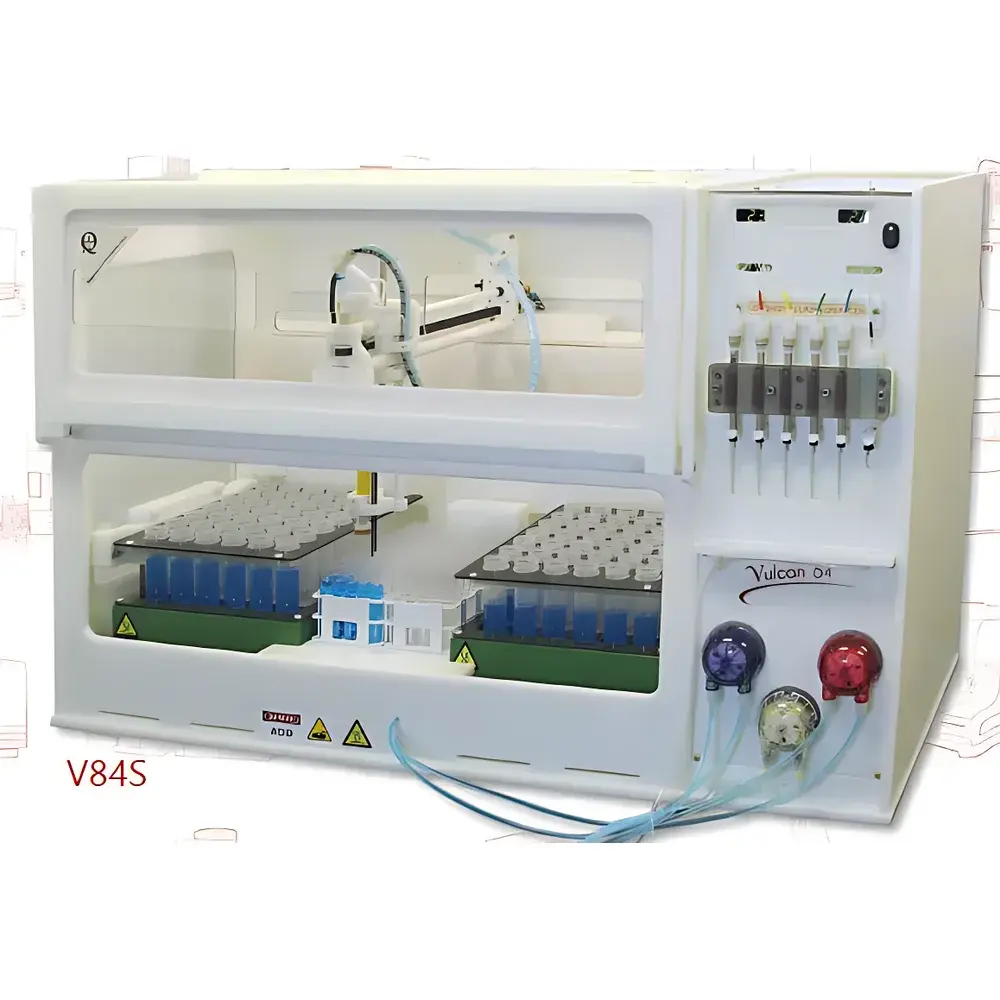
Qtechcorp Vulcan84 Fully Automated Microwave-Free Acid Digestion Workstation
| Brand | Qtechcorp |
|---|---|
| Origin | Canada |
| Manufacturer Type | Authorized Distributor |
| Origin Category | Imported |
| Model | Vulcan84 |
| Instrument Type | Electric Heating Digestion System |
| Automation Level | Fully Automated |
| Digestion Positions | 84 |
| Max Heating Temperature | 230 °C |
| Temperature Control Accuracy | ±1 °C |
| Heating Mechanism | Aluminum Block Heater |
| Reagent Channels | 6 |
| Dimensions (W×D×H) | 125 × 66 × 75 cm |
| Reagent Delivery Speed | ≥2 mL/s |
| Liquid Dispensing Accuracy | ±0.05 mL |
| Volume Calibration Precision | ±0.5 mm (meniscus height) |
| Compatible Vessels | 42 × 50 mL or 30 × 100 mL digestion tubes |
| Safety Features | Auto Over-Temperature Protection, Integrated Fume Hood |
| Software | Graphical PC-Based Control with Audit Trail Capability |
| Compliance Standards | EPA Methods 7470, 7471, 200.2, 200.7, 200.8, 3010A, 3020B, 3050B |
Overview
The Qtechcorp Vulcan84 Fully Automated Microwave-Free Acid Digestion Workstation is an integrated, benchtop sample preparation platform engineered for high-throughput, reproducible open-vessel acid digestion of solid and liquid matrices prior to elemental analysis. Unlike microwave-assisted systems, the Vulcan84 employs precisely controlled electric heating via dual aluminum blocks—each accommodating 42 positions—to deliver consistent thermal energy across all samples without cavity-mode limitations or pressure-related safety constraints. Its architecture combines programmable reagent dispensing, non-contact ultrasonic volume calibration, gas-driven homogenization, and automated post-digestion transfer—all within a fully enclosed, corrosion-resistant polymeric fume hood. Designed explicitly for laboratories supporting ICP-OES, ICP-MS, AAS, and AFS instrumentation, the Vulcan84 eliminates manual handling steps that introduce variability in digestion efficiency, contamination risk, and volumetric accuracy—thereby enhancing method robustness and data traceability in regulated environments.
Key Features
- Dual independent 42-position aluminum heating blocks (84 total), each with individual temperature zoning and real-time monitoring for parallel processing of heterogeneous sample batches.
- Six standard reagent channels driven by precision syringe pumps—including one PTFE-lined pump dedicated to hydrofluoric acid (HF) delivery—plus two wash pumps and one dilution pump for post-digestion sample conditioning.
- Non-contact ultrasonic meniscus detection system enabling accurate volumetric calibration to ±0.5 mm, compatible with standard borosilicate or quartz digestion tubes (50 mL or 100 mL formats).
- Pneumatic bubble agitation module with adjustable flow rate and dwell time, ensuring homogeneous mixing post-calibration without introducing particulate carryover or foam formation.
- Automated sample transfer function delivering calibrated digestates directly into standardized autosampler vials (e.g., 15 mL or 50 mL polypropylene tubes), including optional inline dilution during transfer for high-concentration analyte matrices.
- Integrated full-plastic fume extraction system compliant with ANSI Z9.5 laboratory ventilation standards, eliminating metal corrosion risks while maintaining Class II biosafety-level containment integrity.
Sample Compatibility & Compliance
The Vulcan84 supports a broad spectrum of environmental, food, pharmaceutical, and geological matrices—including soils, sediments, wastewater, biological tissues, seafood, cereals, herbal products, and pharmaceutical excipients. Its open-vessel design enables safe digestion of fluoride-rich samples (e.g., silicates, ceramics) using HF–HNO₃–HClO₄ sequences without pressurized vessel limitations. The workstation is validated for use with EPA Methods 3050B (acid digestion of sediments and sludges), 3010A (total recoverable metals in aqueous samples), 200.7 and 200.8 (ICP and ICP-MS determinations), as well as Chinese national standards GB/T 22105.*-2008 (soil heavy metal testing) and GB/T 5009.*-2003 (food nutrient and contaminant analysis). All hardware and software components are designed to support GLP/GMP workflows, including user access control, electronic signatures, and 21 CFR Part 11–compliant audit trail logging.
Software & Data Management
Controlled via a Windows-based graphical interface, the Vulcan84 software provides intuitive protocol building with nested step logic (e.g., “add HNO₃ → heat to 120 °C for 30 min → add H₂O₂ → ramp to 180 °C”), real-time thermal profiling, reagent consumption tracking, and automatic error logging. Each run generates a timestamped digital record containing setpoints, actual temperatures, dispensed volumes, calibration events, and operator ID—exportable in CSV or PDF format. The system supports LIMS integration through ASTM E1578-compliant data export templates and includes built-in validation tools for IQ/OQ documentation per ISO/IEC 17025 requirements.
Applications
- Routine digestion of environmental soil and sediment samples for multi-element screening by ICP-OES.
- Preparation of seafood and aquaculture tissue digests for mercury and arsenic speciation studies.
- High-volume food safety labs performing lead, cadmium, and chromium analysis in grains and infant formula per FDA Elemental Analysis Manual (EAM) Chapter 4.
- Pharmaceutical QC labs validating elemental impurities in active pharmaceutical ingredients (APIs) under ICH Q3D guidelines.
- Research laboratories conducting method development for novel digestion chemistries involving mixed-acid systems or low-temperature chelation-assisted protocols.
FAQ
Does the Vulcan84 support hydrofluoric acid (HF) handling?
Yes—the system includes a dedicated PTFE-syringe pump and HF-compatible fluid path components, with full containment inside the integrated fume hood.
Can digestion protocols be exported and shared between instruments?
Yes—protocols are saved as encrypted XML files and can be imported across Vulcan-series workstations running identical firmware versions.
Is remote monitoring or troubleshooting supported?
The workstation supports secure RDP and VNC access when deployed on a lab LAN; remote diagnostics require prior authorization and TLS-encrypted session initiation.
What maintenance intervals are recommended for the reagent delivery system?
Syringe seals should be inspected every 500 cycles; pump tubing requires replacement every 6 months under continuous operation, with automated wear diagnostics logged in the service history.
How does the Vulcan84 ensure traceability for regulatory audits?
All user actions, parameter changes, and execution logs are time-stamped, digitally signed, and stored locally with immutable write-once archiving options compliant with 21 CFR Part 11 Annex 11 requirements.



