
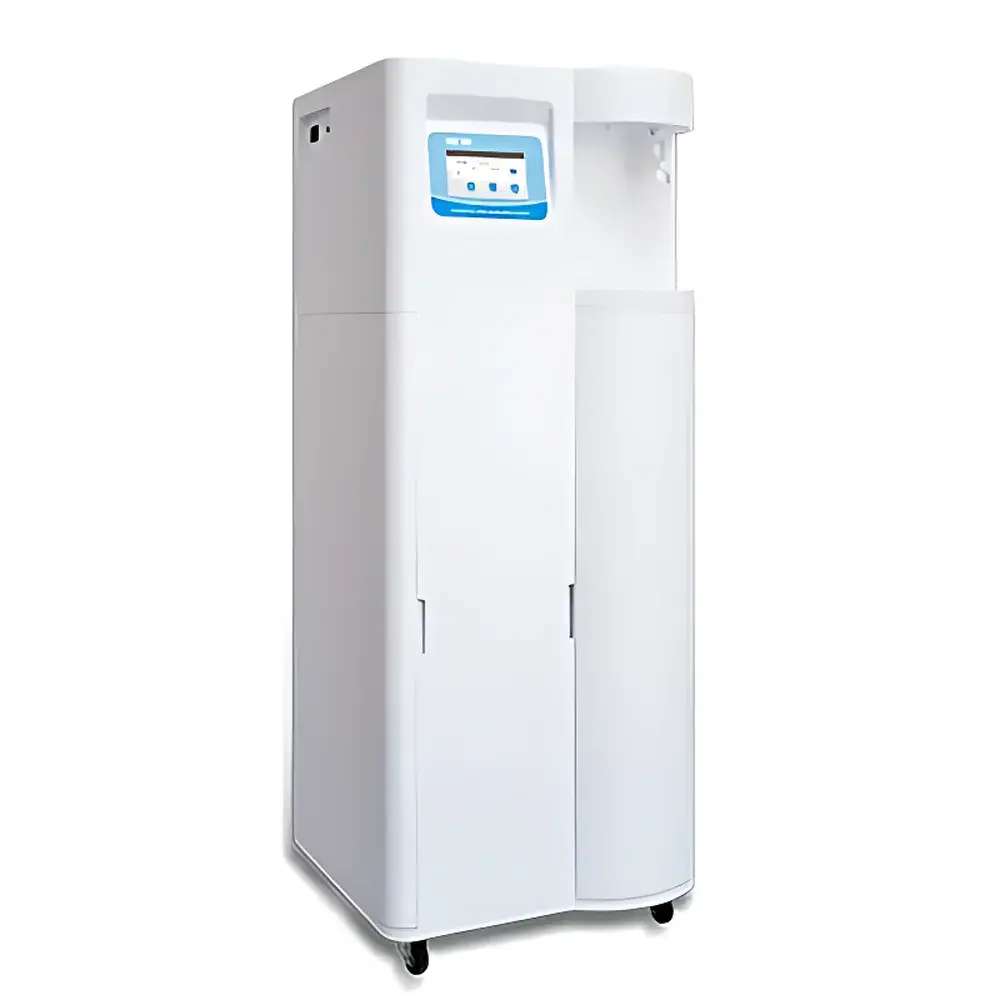
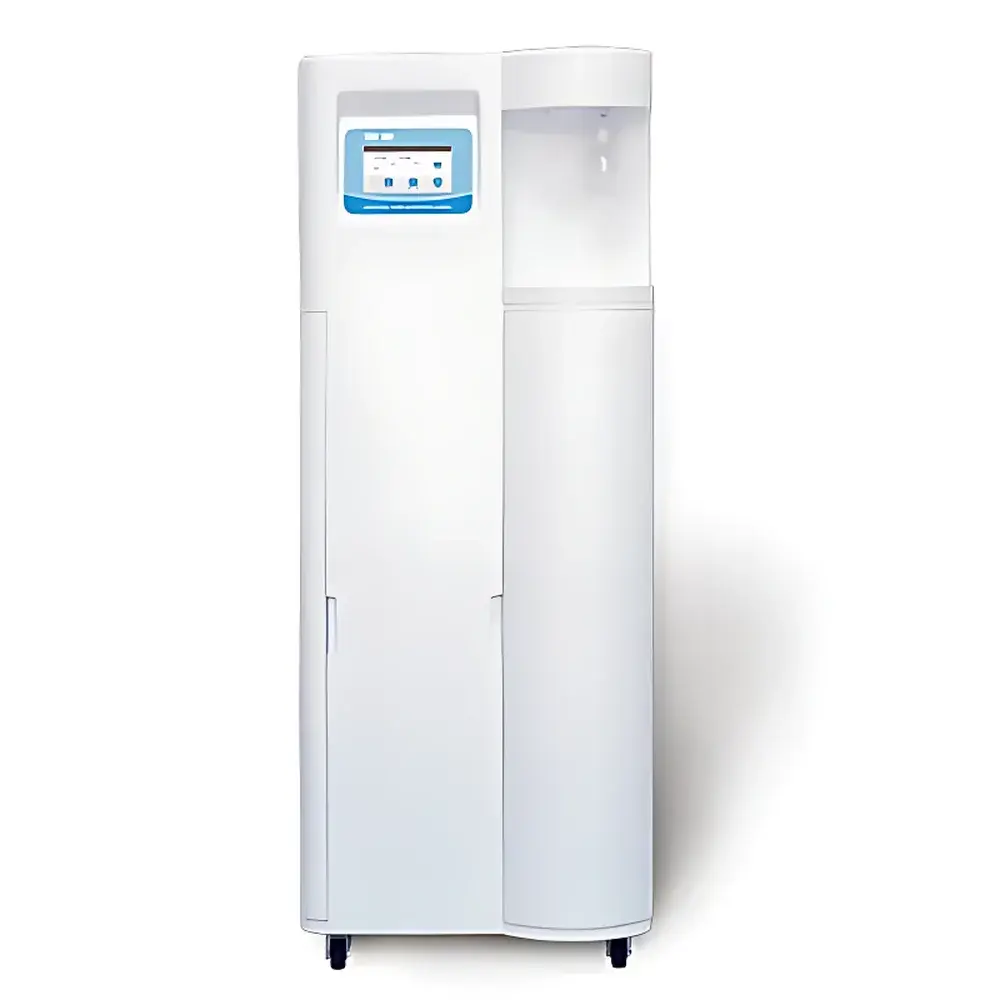
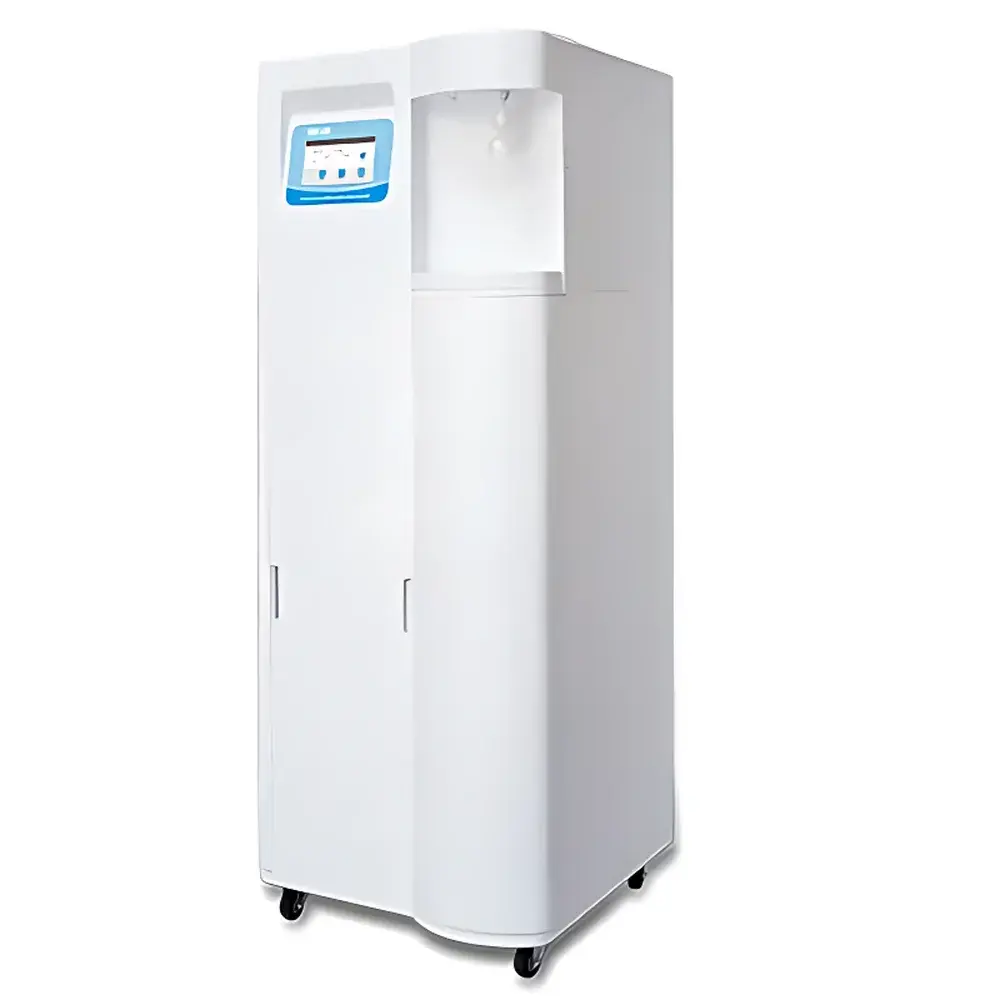
Zelab Center-EDI-D Series Ultra-Pure Water System (Model Center-EDI45D / Center-EDI60D / Center-EDI90D)
| Brand | Zelab |
|---|---|
| Origin | USA |
| Model | Center-EDI45D / Center-EDI60D / Center-EDI90D |
| Pure Water Grade | Type I (ASTM D1193, ISO 3696, CLSI, USP/EP/JP Pharmacopeia) |
| Resistivity | >10 MΩ·cm at 25 °C |
| Heavy Metals & Soluble Silica | <0.1 ppb |
| Total Organic Carbon (TOC) | <3 ppb |
| Microbial Count | <0.01 CFU/mL |
| Endotoxin | <0.001 EU/mL |
| Particles (>0.1 µm) | <1 particle/mL |
| Output Flow Rate | 45–90 L/h |
| RO Feed Water Requirement | Municipal tap water, 5–45 °C, 1.0–4.0 kgf/cm² pressure |
Overview
The Zelab Center-EDI-D Series is a high-performance, fully integrated ultra-pure water system engineered for demanding laboratory environments requiring continuous, reliable supply of Type I ultrapure water per ASTM D1193, ISO 3696, CLSI (formerly NCCLS), and pharmacopeial standards (USP, EP, JP). It employs a rigorously validated dual-stage reverse osmosis (RO) pretreatment architecture—featuring dual high-efficiency pumps, dual RO membranes, and an intermediate storage tank—to maximize contaminant rejection while minimizing energy consumption and wastewater generation. This configuration ensures stable secondary RO permeate conductivity of 1–5 µS/cm even under suboptimal feed water conditions. The core purification stage integrates electro-deionization (EDI) with proprietary high-purity nuclear-grade ion exchange resin (Dow Chemical), delivering consistent resistivity >10 MΩ·cm at 25 °C and TOC <3 ppb. All wetted materials—including 0.2 µm PES terminal filters, NSF-certified quick-connect fluid path components, and Dow RO membranes—are selected for low leachables, high chemical resistance, and long-term stability under GLP/GMP-compliant operation.
Key Features
- 7-inch full-color capacitive touchscreen with animated, intuitive menu navigation and real-time system diagnostics
- Triple-point water quality monitoring: feed water, RO permeate, and EDI product water—displayed continuously without manual sampling
- Dual precision dispensing modes: volumetric (10–999,999 mL) and resistivity-triggered (0–18.25 MΩ·cm)
- Automated RO membrane antiscalant flush cycle with programmable interval and duration; manual override available
- Integrated dual-storage architecture: 20 L polyethylene (PE) non-pressurized tank + 20 L NSF-certified pressurized accumulator tank—reducing footprint and eliminating external reservoirs
- Three independent service-access doors enabling modular maintenance and rapid consumable replacement (pre-filters, RO membranes, EDI stack, polishing cartridge)
- Removable spill tray with integrated drainage channel to contain accidental overflow and simplify cleaning
- Comprehensive consumable lifecycle management: usage timers, remaining life estimation, and configurable end-of-life alerts for PP, KDF, AC, RO, and TF cartridges
- Full-system data logging via USB port and SD card—retaining ≥12 months of operational history including alarms, flow rates, resistivity trends, and maintenance events
- NSF-certified fluid path components and Dow-sourced critical consumables (RO membranes, nuclear-grade resin, PES final filter)
Sample Compatibility & Compliance
The Center-EDI-D system is designed for compatibility with a broad range of analytical and life science applications requiring ultrapure water as solvent, reagent diluent, or instrument feed. Its output meets or exceeds the most stringent specifications for Type I water defined in ASTM D1193 Table I (resistivity, TOC, silica, bacteria), ISO 3696 Class 2, CLSI C3-A4, GB/T 6682-2008 (Grade I), and pharmacopeial monographs (USP , EP 2.2.44, JP XVII). All electronic controls support audit-trail functionality aligned with FDA 21 CFR Part 11 requirements when paired with validated software configurations. The system’s mechanical design—constructed entirely from corrosion-resistant engineering plastics—ensures compliance with GLP facility hygiene standards and eliminates metallic ion leaching risks.
Software & Data Management
Embedded firmware supports time-stamped event logging for all critical parameters: source water conductivity, RO stage performance, EDI current/voltage, resistivity, TOC (via optional add-on sensor), flow rate, tank levels, and alarm status. Data export is performed via standard USB mass-storage protocol; no proprietary drivers required. Users may define custom reporting windows (e.g., daily, weekly, per maintenance cycle) and generate CSV-compatible logs suitable for LIMS integration or regulatory submission. Password-protected access includes separate administrator and operator accounts, with granular permission control over calibration, alarm thresholds, timer settings, and consumable reset functions. System clock synchronization, scheduled standby/shutdown, and automatic timestamping of all user actions further reinforce data integrity and traceability.
Applications
This system serves as the primary water source for high-sensitivity analytical instrumentation including HPLC, UHPLC, LC-MS, ICP-MS, and AAS, where trace-level organic or ionic contamination compromises detection limits and column longevity. It is equally suited for molecular biology workflows (PCR, cell culture media preparation, electrophoresis buffer formulation), pharmaceutical QC testing (endotoxin assays, dissolution media), and semiconductor wafer rinsing protocols requiring ultra-low particle counts. The stable resistivity and minimal TOC enable reproducible baseline stability in electrochemical and surface characterization experiments.
FAQ
What standards does the Center-EDI-D meet for Type I ultrapure water?
It complies with ASTM D1193 (Type I), ISO 3696 (Grade 2), CLSI C3-A4, USP , EP 2.2.44, JP XVII, and GB/T 6682-2008 (Grade I) specifications.
Can the system operate with variable inlet water quality?
Yes—the dual-stage RO architecture maintains secondary permeate conductivity between 1–5 µS/cm across typical municipal feed water variations (TDS 50–500 ppm, temperature 5–45 °C).
Is the system compatible with external water storage tanks?
It supports both internal pressurized accumulator tanks and external level-sensing reservoirs via configurable analog/digital interface options.
How is data integrity ensured for regulatory audits?
All operational events are time-stamped, tamper-evident, and exportable in raw CSV format; password protection and role-based access align with FDA 21 CFR Part 11 principles.
What consumables require scheduled replacement, and how is lifecycle managed?
PP sediment, KDF/AC prefilter, RO membranes, EDI stack, and polishing cartridge lifetimes are individually tracked; alerts trigger based on runtime or water volume processed.



