
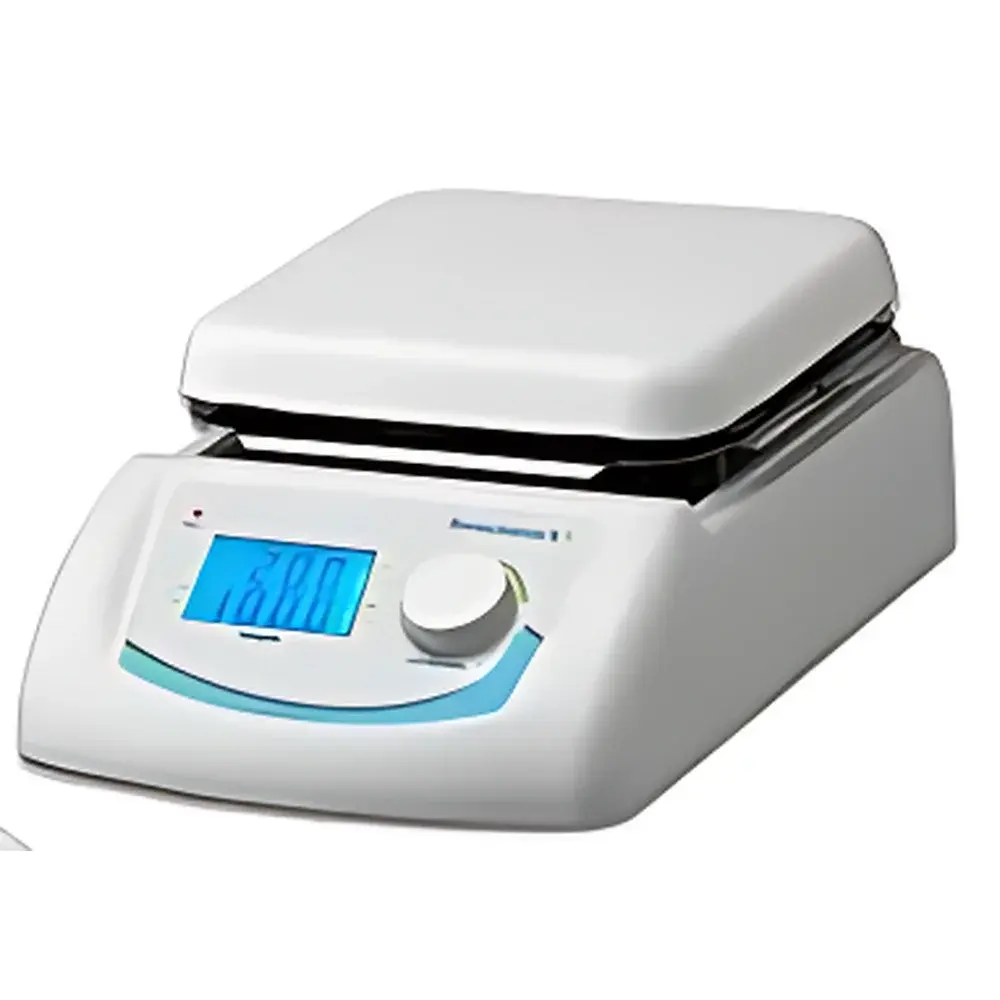
Benchmark H3760 Series Ceramic-Top Hotplate Stirrer
| Key | Brand: Benchmark |
|---|---|
| Origin | USA |
| Model | H3760 |
| Stirring Speed Range | 200–1500 rpm |
| Heating Temperature Range | Ambient +5°C to 380°C |
| Maximum Stirring Volume | 20 L |
| Control Type | Microprocessor-Based Digital Control |
| Display | Backlit LCD |
| Plate Material | White Ceramic |
| Plate Dimensions | 16.5 × 16.5 cm |
| Power Supply | 115 V, 50–60 Hz, 500 W |
| Temperature Accuracy (with Probe) | ±0.5°C |
| Optional Accessories | H3760-ROD Support Rod, External Temperature Probe |
Overview
The Benchmark H3760 Series Ceramic-Top Hotplate Stirrer is a compact, high-integrity benchtop instrument engineered for simultaneous heating and magnetic stirring in analytical, quality control, and synthetic chemistry laboratories. Designed around a robust microprocessor-controlled architecture, the system integrates precise thermal regulation with consistent rotational agitation—enabling reproducible reaction kinetics, dissolution testing, sample homogenization, and reagent preparation under controlled conditions. Its core operating principle combines resistive ceramic plate heating (via embedded high-stability heating elements) with a permanent-magnet drive system that couples magnetically through non-magnetic vessel walls to rotate stir bars. The white ceramic top surface provides exceptional chemical resistance against acids, bases, and organic solvents—eliminating corrosion-related calibration drift or surface degradation common in stainless-steel or aluminum hotplates.
Key Features
- Ceramic work surface (16.5 × 16.5 cm) offering Class A chemical inertness and thermal shock resistance up to 380°C
- Microprocessor-based digital control system with real-time backlit LCD display showing both setpoint and actual values for speed (rpm) and temperature (°C)
- Independent or combined operation modes: hotplate-only, stirrer-only, or synchronized hotplate/stirrer functionality
- Over-temperature safety cutoff and LED status indicator activated at plate surface temperatures >50°C
- Precise temperature regulation via optional external Pt100 or thermistor probe—enabling closed-loop feedback control of sample temperature (not just plate temperature), with accuracy maintained within ±0.5°C
- Modular accessory compatibility including the H3760-ROD support rod for vertical mounting of temperature probes, pH electrodes, or condensers
- Compact footprint (7 × 10.5 × 4 in / 17.8 × 26.7 × 10.2 cm) optimized for space-constrained fume hoods and shared lab benches
- Universal compatibility with standard borosilicate glassware—including round-bottom flasks (up to 20 L capacity), beakers, digestion vessels, and jacketed reactors
Sample Compatibility & Compliance
The H3760 Series supports a broad range of container geometries and materials, including borosilicate glass (e.g., Pyrex®, Duran®), PTFE-coated vessels, and certain high-temp polymers rated for continuous exposure up to 380°C. Its low-profile design accommodates vessels with heights up to 25 cm when used with the H3760-ROD support system. From a regulatory standpoint, the instrument’s digital control architecture supports audit-ready operation when integrated into GLP- or GMP-compliant workflows: all setpoints, runtime logs, and probe-derived temperature readings can be manually recorded or exported via external data logging interfaces (RS-232 optional). While not inherently 21 CFR Part 11 compliant out-of-the-box, its deterministic control logic and stable parameter retention align with foundational requirements for instrument qualification per ASTM E2500 and ISO/IEC 17025 Annex A.2.
Software & Data Management
The H3760 operates as a standalone instrument with no proprietary software dependency. All operational parameters are configured directly via front-panel membrane keys and validated through on-screen confirmation prompts. For laboratories requiring electronic recordkeeping, optional RS-232 serial output enables integration with third-party SCADA systems, LIMS platforms, or custom Python/Excel-based acquisition scripts. When paired with an external temperature probe, the unit maintains timestamped internal logs of setpoint deviations and stabilization events—supporting root-cause analysis during method validation or deviation investigations. No firmware updates are required under normal use; calibration verification is performed using NIST-traceable reference thermometers and tachometers per user-defined SOPs.
Applications
- Controlled-temperature synthesis of metal-organic frameworks (MOFs) and coordination polymers
- Dissolution testing per USP and Ph. Eur. 2.9.3 protocols using calibrated probe feedback
- Standardized sample digestion for ICP-MS/OES preparation in environmental and clinical labs
- Viscosity-dependent mixing of polymer solutions and colloidal suspensions
- Buffer equilibration and reagent aging studies requiring stable thermal profiles over extended durations (e.g., 12–72 h)
- Teaching laboratory demonstrations of Arrhenius kinetics, Le Chatelier’s principle, and heat-transfer fundamentals
FAQ
Does the H3760 require routine calibration?
Yes—annual verification of temperature accuracy (using a traceable thermometer) and speed accuracy (using a calibrated tachometer) is recommended per ISO/IEC 17025 Clause 6.5.
Can the H3760 be used with sealed or pressurized vessels?
It is compatible with standard atmospheric-pressure glassware; use with sealed systems requires independent pressure rating validation of the vessel and appropriate safety shielding.
Is the ceramic plate resistant to HF or molten alkali metals?
No—while highly resistant to most common laboratory chemicals, white ceramic surfaces are susceptible to etching by hydrofluoric acid and degradation upon contact with molten sodium or potassium.
What stir bar sizes are recommended for optimal performance at 20 L volume?
Elliptical or cross-shaped stir bars measuring 60–80 mm in length and ≥12 mm in diameter provide optimal torque transfer and vortex stability in large-volume configurations.
Does Benchmark provide IQ/OQ documentation packages?
Yes—customizable Installation Qualification (IQ) and Operational Qualification (OQ) templates are available upon request to support regulated laboratory deployments.



