
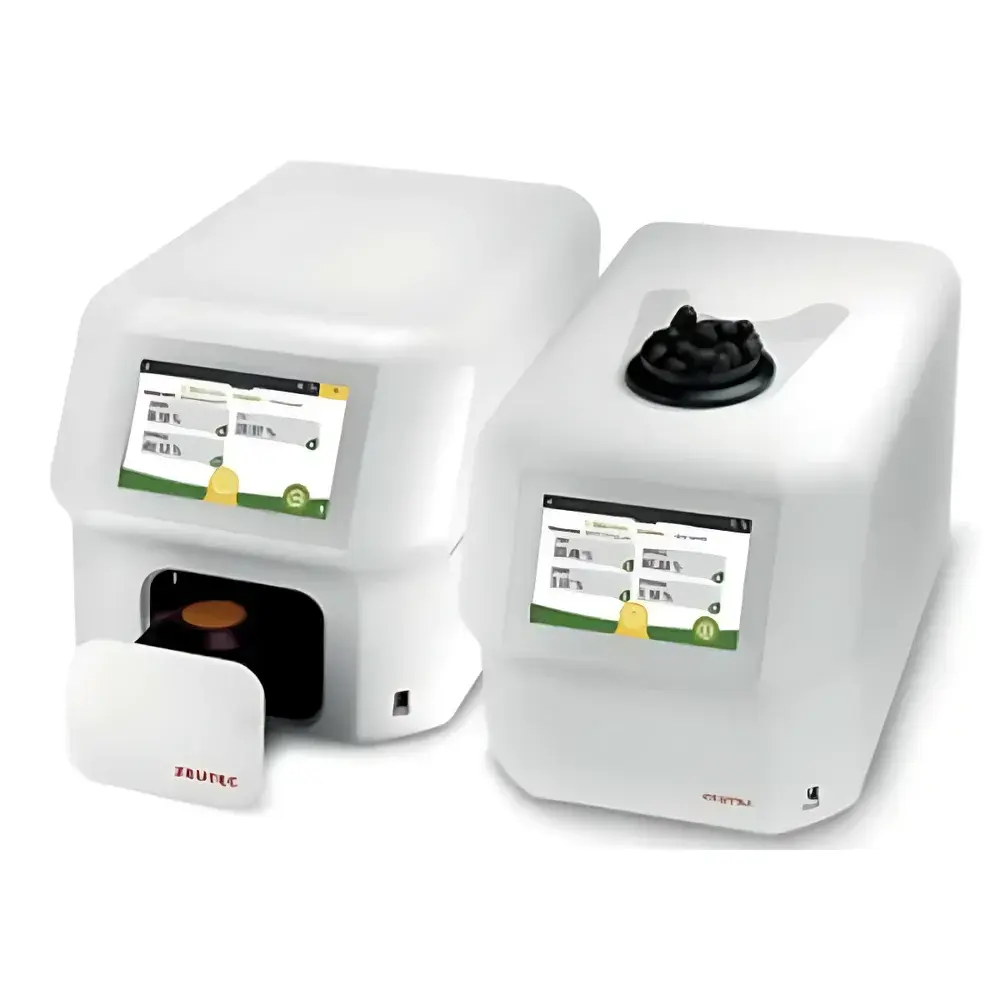
JHX SpectraAlyzer OLIVE Olive Oil Quality Analyzer
| Brand | JHX |
|---|---|
| Origin | Germany |
| Model | OLIVE |
| Type | Benchtop Optical Quality Analyzer for Olive Matrixes |
| Measurement Principle | Multi-Wavelength Absorption & Scattering Spectrophotometry |
| Analysis Time | ≤45 s per sample |
| Sample Types | Whole olives, olive paste, virgin olive oil, olive pomace |
| Parameters Measured | Oil yield (% w/w), moisture content (% w/w), free acidity (as oleic acid, %), peroxide value (meq O₂/kg), and auxiliary spectral indices correlated to oxidation state and phenolic profile |
| Calibration | Factory-predefined chemometric models based on reference ASTM D6584, ISO 660, ISO 8534, and IOC/T.20/Doc. No. 29 datasets |
| Compliance | CE-marked |
| Operating Environment | 10–40 °C, 20–80% RH non-condensing, IP54-rated enclosure |
| Interface | 7″ capacitive touchscreen, USB-C, Ethernet, optional RS-232 |
| Software | SpectraAlyzer v4.2 with GLP-compliant audit trail, user role management, and 21 CFR Part 11-ready configuration |
Overview
The JHX SpectraAlyzer OLIVE is a dedicated benchtop optical quality analyzer engineered for rapid, reagent-free assessment of critical quality parameters across the entire olive processing chain—from whole fruit through paste and virgin oil to exhausted pomace. Unlike conventional wet-chemistry or chromatographic methods, it employs multi-wavelength absorption and scattering spectrophotometry in the visible–near-infrared (VIS–NIR) range (400–1050 nm) to quantify compositional and oxidative markers via pre-validated partial least squares (PLS) regression models. These models are built upon extensive reference datasets aligned with international olive oil standards—including IOC Method T.20/Doc. No. 29 for acidity and peroxide determination, ISO 660 for acid value, ISO 8534 for moisture in olive paste, and ASTM D6584 for peroxide value—ensuring metrological traceability without requiring operator intervention or calibration transfers. The system delivers results in ≤45 seconds per sample, eliminating centrifugation, titration, solvent extraction, or glassware cleaning—making it suitable for real-time process monitoring near production lines.
Key Features
- Reagent-free, non-destructive analysis: No solvents, acids, or indicators required; minimal sample preparation (homogenized paste or filtered oil only).
- Integrated optical path with dual-beam referencing: Compensates for lamp drift, ambient light fluctuations, and dust accumulation on optics—critical for factory-floor deployment.
- Rugged industrial design: IP54-rated enclosure, shock-absorbing chassis, and thermally stabilized detector array ensure stable performance under ambient temperature swings (10–40 °C) and mechanical vibration.
- Touchscreen-driven workflow: Intuitive interface guides users through sample loading, measurement, and report generation—no spectroscopy expertise needed.
- Factory-calibrated chemometric models: Pre-loaded PLS algorithms validated against >1,200 reference samples from EU, North African, and South American olive cultivars and harvest years.
- Modular sample handling: Interchangeable cuvette holders for liquid oils (10-mm pathlength quartz cells) and custom sample cups for semi-solid paste or crushed olives.
Sample Compatibility & Compliance
The SpectraAlyzer OLIVE accepts raw, unfiltered virgin olive oil; homogenized olive paste (with particle size <200 µm); whole pitted olives (crushed in situ); and dried pomace (moisture <15%). It complies with ISO/IEC 17025:2017 requirements for method validation documentation and supports laboratory accreditation under EN ISO/IEC 17025. Instrument firmware and software are configurable for GLP and GMP environments, including electronic signature support, audit trail logging (per FDA 21 CFR Part 11), and secure user access levels (administrator, analyst, reviewer). All measurement outputs include uncertainty estimates derived from model cross-validation residuals and instrument noise profiles.
Software & Data Management
SpectraAlyzer v4.2 software provides full data lifecycle control: acquisition, processing, reporting, and archival. Raw spectral data (ASCII-exportable) and processed parameter tables are stored with time/date stamps, operator ID, and instrument serial number. Batch reports can be generated in PDF or CSV format, with configurable templates compliant with internal QA forms or third-party certification bodies (e.g., COI, UNI, UNE). Remote diagnostics and firmware updates are supported over Ethernet; local backup is enabled via USB-C drive. Audit trails record all changes to calibration files, user permissions, and result modifications—retained for ≥36 months by default.
Applications
- Real-time quality gate at reception: Rapid screening of incoming olive lots for acidity and moisture before milling.
- In-process optimization: Adjusting malaxation time/temperature based on evolving oil yield and peroxide trends in paste.
- Final product release testing: Confirming compliance with extra virgin olive oil specifications (e.g., ≤0.8% free acidity, ≤20 meq O₂/kg peroxide value) prior to bottling.
- Pomace valorization: Quantifying residual oil and moisture content to determine optimal drying and solvent extraction economics.
- Research & development: Tracking oxidative stability indices during storage trials or antioxidant fortification studies.
FAQ
Does the OLIVE require daily recalibration?
No—factory calibration remains stable for ≥6 months under normal use. A quarterly verification using certified reference olive oil standards (traceable to NIST SRM 2384) is recommended.
Can it measure chlorophyll or polyphenols directly?
It does not report absolute concentrations of individual phenolics or pigments, but delivers validated spectral indices strongly correlated with total phenol content (R² = 0.92 vs. Folin–Ciocalteu) and chlorophyll-a equivalents (R² = 0.89 vs. HPLC), as documented in the validation report.
Is method transfer possible between instruments?
Yes—spectral data exchange and model portability are supported via encrypted .spm file packages, enabling harmonized measurements across multiple sites within a multinational producer network.
What maintenance is required?
Annual optical alignment verification and detector dark-current characterization by authorized JHX service engineers; no user-serviceable optical components.
Is training provided?
Yes—JHX offers onsite or virtual 1-day operational training, including sample preparation protocols, troubleshooting workflows, and GLP documentation practices.





