
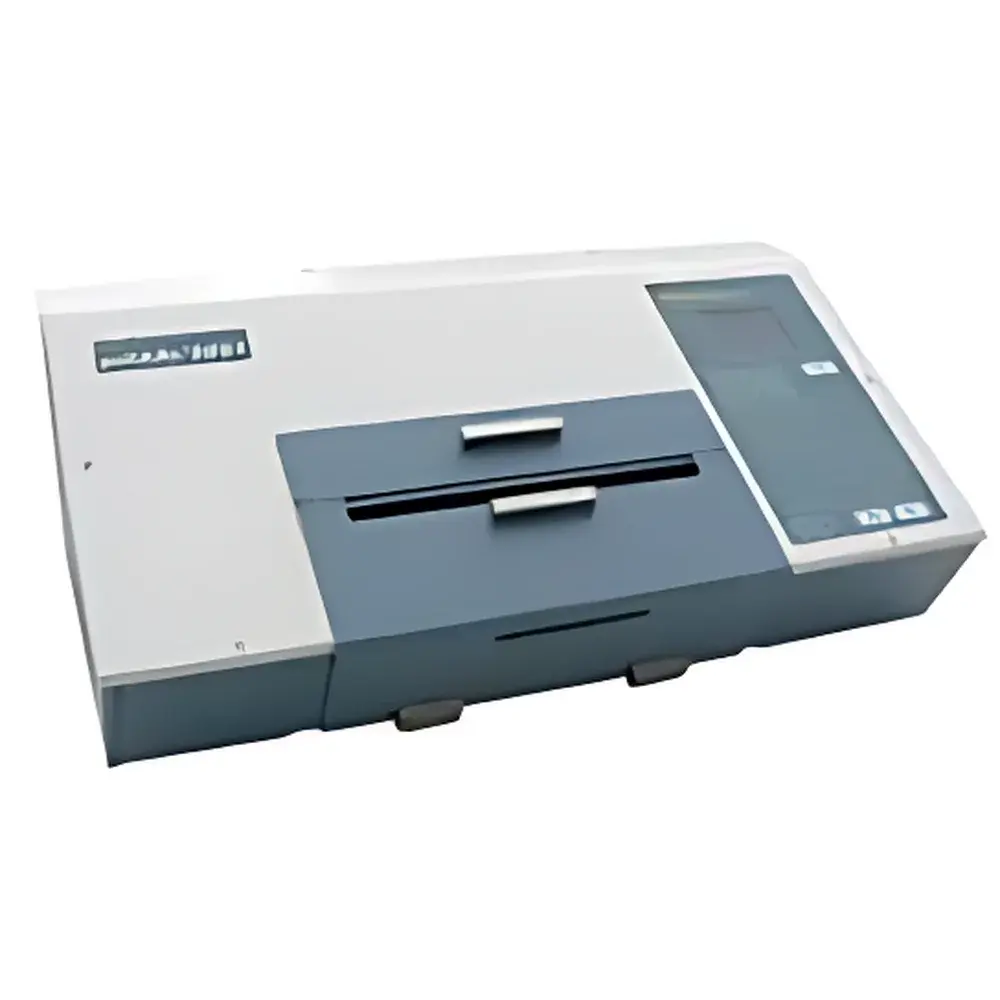
OP SacchAAr 880 Dual-Wavelength Automatic Polarimeter
| Brand | OP |
|---|---|
| Origin | United Kingdom |
| Model | SacchAAr 880 |
| Type | Automatic Polarimeter |
| Temperature Control | Yes |
| Digital Display | Yes |
| Light Source | 20 W Tungsten-Halogen Lamp |
| Wavelengths | 589.44 nm (Na-D line) and 880 nm (NIR) |
| Optical Density Tolerance | OD 4.5 @ 880 nm, OD 3.0 @ 589.44 nm |
| Measurement Range | ±90° optical rotation, ±130°Z (ISS scale) |
| Accuracy | ±0.001° @ 0°–10°, ±0.01°Z @ 0°Z–25°Z |
| Repeatability | ±0.001° |
| Response Time (Continuous Mode) | ~10 s |
| Sample Cell Compatibility | Standard tubes up to 200 mm path length, inner diameter 1.5–8 mm, max neck diameter 30 mm |
| Temperature Sensor | Integrated Pt100 probe, range 0–100 °C, accuracy ±0.25 °C, resolution 0.1 °C |
| Interfaces | Two RS-232 (25-pin D-sub), one remote control port (9-pin D-sub) |
| Power Supply | 86–265 VAC, 47–63 Hz, max. 40 W |
| Dimensions | 515 × 380 × 198 mm |
| Weight | 15.7 kg |
| Calibration | UKAS-traceable (certification optional, order code 10-01) |
Overview
The OP SacchAAr 880 Dual-Wavelength Automatic Polarimeter is a precision optical instrument engineered for high-accuracy measurement of optical rotation in optically active substances—primarily carbohydrates, pharmaceutical intermediates, chiral compounds, and natural extracts. It operates on the fundamental principle of polarimetry: linearly polarized light is rotated as it passes through a chiral medium, with the magnitude and direction of rotation directly proportional to concentration, path length, temperature, and wavelength. Unlike conventional single-wavelength polarimeters, the SacchAAr 880 integrates two discrete, switchable wavelengths—589.44 nm (sodium D-line, standardized for international sugar scale compliance) and 880 nm (near-infrared)—enabling robust performance across highly absorbing or deeply colored samples without chemical decolorization (e.g., elimination of lead acetate treatment). This dual-wavelength architecture supports both regulatory-grade sugar analysis per ISS (International Sugar Scale) and research-grade chiral characterization under controlled thermal conditions.
Key Features
- Dual-wavelength operation (589.44 nm and 880 nm) with automatic wavelength selection logic: instrument alerts “Dark sample—switch to IR mode” when transmission falls below 3% at 589 nm.
- High-stability 20 W tungsten-halogen light source with >2000 h lifetime, coupled with precision interference filters for spectral purity and minimal thermal drift.
- Temperature-controlled sample chamber with integrated Pt100 sensor (0–100 °C, ±0.25 °C accuracy), enabling real-time thermal correction per ISS protocols and user-defined temperature compensation algorithms.
- Full-angle measurement capability: ±90° optical rotation, extended to ±130°Z on the International Sugar Scale (ISS), with resolution of 0.0001° and certified accuracy of ±0.001° (0°–10° range).
- Configurable readout modes: continuous monitoring, timed interval output, event-triggered recording (e.g., on value change > threshold), and stability-triggered acquisition (user-defined convergence window and hold time).
- Alphanumeric keypad with lockable interface, dedicated function keys (zero, scale select, print, sample ID entry), and support for up to five user-defined metadata fields per measurement.
Sample Compatibility & Compliance
The SacchAAr 880 accommodates standard cylindrical sample cells—including stainless steel, borosilicate glass, flow-through, and disposable quartz tubes—with internal diameters from 1.5 mm to 8 mm and maximum path lengths up to 200 mm. Its 880 nm NIR channel achieves an optical density tolerance of OD 4.5 (99.997% absorption), permitting direct analysis of molasses, caramelized syrups, fruit concentrates, and botanical extracts without dilution or pretreatment. The instrument complies with key industry standards including ISO 5725 (accuracy and precision of measurement methods), ASTM D1005 (standard test method for optical rotation of sugars), and EU Pharmacopoeia 2.2.7 (polarimetric assay of chiral APIs). Optional UKAS-traceable calibration (certificate available upon request, order code 10-01) satisfies GLP/GMP audit requirements for QC laboratories operating under FDA 21 CFR Part 11 and Annex 11 frameworks.
Software & Data Management
Data output is structured and machine-readable via dual RS-232 ports: each record includes sample ID, optical rotation value (in ° or °Z), selected wavelength, chamber temperature, timestamp (date + time), instrument serial number, active scale, and all user-configured parameters. No proprietary software is required for basic data capture; however, integration with LIMS or ELN systems is supported through ASCII-based serial protocol. Audit trail functionality logs all parameter changes, calibration events, and user actions—aligned with ALCOA+ principles (Attributable, Legible, Contemporaneous, Original, Accurate). Remote control port enables external triggering of measurements and synchronization with auxiliary instruments such as refractometers (e.g., Index Instruments models) for concurrent Brix and polarization-based purity assessment.
Applications
- Quantitative sucrose, glucose, and fructose determination in food & beverage QC labs per ISS and ICUMSA guidelines.
- Chiral purity verification of synthetic intermediates and active pharmaceutical ingredients (APIs) during process development and release testing.
- Stability-indicating assays for optically labile compounds under accelerated aging or photolysis studies.
- Raw material authentication of natural extracts (e.g., essential oils, glycosides) where color interference invalidates traditional 589 nm methods.
- Method transfer between R&D and production environments requiring traceable, temperature-compensated, and wavelength-validated polarimetric protocols.
FAQ
Is the SacchAAr 880 compliant with FDA 21 CFR Part 11 for electronic records and signatures?
Yes—when operated with configured audit logging, user access controls, and UKAS-traceable calibration documentation, the system meets foundational requirements for Part 11 compliance in regulated environments.
Can I use non-OP sample cells with this instrument?
Yes—the SacchAAr 880 accepts any standard cylindrical cell meeting dimensional specifications (max. 30 mm neck diameter, 200 mm length, 1.5–8 mm bore), including third-party stainless steel, glass, or quartz tubes.
How is calibration performed for the 880 nm channel?
The primary calibration reference is a quartz control plate at 589.44 nm. For routine verification at 880 nm, users may employ any transparent, stable sugar solution of known rotation—eliminating dependency on specialized NIR standards.
Does the instrument support automated temperature ramping or programmable thermal profiles?
No—the SacchAAr 880 provides passive thermal stabilization (±3 °C above ambient) and real-time temperature measurement, but does not include active Peltier-based heating/cooling or programmable thermal gradients.
What is the minimum detectable rotation change under continuous monitoring mode?
The instrument resolves changes of 0.0001°, with repeatability confirmed at ±0.001° over 10 consecutive readings under stabilized thermal and optical conditions.




