
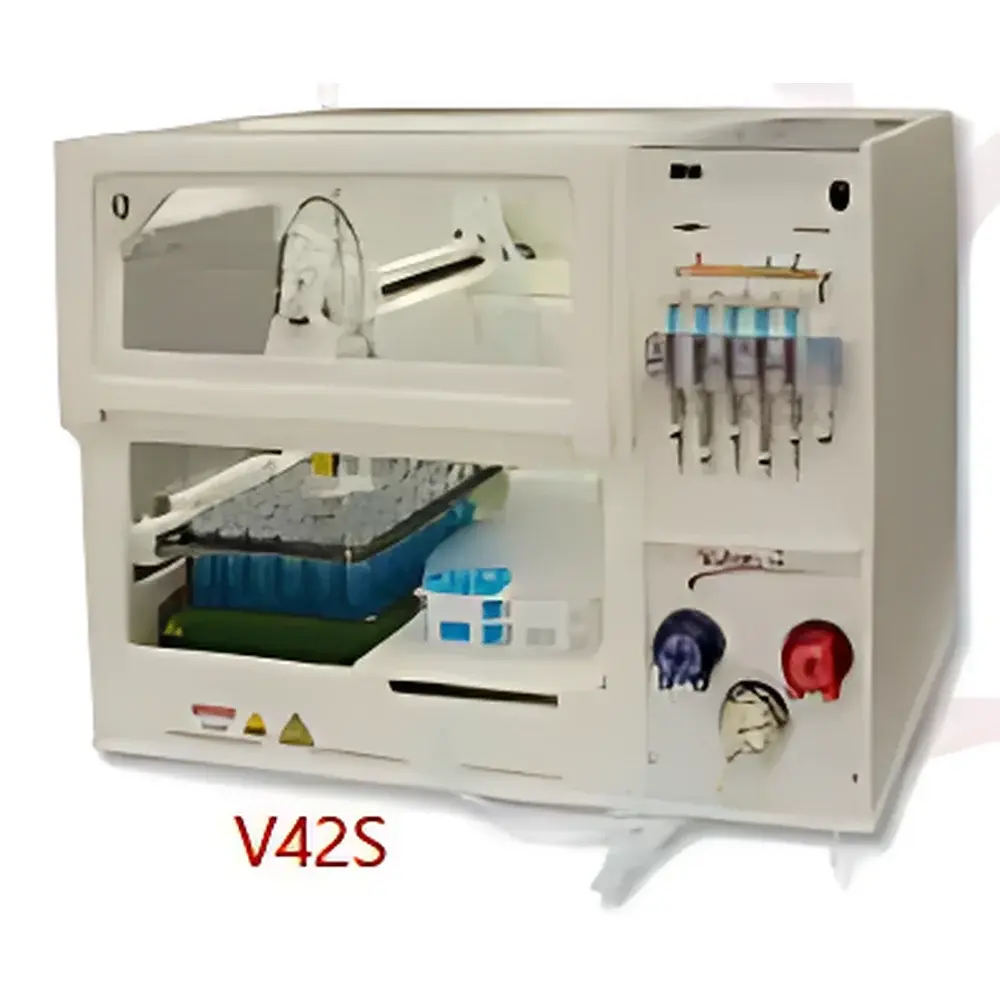
Qtechcorp Vulcan 42S Fully Automated Microwave-Free Acid Digestion Workstation
| Origin | Canada |
|---|---|
| Manufacturer Type | Authorized Distributor |
| Origin Category | Imported |
| Model | Vulcan 42S |
| Instrument Type | Electric Heating Digestion System |
| Automation Level | Fully Automated |
| Digestion Positions | 42 |
| Max Heating Temperature | 230 °C |
| Temperature Control Accuracy | ±1 °C |
| Heating Principle | Resistive Electric Heating |
| Reagent Channels | 12 (expandable) |
| Liquid Delivery Speed | ≥2 mL/s |
| Dispensing Accuracy | ±0.05 mL |
| Volumetric Completion Precision | ±0.5 mm (meniscus height) |
| Graphite Block Capacity | 42 × 50 mL or 30 × 100 mL tubes |
| Dimensions (W×D×H) | 125 × 66 × 75 cm |
| Integrated Fume Hood | Yes |
| Material Construction | All-Plastic (Chemical-Resistant Polymer Enclosure) |
| Reagent Pumps | 6 Syringe Pumps (incl. PTFE-lined HF-compatible pump) + 1 Dilution Pump + 2 Wash Pumps |
| Mixing Mechanism | Programmable Air-Bubble Agitation |
| Final Volume Adjustment | Non-contact Ultrasonic Meniscus Detection |
| Sample Transfer Function | Robotic Arm-Assisted Tube-to-Tube Transfer with On-the-Fly Dilution Capability |
Overview
The Qtechcorp Vulcan 42S is a fully automated, microwave-free acid digestion workstation engineered for high-throughput, trace-metal-grade sample preparation in regulated analytical laboratories. Unlike conventional hotplate-based digesters, the Vulcan 42S integrates electrothermal digestion, precision reagent dispensing, real-time volumetric completion sensing, pneumatic mixing, and post-digestion transfer—all within a single, all-plastic, corrosion-resistant enclosure equipped with an integrated fume hood. Its core architecture follows the principles of controlled open-vessel digestion under programmable temperature ramps and reflux conditions, compliant with EPA Methods 3050B, 3010A, 200.2, 200.7, 200.8, 7470A, and 7471A, as well as Chinese national standards GB/T 22105.*-2008 and GB/T 5009.*-2003. Designed specifically for compatibility with ICP-OES, ICP-MS, AAS, and HG-AFS instrumentation, the system eliminates manual handling steps that introduce contamination, variability, or operator exposure to aggressive acids—including HF, HNO₃, HCl, H₂SO₄, and HClO₄.
Key Features
- 42-position independent graphite heating block with dual-tube compatibility (50 mL or 100 mL vessels), enabling parallel processing of heterogeneous sample matrices without cross-contamination.
- 12-expandable reagent channels driven by six chemically inert syringe pumps—each calibrated for acid-specific delivery; one PTFE-lined pump is dedicated exclusively to hydrofluoric acid handling per ASTM D5686 and ISO 17294-2 safety requirements.
- Non-contact ultrasonic meniscus detection ensures precise final volume adjustment at ±0.5 mm tolerance, eliminating optical interference from colored or turbid digestates.
- Programmable air-bubble agitation module delivers reproducible homogenization post-digestion, with adjustable flow rate and duration to prevent foaming in organic-rich samples (e.g., seafood, soil, pharmaceutical excipients).
- Robotic sample transfer arm performs tube-to-tube liquid transfer with on-the-fly dilution capability—critical for achieving optimal analyte concentration ranges prior to ICP analysis without secondary manual dilution steps.
- All-plastic structural housing (FDA-compliant polypropylene and PVDF composites) provides full resistance to acid vapors and condensates, ensuring long-term mechanical integrity and minimizing background metal leaching.
Sample Compatibility & Compliance
The Vulcan 42S supports a broad spectrum of solid and semi-solid environmental and regulatory matrices, including but not limited to: soils and sediments (EPA SW-846 Method 3050B), wastewater and drinking water solids (EPA 200.7), biological tissues (AOAC 999.10), foodstuffs (GB/T 5009.12-2003), pharmaceutical dosage forms (USP ), and marine biota (ISO 17294-2). Its operational workflow adheres to GLP and GMP documentation requirements, with audit-trail-enabled software logging all temperature profiles, reagent consumption, volume adjustments, and error events. The system meets CE marking requirements for laboratory equipment (2014/30/EU EMC Directive and 2014/35/EU LVD) and conforms to NFPA 45–2022 ventilation performance criteria for acid digestion enclosures.
Software & Data Management
Controlled via a Windows-based graphical interface, the Vulcan PC software enables method-driven operation with full parameter scripting—temperature ramping, hold times, reagent sequence logic, gas purge cycles, and multi-step dilution protocols. All instrument actions are timestamped and stored in encrypted SQLite databases compliant with FDA 21 CFR Part 11 requirements for electronic records and signatures. Raw data exports support CSV, PDF, and XML formats for integration into LIMS platforms (e.g., LabWare, STARLIMS). Software validation packages—including IQ/OQ documentation templates and protocol execution logs—are available upon request for regulated environments.
Applications
- Routine heavy metal quantification (As, Cd, Cr, Cu, Ni, Pb, Zn, Hg) in environmental monitoring programs aligned with EU Water Framework Directive and China’s GB 3838-2002.
- Regulatory compliance testing for elemental impurities in pharmaceuticals per ICH Q3D guidelines, where sub-pptr detection limits demand ultra-low blank contributions.
- Multi-element screening in agricultural commodities using ICP-MS, requiring consistent matrix removal and minimal procedural variability across hundreds of daily samples.
- Method development for novel digestion protocols involving mixed-acid systems (e.g., HNO₃–HF–HClO₄) where thermal stability and vapor containment are critical.
- Reference material certification workflows (e.g., NIST SRMs, GBW standards) where inter-laboratory reproducibility depends on standardized digestion kinetics and final volume accuracy.
FAQ
Does the Vulcan 42S support hydrofluoric acid (HF) digestion?
Yes—the system includes a dedicated PTFE-lined syringe pump and chemically resistant fluid path components rated for continuous HF exposure up to 48% concentration, in accordance with ASTM D5686 and ISO 17294-2 safety specifications.
Can the system be validated for 21 CFR Part 11 compliance?
Yes—software audit trails, electronic signature support, and configurable user access levels are built-in; full validation documentation kits (IQ/OQ/PQ) are provided for GxP implementation.
What is the maximum recommended digestion temperature for organic-rich samples?
For samples with high lipid or protein content (e.g., fish tissue, dairy products), we recommend limiting ramped heating to ≤180 °C during initial oxidation phases to minimize splattering and carbon residue formation.
Is external exhaust ducting required?
No—the integrated all-plastic fume hood meets NFPA 45–2022 airflow and containment performance standards when operated with the supplied inline acid scrubber and variable-speed exhaust fan.
How does the ultrasonic meniscus detection avoid interference from suspended particles?
The transducer operates at 2.5 MHz with adaptive signal filtering that discriminates between acoustic reflections from the liquid surface and particulate scatter—validated across slurries with up to 15% w/v total suspended solids.



