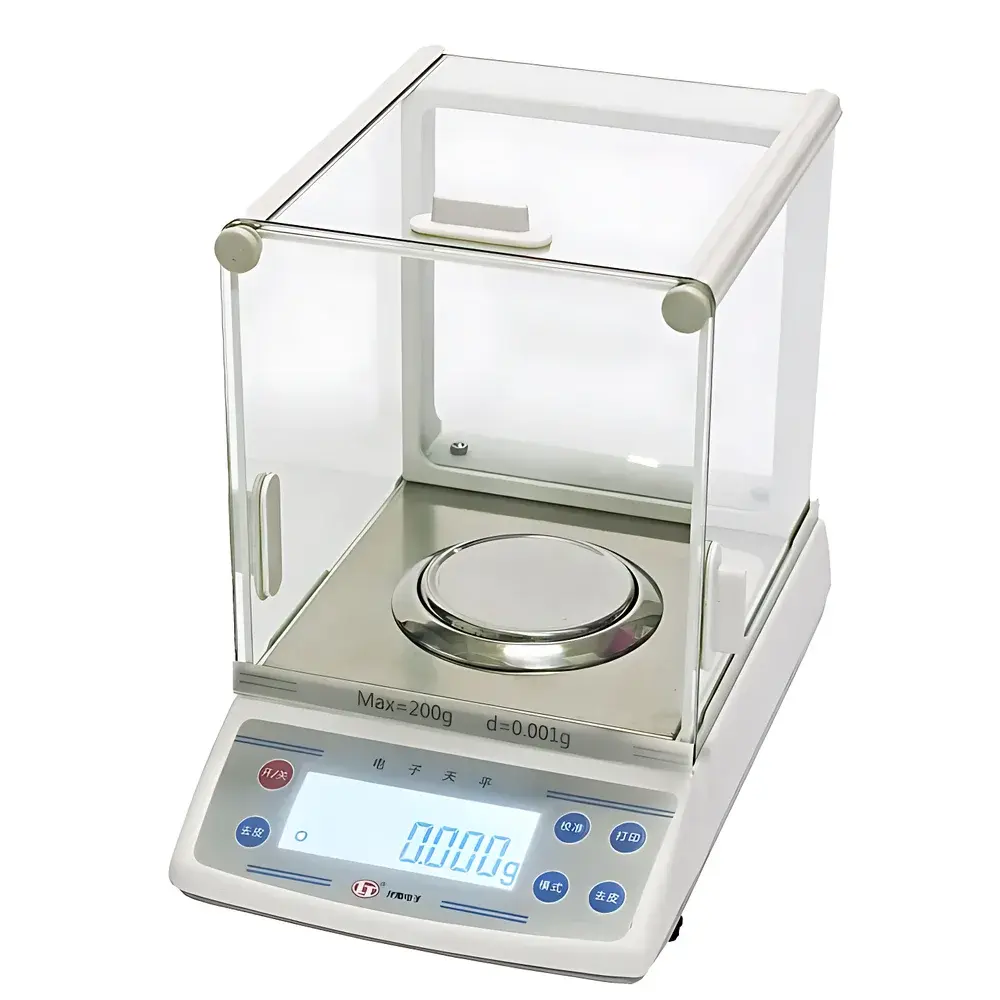
Longteng JD-3/4 Series Precision Analytical Balances
| Brand | Longteng |
|---|---|
| Origin | Liaoning, China |
| Manufacturer Type | Authorized Distributor |
| Product Category | Domestic |
| Model | JD-3/4 Series |
| Instrument Type | Analytical Balance |
| Maximum Capacity | 1000 g |
| Readability | 0.0001 g (JD-4) / 0.001 g (JD-3) |
| Repeatability | ≤ ±0.0001 g (JD-4) / ≤ ±0.001 g (JD-3) |
| Calibration | Automatic internal or external (with supplied stainless steel calibration weights) |
| Pan Diameter | Φ90 mm |
| Interface | RS232 serial output |
| Compliance | Designed for GLP/GMP-compliant environments with audit-ready operation logs |
Overview
The Longteng JD-3/4 Series Precision Analytical Balances are engineered for high-reproducibility mass measurement in regulated laboratory environments. These balances operate on electromagnetic force compensation (EMFC) principle—where sample weight is counterbalanced by a precisely controlled magnetic field—and deliver stable, drift-compensated readings across ambient temperature fluctuations. With readability options of 0.0001 g (JD-4 sub-series) and 0.001 g (JD-3 sub-series), the series supports routine analytical weighing, formulation, quality control, and method validation workflows requiring traceable accuracy. The lower-mounted EMFC sensor architecture minimizes mechanical hysteresis and enhances long-term stability, while the integrated thermal drift compensation algorithm continuously adjusts for environmental thermal gradients—ensuring consistent performance without manual recalibration during extended shifts.
Key Features
- Electromagnetic force compensation (EMFC) sensor with downward mounting configuration for improved linearity and reduced mechanical noise
- Thermal drift compensation and automatic zero-tracking algorithms for enhanced stability under variable lab conditions
- Triple-door, fully transparent draft shield with optimized airflow dynamics—reducing turbulence-induced weighing errors and enabling rapid stabilization (typically <3 seconds for full-scale settling)
- Stainless steel weighing pan (Φ90 mm) compatible with volumetric flasks, crucibles, and multi-well plates; corrosion-resistant surface meets ISO 8549-1 surface finish requirements
- Backlit LCD display with adjustable contrast and auto-brightness sensing—optimized for both low-light and high-glare environments per IEC 61000-4-5 immunity standards
- RS232 serial interface compliant with EIA/TIA-232-F specifications, supporting direct connection to LIMS, label printers, and data acquisition systems
- Multi-function weighing modes: counting, percentage weighing, animal/dynamic weighing, density determination (with optional density kit), and below-balance weighing (via optional hook assembly)
Sample Compatibility & Compliance
The JD-3/4 Series accommodates samples ranging from fine powders (e.g., API batches) to bulk containers (up to 1000 g capacity), with minimal interference from electrostatic charge due to grounded metal housing and conductive pan coating. All models meet essential metrological requirements outlined in OIML R76-1 (2021) for Class II analytical balances and support traceability to national standards via built-in calibration protocols. Internal calibration (JD-4A models) incorporates motorized, in-situ reference mass deployment meeting ASTM E898-22 criteria for automated verification frequency. External calibration (JD-3/JD-4) utilizes certified stainless steel weights traceable to NIST SRM 31a or equivalent national metrology institutes. The balance firmware records all calibration events—including date, time, operator ID (if networked), and deviation values—for full audit trail compliance under FDA 21 CFR Part 11 and EU Annex 11.
Software & Data Management
Data export follows ASCII-based RS232 framing protocol with user-selectable delimiters (tab, comma, semicolon) and configurable transmission triggers (stable reading, key press, timer interval). Optional PC software enables real-time streaming, statistical analysis (mean, SD, CV%), and report generation in PDF/CSV formats aligned with ISO/IEC 17025 documentation templates. Audit trail functionality logs all critical operations—including unit changes, tare actions, calibration sequences, and error events—with immutable timestamps. Firmware supports password-protected access levels (operator, supervisor, administrator) to enforce role-based data integrity controls required under GLP and GMP frameworks.
Applications
These balances serve as primary mass measurement tools in pharmaceutical QC labs (USP <41>, EP 2.1.1), academic research facilities conducting stoichiometric synthesis, environmental testing labs performing gravimetric particulate analysis (EPA Method 201A), and food safety laboratories executing moisture content determination per AOAC 950.46. Their robustness against electromagnetic interference (tested to IEC 61326-1:2022 Class A limits) makes them suitable for shared instrumentation rooms adjacent to centrifuges, HPLC systems, or RF-emitting equipment. The density measurement mode—when paired with the optional buoyancy-corrected density kit—supports solid/liquid density profiling per ISO 1183-1 and ASTM D792.
FAQ
What calibration standards are supported for traceability?
All models accept external calibration using Class M1 or better stainless steel weights traceable to NIST, PTB, or NIM. JD-4A models include an internal motorized calibration mass certified to ±0.00005 g uncertainty.
Is the RS232 interface compatible with modern LIMS platforms?
Yes—the interface outputs ASCII-formatted data packets with user-defined prefixes/suffixes and supports handshake protocols (XON/XOFF or hardware RTS/CTS) for reliable integration with Thermo Fisher SampleManager, LabVantage, and LabWare LIMS.
How does the temperature compensation algorithm function?
An embedded thermistor array monitors internal sensor housing temperature at three spatial points; the firmware applies a dynamic correction coefficient derived from factory-characterized thermal response curves stored in non-volatile memory.
Can the balance be validated under GxP requirements?
Yes—built-in diagnostics, calibration history logging, electronic signature support (via optional USB keyboard), and configurable audit trail depth satisfy IQ/OQ/PQ documentation needs per WHO TRS 992 Annex 4 and FDA Guidance for Industry: Process Validation.
What is the expected service life of the EMFC sensor under continuous operation?
Based on accelerated life testing per IEC 60068-2-64, the sensor exhibits >100,000 hours MTBF when operated within specified environmental ranges (15–30 °C, ≤70% RH non-condensing).