
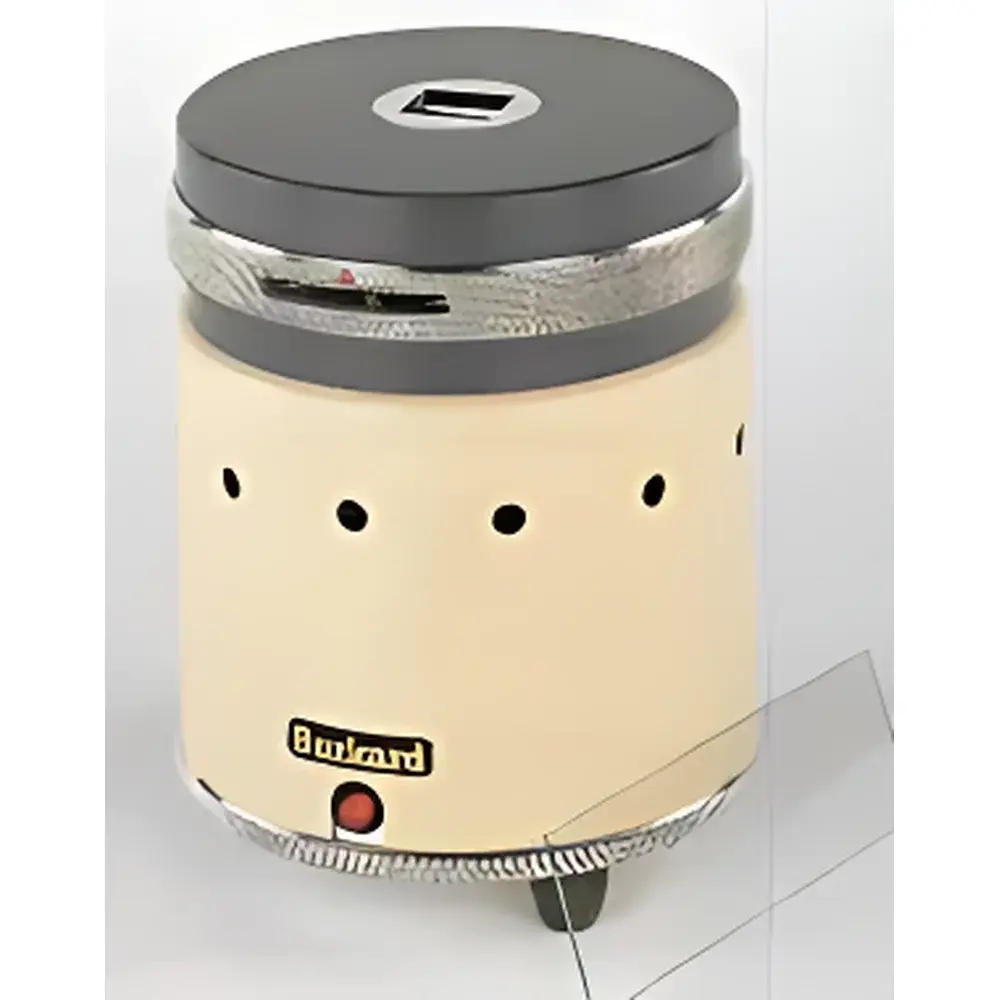
Burkard Mini Volume Air Sampler
| Origin | UK |
|---|---|
| Manufacturer Type | Distributor |
| Origin Category | Imported |
| Model | Burkard (UK) |
| Pricing | Upon Request |
| Weight | 640 g |
| Dimensions (H × D) | 115 mm × 88 mm |
| Flow Rate | 10 L/min |
| Power | Rechargeable NiCd battery (700 mAh), external DC charging port |
| Operating Modes | Continuous or timed (1–9 min, plus “0” for continuous) |
| Slide Format | Standard 76 × 26 mm microscope slides |
| Sampling Surface | Vertical impaction plate |
| Indicator | Red LED (pulsing during operation), audible buzzer (end-of-cycle alert & low-battery warning) |
| Motor | Precision DC motor with precious-metal brushes |
| Construction | Anodized aluminum housing and high-impact polymer components |
| Compliance | Designed for ISO 14644-1/ISO 14698-1 compatible environmental monitoring workflows |
Overview
The Burkard Mini Volume Air Sampler is a compact, battery-powered volumetric air sampling instrument engineered for rapid, on-site collection of airborne particulates—particularly viable and non-viable microorganisms—onto standard microscope slides via inertial impaction. Unlike filtration-based systems, this sampler employs a calibrated 10 L/min laminar airflow directed perpendicularly onto a vertically mounted glass slide, enabling direct deposition of particles ≥0.65 µm aerodynamic diameter with high spatial fidelity. Its lightweight (640 g), handheld form factor and absence of external power requirements make it ideal for short-duration indoor air quality assessments, cleanroom environmental monitoring, occupational hygiene surveys in remote or hazardous locations, and field-based bioaerosol screening where mains electricity is unavailable or impractical.
Key Features
- Ultra-portable design: 115 mm height × 88 mm diameter; net weight of 640 g ensures ease of transport and single-hand operation.
- Vertical impaction geometry: Eliminates gravitational settling bias and enables reproducible particle deposition directly onto standard 76 × 26 mm glass slides without adhesive coatings or post-sampling processing.
- Dual-power architecture: Integrated 700 mAh NiCd battery supports full-rated flow for up to 90 minutes continuously; external DC charging via side-mounted port maintains motor speed stability across discharge cycles.
- Precision DC motor with precious-metal brushes: Delivers consistent rotational velocity and extended service life under variable load conditions, critical for maintaining ISO-compliant flow accuracy.
- Intuitive user interface: Front-panel red LED pulses during active sampling; end-of-cycle buzzer (4-second interval) signals completion; continuous tone + steady LED indicates critically low voltage requiring immediate shutdown.
- Rapid slide exchange mechanism: Knurled ring rotates to “OPEN” position aligned with red index mark—enabling slide replacement in <5 seconds without tools or calibration recalibration.
- Robust mechanical construction: Anodized aluminum body and reinforced polymer components resist corrosion, mechanical shock, and thermal drift across ambient operating ranges (10–35 °C).
Sample Compatibility & Compliance
The Burkard Mini Volume Air Sampler is validated for use with untreated or pre-coated standard microscope slides (76 × 26 mm), supporting subsequent Gram staining, culture-based enumeration (e.g., on malt extract agar or tryptic soy agar), or direct epifluorescence microscopy (e.g., with DAPI or acridine orange). Its impaction-based collection principle aligns with the physical sampling principles referenced in ISO 14698-1 (Biocontamination control — Part 1: General principles and methods) and supports data generation compliant with EU GMP Annex 1 (2022) environmental monitoring expectations. While not a certified Class II biological safety device, its sealed airflow path and lack of recirculation minimize cross-contamination risk during sequential sampling. No regulatory certification (e.g., FDA 510(k), CE IVD) applies, as it functions as a passive sampling tool—not an in vitro diagnostic system.
Software & Data Management
This instrument operates as a standalone hardware platform with no embedded firmware, cloud connectivity, or proprietary software dependency. All operational parameters—including sampling duration (1–9 min selectable via rotary dial; “0” = continuous), real-time status indication (LED/buzzer), and battery health feedback—are managed through analog electronic circuitry. This design eliminates cybersecurity vulnerabilities, ensures long-term functional obsolescence resistance, and simplifies audit readiness in GLP/GMP environments where traceability of manual intervention is required. Users maintain full control over metadata documentation (e.g., location, time, operator ID, slide ID) via laboratory notebooks or LIMS-integrated manual entry—consistent with 21 CFR Part 11 principles when paired with appropriate procedural controls.
Applications
- Short-term indoor air quality investigations in offices, hospitals, schools, and pharmaceutical manufacturing suites.
- Baseline bioaerosol mapping prior to cleanroom qualification (ISO 14644-1 Class 5–8 environments).
- Occupational exposure assessment in industrial settings with intermittent or inaccessible power infrastructure.
- Educational microbiology labs requiring hands-on aerosol sampling training with minimal setup complexity.
- Emergency response scenarios involving suspected airborne pathogen release, where rapid deployment and visual confirmation of sampling activity are essential.
- Validation of HVAC filtration efficiency through comparative upstream/downstream sampling campaigns.
FAQ
What slide types are compatible with the Burkard Mini Volume Air Sampler?
Standard 76 × 26 mm plain glass microscope slides—either uncoated or pre-treated with adhesive (e.g., silicone grease) or nutrient media—are fully supported. Slides must be manually loaded and centered on the impaction surface.
Can the sampler operate continuously beyond 9 minutes?
Yes—setting the timer dial to “0” engages continuous mode until manually powered off or battery depletion occurs.
Is calibration required before each use?
No routine recalibration is needed; however, annual verification of flow rate using a primary standard (e.g., calibrated rotameter or mass flow meter) is recommended per ISO/IEC 17025 guidelines.
Does the instrument meet any international standards for air sampling?
It implements impaction physics consistent with ISO 14698-1 Annex B and supports data collection frameworks aligned with EU GMP Annex 1 Section 8.2 for environmental monitoring.
How is battery health monitored during operation?
A pulsing red LED confirms normal operation; intermittent 4-second beeps signal end-of-cycle; continuous beep + solid LED indicates imminent shutdown due to undervoltage—requiring external recharge before next use.
Related Products



