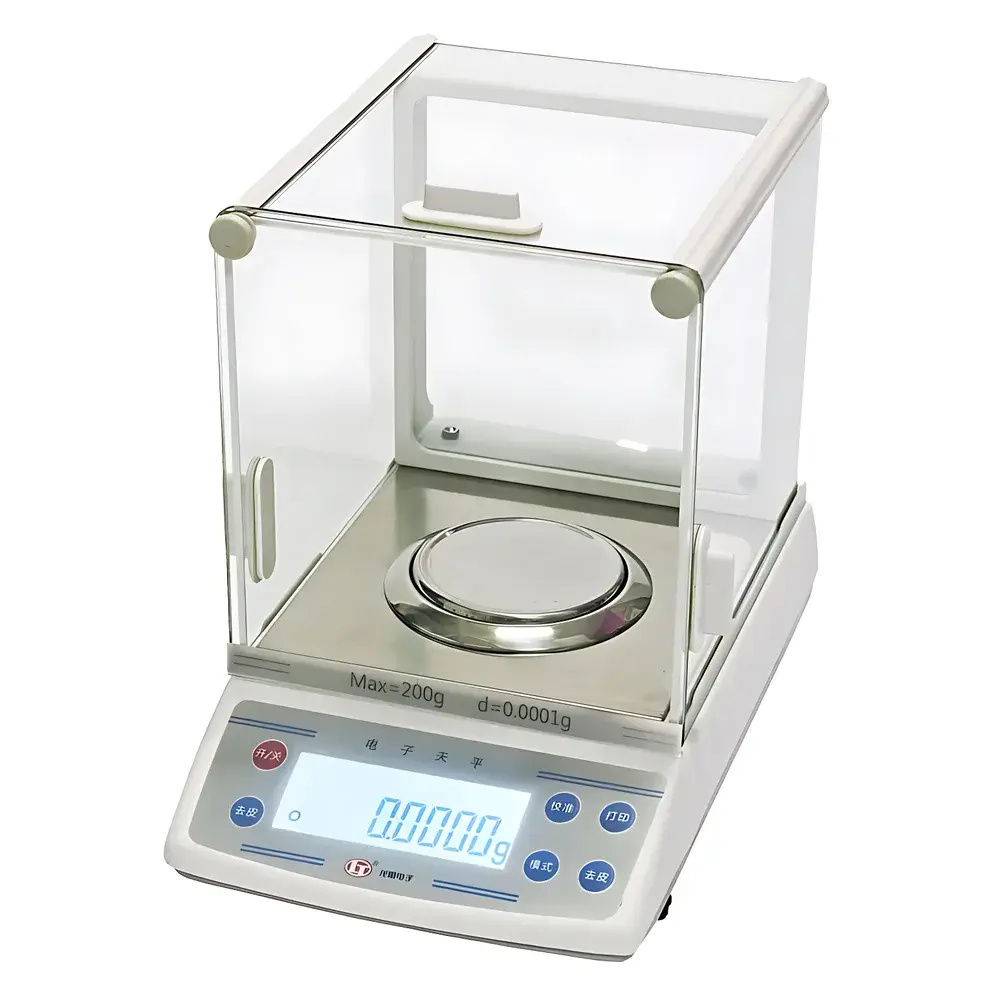
Longteng JD100-4 Precision Analytical Balance
| Brand | Longteng |
|---|---|
| Origin | Liaoning, China |
| Manufacturer Type | Authorized Distributor |
| Product Category | Domestic |
| Model | JD100-4 |
| Instrument Type | Analytical Balance |
| Maximum Capacity | 100 g |
| Readability | 0.1 mg |
| Repeatability | ±0.1 mg |
| Calibration Method | Automatic External Calibration |
| Pan Diameter | Φ90 mm |
| Interface | RS232 |
| Compliance | ISO/IEC 17025-compatible operation environment, GLP/GMP-ready data logging |
Overview
The Longteng JD100-4 Precision Analytical Balance is a high-performance laboratory instrument engineered for precision mass measurement in regulated and research-intensive environments. Utilizing a bottom-mounted electromagnetic force compensation sensor architecture, the balance achieves stable, drift-resistant operation with minimal thermal influence—critical for applications requiring consistent 0.1 mg readability across extended measurement cycles. Its design conforms to fundamental metrological principles defined in OIML R76 and ISO 9001-aligned quality frameworks, supporting traceable calibration through external standard weights (Class E2 or better). The device operates within ambient temperature ranges of 10–30 °C with ≤80% RH non-condensing, and incorporates real-time temperature compensation to mitigate thermal expansion effects on sensor response and internal reference stability.
Key Features
- Electromagnetic force compensation sensor with optimized mechanical layout for reduced air current sensitivity and enhanced long-term stability.
- Triple-door, fully transparent draft shield with ergonomic access and minimized internal turbulence—designed to meet ISO 17025 environmental control recommendations for analytical weighing.
- Stainless steel weighing pan (Φ90 mm) accommodating standard volumetric flasks, crucibles, and sample containers up to 110 mm height without interference.
- Backlit LCD display with adjustable contrast and auto-brightness adaptation—ensuring legibility under variable lighting conditions while reducing operator eye fatigue during prolonged use.
- Automatic external calibration routine triggered manually or scheduled via front-panel interface; supports verification using certified weights traceable to NIST or BIPM standards.
- Integrated overload/underload detection with audible and visual alerts, preventing sensor damage and ensuring operational integrity during routine handling errors.
Sample Compatibility & Compliance
The JD100-4 accommodates solid, granular, and powdered samples within its 100 g capacity envelope. Its open-bottom draft shield design permits compatibility with tall vessels and suspended accessories—including optional density kits (requiring hydrostatic weighing module) and below-pan weighing hooks (for magnetic or volatile sample configurations). All firmware operations comply with basic data integrity requirements for GLP and GMP environments: each weight record includes timestamp, operator ID (manual entry), balance ID, and calibration status flag. While the unit does not natively support 21 CFR Part 11 electronic signatures, audit-trail-capable data export via RS232 enables integration with validated LIMS or ELN platforms where raw ASCII output is accepted as primary data.
Software & Data Management
Data output is standardized via RS232 serial protocol at 9600 baud, 8N1 configuration, compatible with Windows-based terminal emulators (e.g., Tera Term), laboratory information systems, and legacy label printers. Output format follows METTLER TOLEDO-compatible ASCII structure: “S”, enabling direct parsing without proprietary drivers. Optional PC software (sold separately) provides batch logging, statistical analysis (mean, SD, CV%), and PDF report generation—including calibration history and deviation logs. All stored parameters are retained after power cycling; no volatile memory dependency.
Applications
This balance serves core functions across pharmaceutical QC labs (USP repeatability testing), academic chemistry departments (stoichiometric reagent preparation), materials science facilities (powder density characterization), and food safety testing units (moisture content determination per AOAC 950.46). Its 0.1 mg resolution supports gravimetric preparation of reference standards compliant with ISO Guide 35, while the repeatability specification (±0.1 mg) meets minimum performance thresholds outlined in EURACHEM/CITAC Guide CG4 for analytical uncertainty estimation. Routine use cases include quantitative transfer, loss-on-drying assays, formulation blending verification, and titrant standardization.
FAQ
What calibration standards are recommended for daily verification?
Class E2 stainless steel weights (certified to ISO 9001 or ISO/IEC 17025) with nominal values covering 10%, 50%, and 100% of full scale (i.e., 10 g, 50 g, 100 g) are advised for intermediate checks between formal calibrations.
Is the balance suitable for humidity-controlled glovebox integration?
Yes—the unit operates without internal fans or active cooling; however, static pressure differentials must be mitigated via equalization ports if installed inside sealed enclosures.
Does it support internal calibration with built-in weights?
No—the JD100-4 performs only external calibration; no motorized or heated internal mass mechanism is present.
Can density determination be performed without additional hardware?
No—density measurement requires optional accessories: immersion kit, sinker, thermometer input module, and dedicated software license.
What is the warm-up time required before first-use calibration?
Minimum 30 minutes at stable ambient temperature (±1 °C/hour variation) is required to achieve thermal equilibrium of the sensor and electronics subsystems.