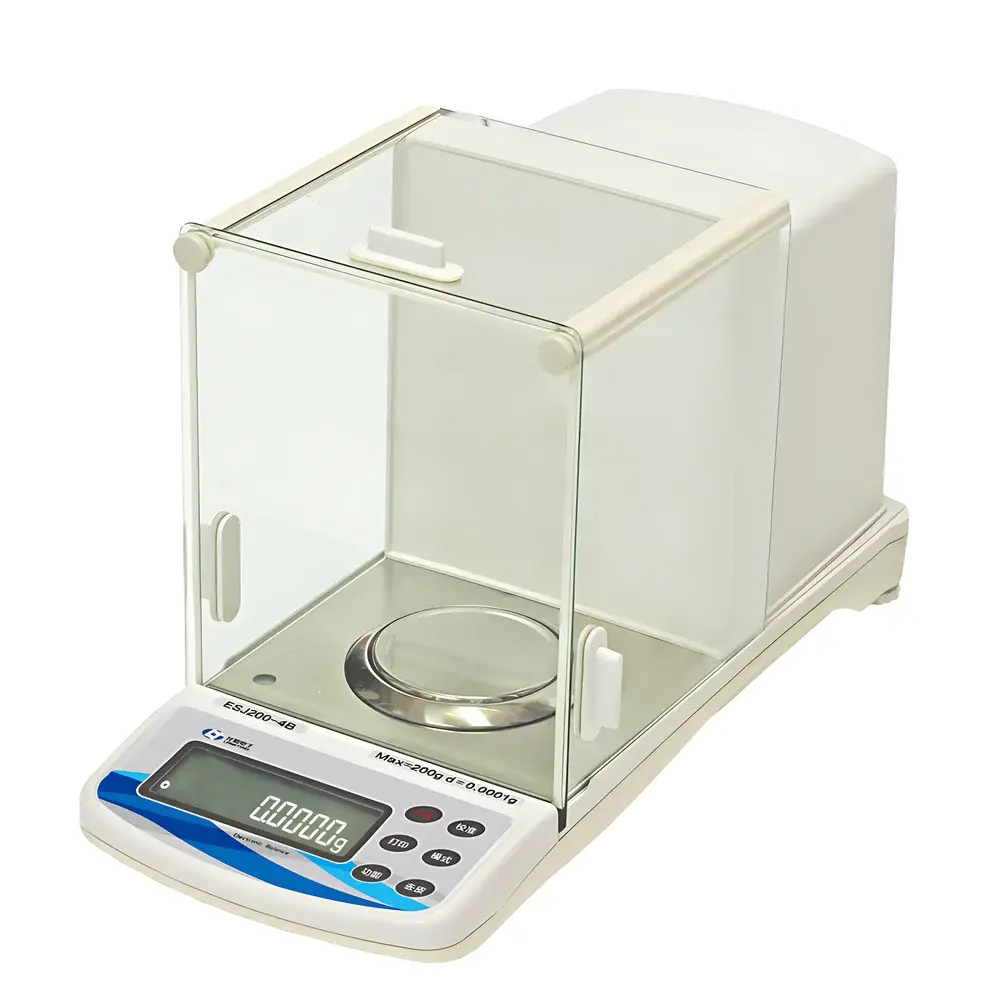
Longteng ESJ200-4B Precision Analytical Balance
| Brand | Longteng |
|---|---|
| Origin | Liaoning, China |
| Manufacturer Type | Authorized Distributor |
| Product Category | Domestic |
| Model | ESJ200-4B |
| Instrument Type | Analytical Balance |
| Maximum Capacity | 200 g |
| Readability | 0.1 mg |
| Calibration Method | External Manual Calibration |
| Repeatability | ≤ ±0.1 mg |
| Pan Diameter | Φ90 mm |
| Dimensions (W×D×H) | 460 × 205 × 280 mm |
| Net Weight | 9.1 kg |
| Interface | RS232 |
| Display | Backlit LCD |
| Optional Accessories | Density Kit, Below-Balance Weighing Hook |
Overview
The Longteng ESJ200-4B Precision Analytical Balance is an entry-level laboratory-grade analytical balance engineered for routine quantitative mass measurement in quality control laboratories, academic research settings, and pharmaceutical production environments where traceable accuracy at the 0.1 mg readability level is required. It operates on the principle of electromagnetic force compensation (EMFC), wherein the downward gravitational force exerted by a sample is counterbalanced by a precisely regulated electromagnetic current; the resulting current magnitude is linearly proportional to mass and digitally converted into a stable, high-resolution reading. Designed with a rear-mounted EMFC sensor architecture, the ESJ200-4B achieves improved thermal stability and mechanical isolation from front-panel disturbances—critical for minimizing drift during extended weighing sessions. Its triple-door draft shield provides full environmental isolation while maintaining ergonomic access, and the Φ90 mm stainless-steel weighing pan accommodates standard volumetric flasks, crucibles, and multi-vial sample carriers without compromising stability.
Key Features
- Rear-mounted high-stability electromagnetic force compensation (EMFC) sensor for enhanced long-term repeatability and reduced thermal drift
- Triple-door acrylic draft shield with optimized airflow geometry to minimize convection-induced errors
- Φ90 mm corrosion-resistant stainless-steel weighing pan—compatible with common laboratory containers and compatible with optional density determination kits
- Backlit LCD display with adjustable brightness for consistent readability under variable ambient lighting conditions (e.g., fume hood or low-light cleanroom environments)
- External calibration capability using certified Class M1 stainless-steel weights (not included), supporting traceable verification per ISO/IEC 17025 requirements
- RS232 serial interface compliant with standard laboratory data acquisition protocols—enables direct connection to PCs, label printers, or LIMS systems
- Integrated overload/underload protection with audible and visual alerts to prevent sensor damage and ensure operational integrity
- Full-range tare function, cumulative weighing, percentage weighing, piece counting, and unit conversion (g, ct, oz, dwt, grain, etc.)
Sample Compatibility & Compliance
The ESJ200-4B supports a broad range of solid and powdered samples within its 200 g capacity and 0.1 mg resolution envelope. Its open pan design and vertical clearance accommodate tall glassware (e.g., 100 mL volumetric flasks) and allows integration with optional below-balance weighing hooks for density measurements or magnetic susceptibility testing. While not certified for GMP-regulated manufacturing environments out-of-the-box, the balance meets fundamental metrological requirements aligned with ASTM E898–22 (Standard Guide for Selection and Use of Laboratory Balances) and supports basic GLP documentation workflows via timestamped RS232 output. Users performing regulatory submissions should implement external calibration logs, environmental monitoring (temperature/humidity), and periodic performance verification per internal SOPs referencing USP and ISO 9001:2015 clause 7.1.5.
Software & Data Management
Data export is handled exclusively through the built-in RS232 interface operating at 9600 baud, 8N1 configuration. No proprietary software is bundled; however, the device transmits ASCII-formatted weight strings (e.g., “+000.1234 g”) upon stabilization or trigger command, making it interoperable with generic terminal emulators (e.g., PuTTY), Excel-based macros, LabVIEW VIs, or enterprise LIMS platforms configured for serial ingestion. The absence of internal memory or audit trail functionality means all data integrity responsibilities—including user attribution, change control, and electronic signature compliance—rest with the host system. For FDA 21 CFR Part 11 compliance, third-party middleware solutions must be deployed to enforce role-based access, electronic signatures, and immutable audit logs.
Applications
- Quantitative preparation of reference standards and working solutions in QC labs
- Weighing of active pharmaceutical ingredients (APIs) during formulation development
- Gravimetric analysis including ash content, moisture loss on drying (LOD), and residue on ignition (ROI)
- Piece counting for small hardware components, tablets, or micro-pellets
- Percentage composition analysis in food science and polymer blending studies
- Density determination of solids when used with optional sinker kit and liquid medium
- Calibration verification of lower-tier balances using certified reference masses
FAQ
What calibration standards are recommended for the ESJ200-4B?
Certified Class M1 stainless-steel weights meeting OIML R111 specifications are recommended for external calibration. Annual recalibration by an ISO/IEC 17025-accredited provider is advised for regulated applications.
Does the balance support internal calibration or automatic adjustment?
No—the ESJ200-4B requires manual external calibration only; it does not feature motorized internal calibration weights or auto-adjustment algorithms.
Can this balance be integrated into a networked laboratory environment?
Yes, via RS232-to-Ethernet converters or USB-serial adapters—but native Ethernet or Wi-Fi connectivity is not supported.
Is the draft shield removable for cleaning or maintenance?
Yes, the three-panel acrylic shield is tool-free and designed for rapid disassembly and reinstallation without recalibration.
What environmental conditions are required for optimal performance?
Operate within 15–30 °C ambient temperature, ≤70% RH non-condensing, on a vibration-isolated bench away from air currents, HVAC vents, and electromagnetic sources.