
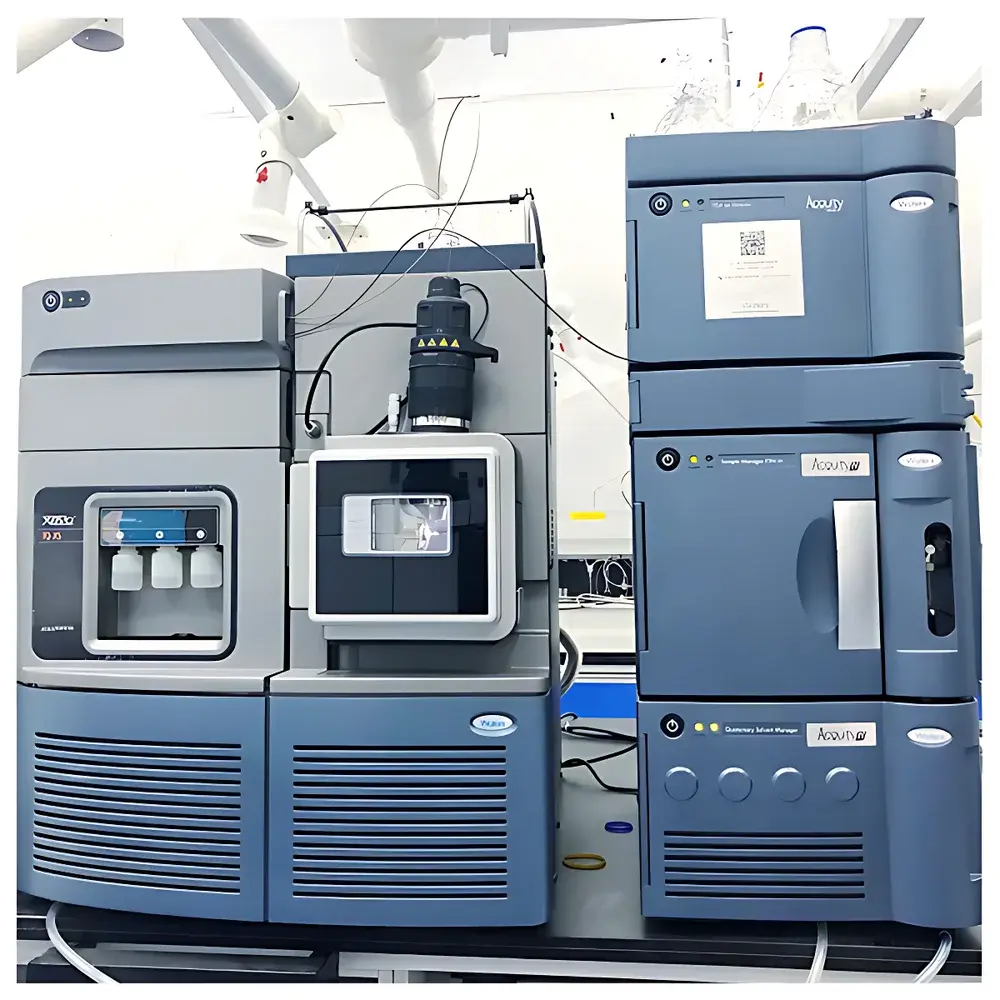
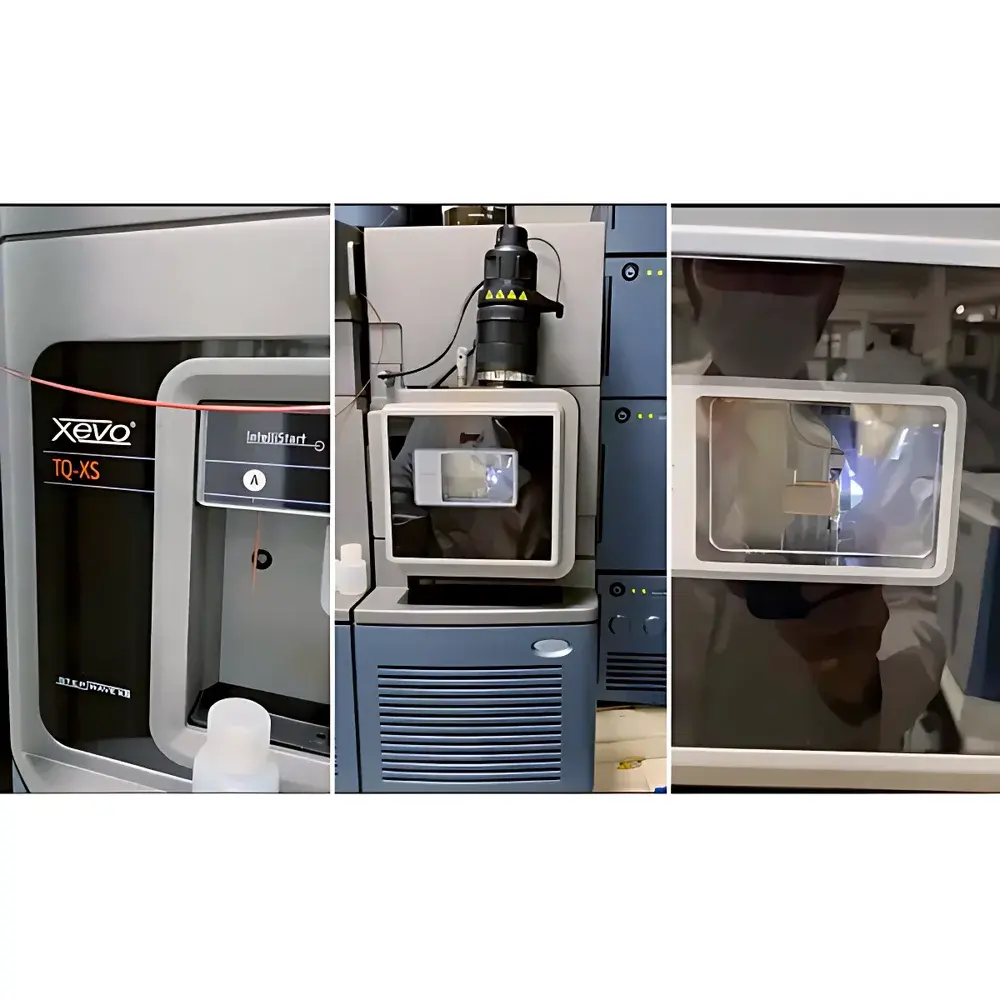
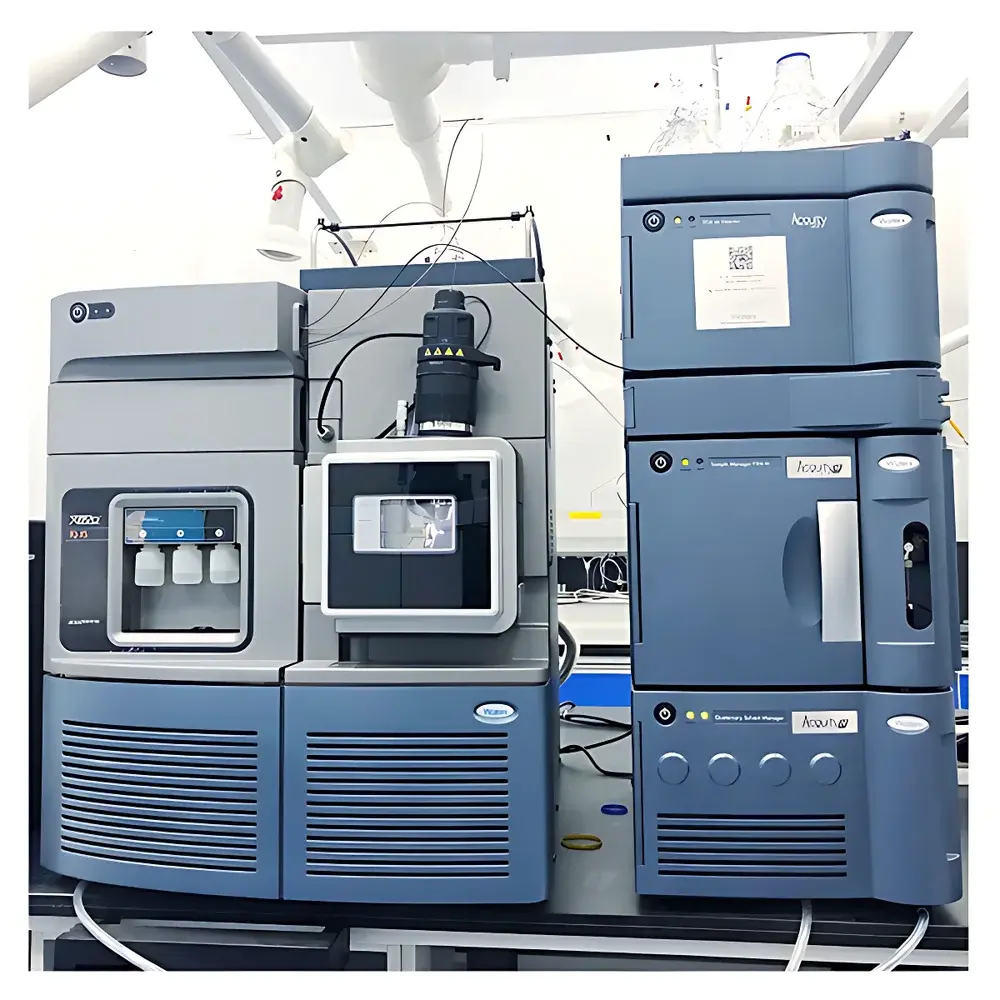
Waters Xevo TQ-XS Triple Quadrupole Mass Spectrometer
| Brand | Waters |
|---|---|
| Origin | USA |
| Manufacturer Type | Authorized Distributor |
| Origin Category | Imported |
| Model | TQ-XS |
| Instrument Type | Triple Quadrupole |
| Application Field | General-Purpose |
| Mass Range | 10–2,000 m/z |
| Sensitivity | <100 fg on-column for typical pharmaceutical compounds (e.g., verapamil) |
| Resolution | Full Width at Half Maximum (FWHM) ≤ 0.5 Da |
| Mass Accuracy | ≤ 0.1 Da (internal calibration) |
| Operating Pressure Range | Up to 1200 bar (LC front-end compatible) |
Overview
The Waters Xevo TQ-XS is a high-performance triple quadrupole liquid chromatography–tandem mass spectrometry (LC-MS/MS) system engineered for robust, reproducible quantitative analysis across diverse sample matrices and analyte classes. Built upon the proven architecture of the Xevo platform, the TQ-XS integrates advanced ion optics, intelligent source design, and scalable software to deliver exceptional sensitivity, wide dynamic range, and operational reliability in regulated and non-regulated laboratory environments. Its core measurement principle relies on electrospray ionization (ESI) or atmospheric pressure chemical ionization (APCI), followed by mass-selective fragmentation in Q2 (collision cell) and detection via tandem mass filtering in Q1/Q3 — enabling highly selective multiple reaction monitoring (MRM) with minimized chemical noise and enhanced signal-to-noise ratios.
Key Features
- StepWave XS Ion Transmission Technology: A patented off-axis ion path that reduces neutral species and gas-phase collisions during ion transfer, improving transmission efficiency and stability—especially for low-abundance, labile, or matrix-suppressed analytes.
- UniSpray™ Ion Source: A dual-mode, tool-free electrospray interface supporting both ESI and APCI mechanisms in a single probe configuration; enables broad compound coverage—including polar, non-polar, thermally labile, and high-molecular-weight species—without hardware swapping.
- Tool-Free Probe Design: All critical ion source components—including capillary, cone, and desolvation gas lines—are accessible and replaceable without tools, ensuring consistent alignment and inter-operator reproducibility across maintenance cycles.
- Xtended Dynamic Range (XDR™) Detector: Provides linear response over six orders of magnitude (10⁶), eliminating the need for sample dilution or multi-injection calibration when quantifying analytes spanning wide concentration ranges within a single run.
- High-Pressure LC Compatibility: Fully integrated with Waters ACQUITY UPLC systems operating up to 1200 bar, enabling superior chromatographic resolution and peak capacity for complex biological and environmental samples.
Sample Compatibility & Compliance
The Xevo TQ-XS supports quantitative analysis of small molecules (e.g., pharmaceuticals, metabolites, pesticides), peptides, and select intact proteins in biological fluids (plasma, serum, urine), tissue homogenates, food extracts, and environmental samples. Its design adheres to key regulatory expectations for analytical instrumentation used in GLP, GMP, and clinical research settings. The system supports 21 CFR Part 11-compliant audit trails, electronic signatures, and secure user access control through Waters Empower™ and TargetLynx XS™ software. Method validation workflows align with ICH M10, USP <1225>, and ISO/IEC 17025 requirements. Demonstrated performance includes RSD <3% across 2000 injections of protein-precipitated plasma for sulfadimethoxine—validating long-term robustness under high-throughput conditions.
Software & Data Management
- Instrument Control & Method Development: MassLynx™ NX provides intuitive method setup, real-time tuning, and automated optimization routines for MRM transitions, collision energies, and source parameters.
- Quantitative Data Processing: TargetLynx XS™ delivers automated peak integration, internal standard normalization, calibration curve fitting (linear/log-linear), and customizable QC flagging based on user-defined acceptance criteria (e.g., %RSD, %bias, retention time drift).
- Method Library & Reusability: QUANPEDIA™ is a searchable, metadata-tagged database of validated LC-MS/MS methods—accelerating method transfer, cross-laboratory harmonization, and compliance-ready documentation.
- Real-Time Quality Monitoring: Inlistart™ initiates pre-run QC checks (e.g., lock mass stability, background noise levels) and halts acquisition if thresholds are exceeded—preventing wasted runs and preserving instrument uptime.
- Trend Analysis & Reporting: TrendPlot™ generates interactive time-series visualizations of QC metrics (e.g., response ratio, retention time, peak width) across batches and instruments, facilitating proactive maintenance and root-cause investigation.
Applications
The Xevo TQ-XS serves as a primary platform for targeted quantitative analysis in pharmaceutical development (PK/PD studies, bioanalysis), clinical toxicology (therapeutic drug monitoring, forensic screening), food safety (residue testing, mycotoxin quantification), environmental monitoring (PFAS, endocrine disruptors), and biomarker verification. Its ability to maintain precision at sub-pg/mL concentrations—while sustaining >95% recovery in challenging matrices like whole blood or soil extracts—makes it suitable for applications requiring high confidence in low-level detection and regulatory submission readiness.
FAQ
What ionization modes does the Xevo TQ-XS support?
The system natively supports electrospray ionization (ESI) and atmospheric pressure chemical ionization (APCI) via the UniSpray™ source, with optional add-ons for APPI and nano-ESI configurations.
Is the TQ-XS compliant with FDA 21 CFR Part 11?
Yes—when operated with Waters Empower™ 3 or later and configured with appropriate security policies, audit trail logging, and electronic signature workflows.
Can the system quantify both small molecules and peptides in the same run?
Yes—optimized MRM transitions and dwell times can be programmed per analyte class; the XDR™ detector accommodates wide concentration disparities without saturation.
What is the typical mass accuracy specification under routine operation?
Internal calibration yields mass accuracy ≤0.1 Da across the 10–2000 m/z range; external calibration using tune mix achieves ≤0.02 Da for high-precision applications.
How does StepWave XS improve sensitivity for difficult matrices?
By decoupling ion transport from gas flow dynamics, StepWave XS reduces in-source fragmentation and neutral interference—particularly beneficial for phospholipids, salts, and surfactants commonly found in plasma and tissue extracts.






