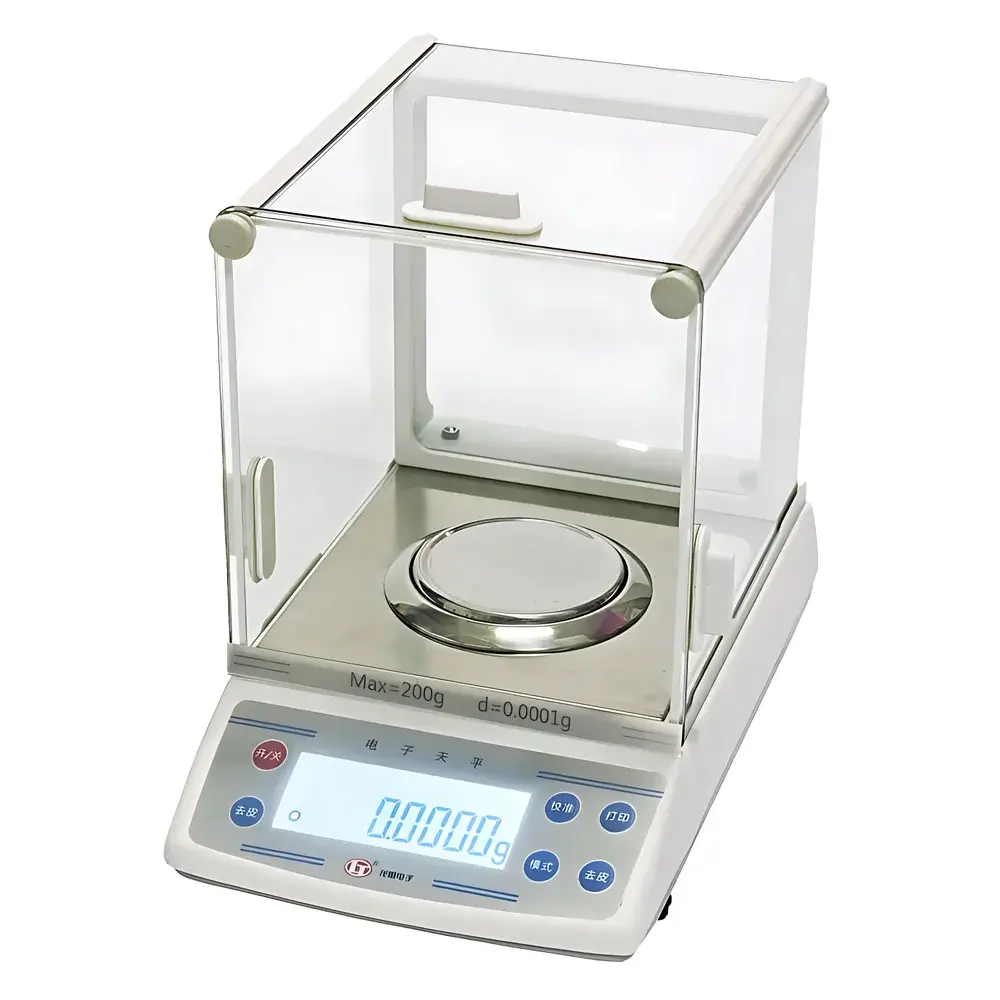
Longteng JD200-4 Precision Analytical Balance
| Brand | Longteng |
|---|---|
| Origin | Liaoning, China |
| Manufacturer Type | Authorized Distributor |
| Product Category | Domestic |
| Model | JD200-4 |
| Price Range | USD 1,150–1,430 |
| Instrument Type | Analytical Balance |
| Capacity | 200 g |
| Readability | 0.1 mg |
| Calibration | Automatic External Calibration |
| Repeatability | ≤ ±0.0001 g |
| Pan Diameter | Φ90 mm |
| Net Weight | 6.7 kg |
| Dimensions (W×D×H) | 335 × 205 × 293 mm |
| Display | Backlit LCD |
Overview
The Longteng JD200-4 Precision Analytical Balance is an entry-level high-resolution analytical instrument engineered for routine mass measurement tasks in quality control laboratories, academic teaching labs, and pharmaceutical R&D environments where trace-level accuracy and operational reliability are required. It operates on the principle of electromagnetic force compensation (EMFC), a widely accepted metrological method in modern analytical balances: when a sample is placed on the pan, the displacement of the load receptor is detected by a photometric sensor; a feedback current is then applied to restore equilibrium, and the magnitude of this current—proportional to gravitational force—is digitally converted into mass reading. With a readability of 0.1 mg (100 µg) and maximum capacity of 200 g, the JD200-4 meets the performance criteria for Class II analytical balances per OIML R 76-1 and ISO 9001-compliant weighing processes. Its design prioritizes mechanical stability and environmental resilience, incorporating temperature compensation algorithms and internal damping to minimize drift under ambient fluctuations typical in non-climate-controlled lab spaces.
Key Features
- Down-mounted electromagnetic force sensor architecture ensures low center-of-gravity stability and minimizes mechanical hysteresis.
- Triple-door, fully transparent draft shield with optimized airflow dynamics reduces convection-induced weighing errors without compromising accessibility.
- Stainless-steel weighing pan (Φ90 mm) supports larger containers and facilitates cleaning and corrosion resistance.
- Backlit LCD display with adjustable brightness enables clear readability across varying ambient light conditions—critical for prolonged operator use and GLP documentation workflows.
- Automatic external calibration function (via included stainless-steel calibration weights) complies with internal audit requirements for traceable verification intervals.
- Integrated overload/underload protection prevents sensor damage and extends service life under inadvertent misuse.
- Full-range tare, accumulation, subtraction, and percentage weighing modes support multi-step protocols common in formulation and assay preparation.
Sample Compatibility & Compliance
The JD200-4 accommodates solid, granular, and low-volatility liquid samples within standard laboratory containers (e.g., weighing boats, vials, crucibles). Its draft shield design conforms to ISO 17025:2017 clause 6.4.2 for environmental isolation during precision weighing. While not certified for USP or ASTM E898-22 compliance out-of-the-box, the balance satisfies prerequisite hardware conditions—such as repeatability ≤ ±0.0001 g and linearity error ≤ ±0.0002 g—for implementation in validated workflows when paired with documented calibration procedures and environmental monitoring logs. It supports GxP-relevant practices via configurable printout headers (date/time/tare ID) and RS232 output compatible with LIMS-integrated printers or data loggers.
Software & Data Management
The JD200-4 features native RS232 serial interface (no USB adapter required) for direct connection to PCs, label printers, or statistical process control (SPC) systems. ASCII-formatted output includes real-time weight, stable flag, unit identifier, and tare status—enabling automated data capture without proprietary drivers. Optional density determination functionality (with add-on density kit and dedicated software module) permits calculation of solid sample density using Archimedes’ principle, supporting material characterization per ASTM D792 or ISO 1183-1. All firmware operations retain full audit trail capability for user-initiated calibrations and configuration changes—aligning with basic FDA 21 CFR Part 11 readiness when deployed with timestamped external logging.
Applications
- Pharmaceutical QC: Active pharmaceutical ingredient (API) dispensing, reference standard weighing, and excipient batch release testing.
- Academic instruction: Stoichiometric calculations, gravimetric analysis, and calibration exercises in general chemistry and analytical chemistry curricula.
- Materials science: Powder mass normalization prior to XRD or SEM sample preparation.
- Food & beverage labs: Nutrient content verification, additive dosage validation, and moisture loss tracking in drying studies.
- Environmental testing: Filter paper mass differential for suspended solids (TSS) quantification per EPA Method 160.2.
FAQ
What calibration standards are recommended for daily verification?
A certified Class M2 stainless-steel weight (200 g nominal) is recommended for daily performance checks; calibration should be performed at least once per shift if used continuously.
Does the balance support internal calibration?
No—the JD200-4 uses automatic external calibration only, requiring manual placement of supplied weights for verification or adjustment.
Can the RS232 interface transmit stable-weight triggers to LabVIEW or custom Python scripts?
Yes—ASCII output includes “S” (stable) and “U” (unstable) flags in real time, enabling programmatic acquisition synchronization without polling delays.
Is the draft shield removable for cleaning or large-sample accommodation?
Yes—the triple-door acrylic shield is tool-free detachable and designed for rapid reinstallation with repeatable alignment.
What is the warm-up time required before first-use calibration?
Minimum 30 minutes at stable room temperature (20–25°C, <60% RH) is advised to achieve thermal equilibrium of the EMFC sensor assembly.