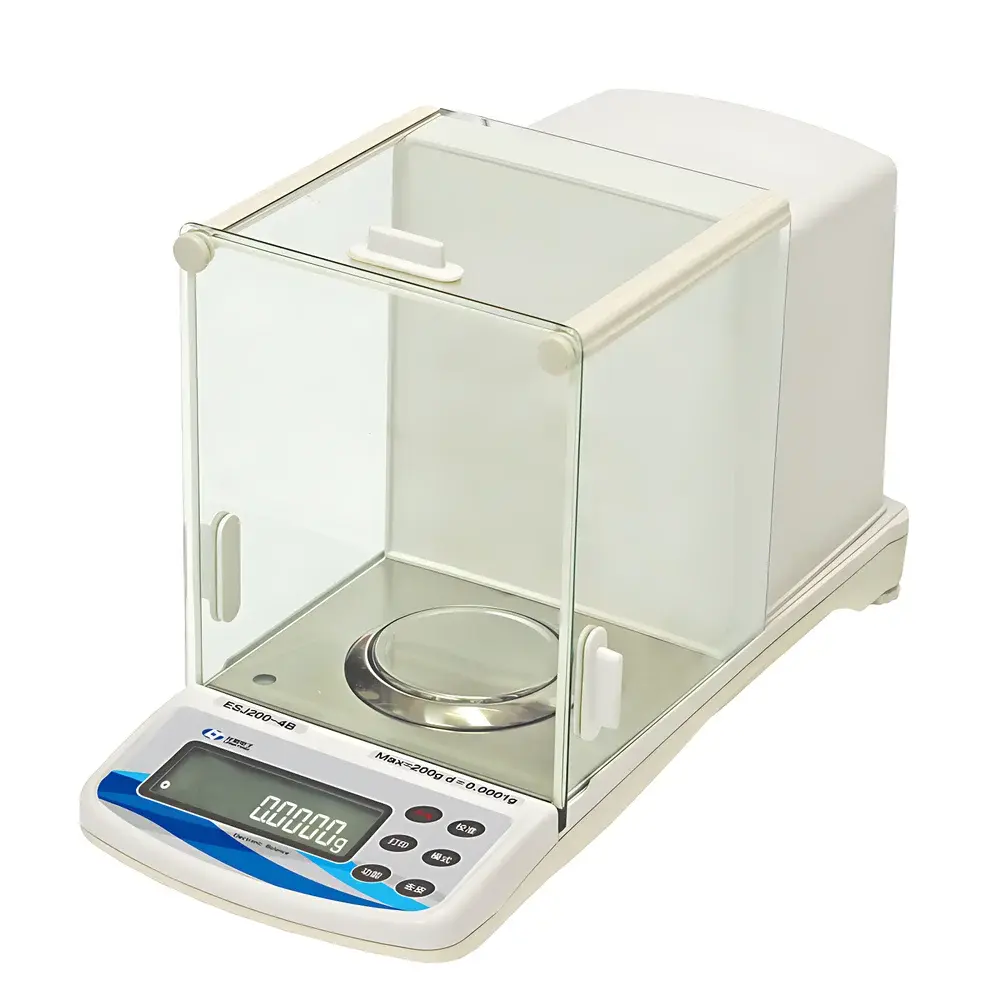
Longteng ESJ220-4B Precision Analytical Balance
| Brand | Longteng |
|---|---|
| Origin | Liaoning, China |
| Manufacturer Type | Authorized Distributor |
| Product Category | Domestic |
| Model | ESJ220-4B |
| Instrument Type | Analytical Balance |
| Maximum Capacity | 220 g |
| Readability | 0.1 mg |
| Repeatability | ±0.1 mg |
| Linearity Error | ±0.2 mg |
| Pan Diameter | Φ90 mm |
| Net Weight | 9.1 kg |
| Dimensions (W×D×H) | 460 × 205 × 280 mm |
| Calibration | External Automatic Calibration |
| Display | Backlit LCD |
| Interface | RS232 |
| Optional Accessories | Density Kit, Below-Balance Weighing Hook |
Overview
The Longteng ESJ220-4B Precision Analytical Balance is an ISO/IEC 17025-aligned laboratory-grade analytical balance engineered for high-reproducibility mass measurement in regulated and research environments. Operating on electromagnetic force compensation (EMFC) principle, it employs a rear-mounted high-stability electromagnetic sensor to deliver consistent, drift-resistant performance across ambient temperature fluctuations (10–30 °C). With a maximum capacity of 220 g and readability of 0.1 mg (100 µg), the instrument meets the metrological requirements for Class I analytical applications defined in OIML R76 and ASTM E898. Its design emphasizes mechanical robustness, thermal equilibrium stability, and minimal air current interference—achieved through a triple-door draft shield with optimized airflow geometry and a spacious Φ90 mm stainless-steel weighing pan compatible with volumetric flasks, crucibles, and multi-vial sample holders.
Key Features
- Rear-mounted electromagnetic force compensation sensor with integrated temperature compensation circuitry for enhanced long-term stability and reduced zero drift.
- Triple-door acrylic draft shield providing full lateral and frontal access while maintaining ISO 14644-1 Class 5 cleanroom-compatible airflow containment.
- Backlit monochrome LCD display with adjustable brightness control—ensures legibility under both low-illumination lab conditions and bright daylight without eye strain.
- External automatic calibration function using certified stainless-steel reference weights (included), compliant with internal audit protocols per GLP and ISO/IEC 17025 Clause 6.5.
- Full-range tare, auto-zero tracking, overload/underload detection, and real-time error diagnostics displayed via intuitive icon-based interface.
- RS232 serial interface supporting ASCII protocol for direct integration with LIMS, electronic lab notebooks (ELN), or label printers—enabling traceable data capture without manual transcription.
Sample Compatibility & Compliance
The ESJ220-4B accommodates diverse sample formats including powder aliquots in weighing boats, liquid-filled containers up to 100 mL, and solid reference standards mounted on magnetic bases. Its open-bottom design permits optional below-balance weighing (with accessory hook kit) for density determination of irregular solids per ASTM D792 or ISO 1183-1. All firmware operations adhere to metrological traceability requirements outlined in JCGM 100:2008 (GUM) and support audit-ready calibration logs. The balance conforms to CE marking directives (2014/30/EU EMC, 2014/35/EU LVD), RoHS 2011/65/EU, and is suitable for use in environments complying with USP , USP , and FDA 21 CFR Part 11 when paired with validated data acquisition software.
Software & Data Management
While the ESJ220-4B operates as a standalone instrument, its RS232 port enables seamless bidirectional communication with third-party software platforms—including LabWare LIMS, Thermo Fisher SampleManager, and open-source tools like QGIS-integrated weight logging scripts. Data output includes timestamped mass values, unit identifiers (g, ct, oz, %), net/gross/tare flags, and status codes (e.g., “CAL”, “OVER”, “STAB”). When configured with compliant terminal software, the system supports electronic signatures, audit trails, and user-access-level restrictions aligned with ALCOA+ principles (Attributable, Legible, Contemporaneous, Original, Accurate, Complete, Consistent, Enduring, Available).
Applications
- Quantitative preparation of standard solutions and calibration standards in pharmaceutical QC laboratories (e.g., assay of active pharmaceutical ingredients per USP ).
- Weighing of catalysts, nanomaterials, and microgram-scale reagents in materials science R&D where repeatability ≤ ±0.1 mg is critical.
- Gravimetric moisture analysis using pre- and post-drying mass differentials (ASTM D2231, ISO 1183-2).
- Counting applications for uniform parts (e.g., tablets, microbeads) with built-in piece-count mode and statistical averaging over ≥10 samples.
- Density determination of polymers and metals using the optional density kit with sinker assembly and temperature-compensated liquid bath.
FAQ
What calibration standards are required for routine verification?
Certified Class M2 or better stainless-steel weights (e.g., 100 g and 200 g) are recommended for daily verification; annual external calibration should be performed by an ISO/IEC 17025-accredited provider.
Is the balance compatible with Windows 11 and macOS Ventura+
Yes—when connected via USB-to-RS232 adapter, it functions as a virtual COM port device; no proprietary drivers are needed.
Can the balance store calibration history internally?
No—the ESJ220-4B does not feature non-volatile memory for calibration logs; all calibration events must be recorded externally via RS232 output or manual entry into lab notebooks.
Does the instrument support GLP-compliant audit trails?
Not natively—but when interfaced with validated LIMS or ELN systems that enforce user authentication and immutable timestamping, full GLP traceability is achievable.
What is the warm-up time required before first use?
Minimum 30 minutes at stable room temperature (20 ±2 °C) is required to achieve thermal equilibrium of the EMFC sensor and ensure optimal repeatability.