
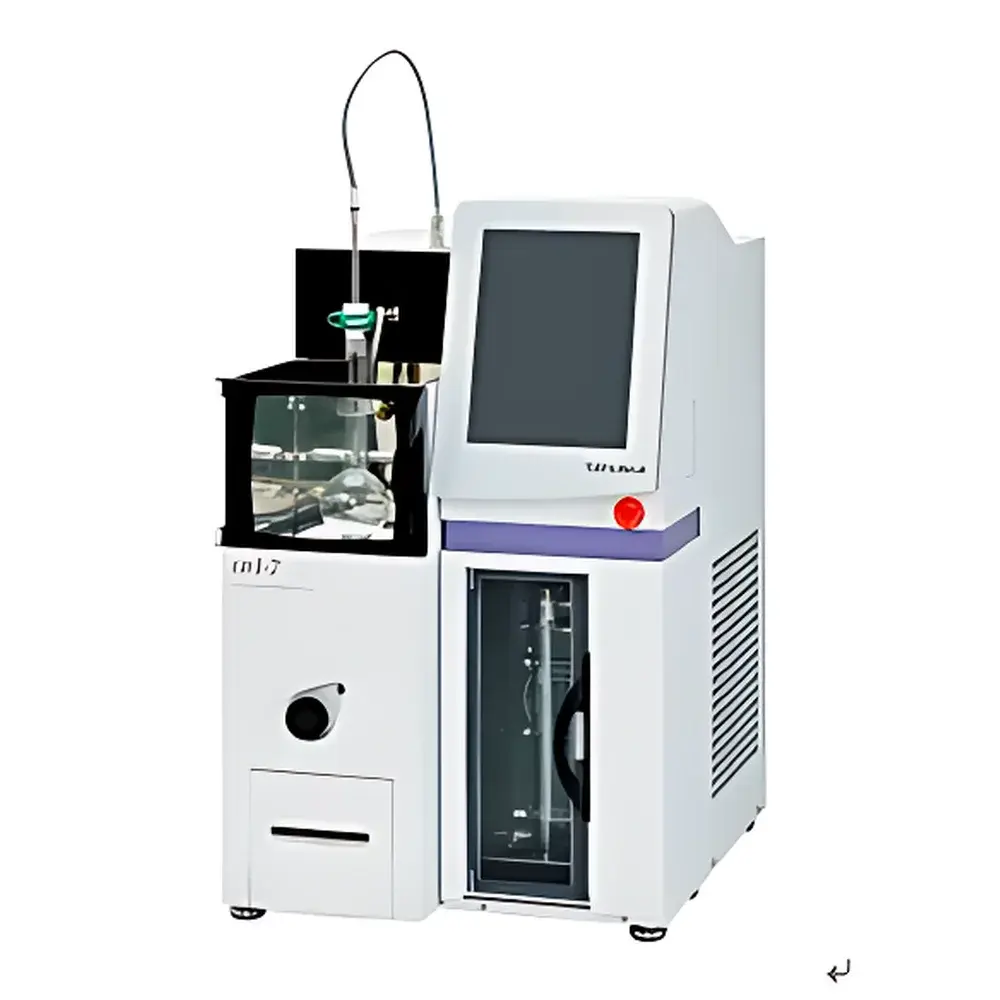
Tanaka AD-7 Automated Petroleum Distillation Apparatus
| [Brand | Tanaka |
|---|---|
| Origin | Japan |
| Model | AD-7 |
| Standards Compliance | ASTM D86, ASTM D850, ASTM D1078, GB/T 6536 |
| Temperature Range | 0–450 °C |
| Condenser Temp Control | 0–69.9 °C (Peltier-cooled) |
| Receiving Chamber Temp Control | 10–50 °C |
| Distillation Rate | 2–9 mL/min (PID-controlled, factory-set at 4.5 mL/min) |
| Initial Boiling Point (IBP) Detection | Infrared photoelectric sensor |
| Final Boiling Point (FBP)/Dry Point Detection | Dual-mode (manual visual + optional auto-sensor) |
| Display | 10.4″ color TFT touchscreen |
| Data Storage | 5,000 test records |
| Predefined Methods | 200 user-configurable protocols |
| Interface | RS-232C, Ethernet (TDAS/LIMS), USB |
| Safety Systems | Flame detection sensor, automatic power cutoff, integrated halon-free fire suppression, flask support stop mechanism, sensor fault monitoring, over-temperature interlock] |
Overview
The Tanaka AD-7 Automated Petroleum Distillation Apparatus is a fully integrated, microprocessor-controlled system engineered for precise, repeatable distillation analysis of petroleum products in strict accordance with internationally recognized standard test methods—including ASTM D86 (Standard Test Method for Distillation of Petroleum Products at Atmospheric Pressure), ASTM D850 (for solvent distillation), ASTM D1078 (for volatility determination), and GB/T 6536 (Chinese national standard equivalent to ASTM D86). The instrument implements classical atmospheric batch distillation methodology: a defined sample volume is heated under controlled ramp-and-hold conditions while vapor temperature, distilled volume, and condensate collection are continuously monitored. Critical phase-change temperatures—including initial boiling point (IBP), 10%, 50%, 90% recovery points, and final boiling point (FBP)—are determined via high-stability PT100 platinum resistance thermometers and infrared optical detection of liquid level in the receiving cylinder. Unlike water-cooled systems, the AD-7 employs an embedded Peltier-based thermoelectric cooling module for both condenser tube and receiving chamber thermal regulation—eliminating external chillers, reducing footprint by >30%, and minimizing environmental impact through zero refrigerant use.
Key Features
- Integrated Peltier cooling system for condenser (0–69.9 °C) and receiving chamber (10–50 °C), enabling compact benchtop deployment without auxiliary cooling infrastructure.
- 10.4-inch full-color resistive touchscreen interface with intuitive graphical workflow navigation—supporting direct parameter selection, method recall, and real-time curve visualization.
- Dual infrared photodetectors for unambiguous IBP identification and precise volumetric endpoint detection (e.g., 5%, 10%, …, 95%, 97% recovery) with ±0.1 mL resolution.
- 24 V/600 W spiral heating element with forced-air cooling and closed-loop PID control, ensuring stable thermal ramp rates and reproducible vapor-phase temperature profiles.
- Comprehensive safety architecture: flame detection sensor triggers immediate power cutoff and non-toxic gaseous fire suppressant discharge; mechanical flask support limiter prevents neck fracture during thermal expansion; continuous sensor health monitoring with fault logging.
- Automated atmospheric pressure correction—either via built-in barometric sensor or manual entry—applied in real time to all temperature readings per ASTM D86 Annex A1 requirements.
Sample Compatibility & Compliance
The AD-7 is validated for Group 0–Group 4 hydrocarbon liquids per ASTM D86 classification, including gasoline, naphtha, kerosene, diesel fuel, light lubricating oils, and aromatic solvents (e.g., benzene, toluene, xylene blends). It supports both fuel-grade and solvent-grade distillation protocols with identical hardware configuration—no mechanical reconfiguration required. All critical measurements traceably comply with ISO/IEC 17025 calibration requirements when operated within specified environmental conditions (23 ± 2 °C, <70% RH). Instrument firmware and data handling routines are structured to support GLP and GMP environments: audit trails record operator ID, method version, timestamped parameter changes, and raw sensor outputs. Electronic records meet FDA 21 CFR Part 11 criteria when used with TDAS software configured with electronic signatures and role-based access control.
Software & Data Management
The AD-7 operates with Tanaka’s TDAS (Tanaka Distillation Analysis Software), a Windows-based application supporting remote instrument control, method development, automated report generation, and LIMS integration via ASTM E1384-compliant messaging. TDAS stores all raw time-series data (vapor temperature vs. recovered volume), intermediate calculations (e.g., % recovery, temperature differentials), and metadata (operator, ambient pressure, calibration status) in encrypted SQLite databases. Reports export to PDF, CSV, or XML formats—with configurable templates aligned to ASTM D86 reporting conventions (e.g., “Temperature at 90% Recovery”, “Loss Correction Method”, “Distillation Curve Plot”). Up to 5,000 complete test records—including annotated curves and deviation flags—are retained onboard; additional archival is supported via network share or USB mass storage. Firmware updates and method libraries are distributed as digitally signed packages to ensure integrity verification.
Applications
- Quality control laboratories verifying refinery output against specification limits (e.g., ASTM D439 for gasoline volatility, ASTM D975 for diesel distillation range).
- Research and development of alternative fuels—assessing volatility behavior of bio-blends, synthetic hydrocarbons, and oxygenated additives under standardized thermal stress.
- Regulatory compliance testing for transportation fuel certification (EPA Tier 3, EN 228, JIS K 2202) where distillation characteristics directly impact engine performance, emissions, and cold-start behavior.
- Solvent purity validation in pharmaceutical excipient manufacturing per USP and ICH Q5C guidelines—where narrow boiling ranges indicate absence of low- or high-boiling impurities.
- Educational laboratories teaching fundamental principles of fractional volatility, Raoult’s law deviations, and azeotrope formation using reproducible, instructor-auditable datasets.
FAQ
Does the AD-7 require external cooling water or chiller units?
No—the AD-7 uses an integrated Peltier thermoelectric cooling system for both condenser and receiver temperature control, eliminating dependency on tap water or recirculating chillers.
Can the instrument automatically detect dry point without operator intervention?
Yes—when equipped with the optional dry point sensor, the AD-7 identifies final boiling point via thermal gradient analysis and vapor-phase conductivity shift; manual visual confirmation remains available as a fallback mode.
How is atmospheric pressure correction applied during testing?
The system either reads ambient pressure from its internal barometer or accepts manual input; correction algorithms conform to ASTM D86 Annex A1 and are applied dynamically to all temperature measurements before reporting.
Is TDAS software validated for regulated environments (e.g., FDA, ISO 17025)?
TDAS supports 21 CFR Part 11 compliance when deployed with appropriate IT infrastructure (audit trail enablement, electronic signature modules, and secure user authentication); full validation documentation is provided upon request.
What maintenance intervals are recommended for long-term reliability?
Annual calibration of all PT100 sensors and infrared detectors is advised; Peltier module performance should be verified quarterly using NIST-traceable reference fluids; cleaning of condenser bore and receiver cylinder is required after every 50 tests.





