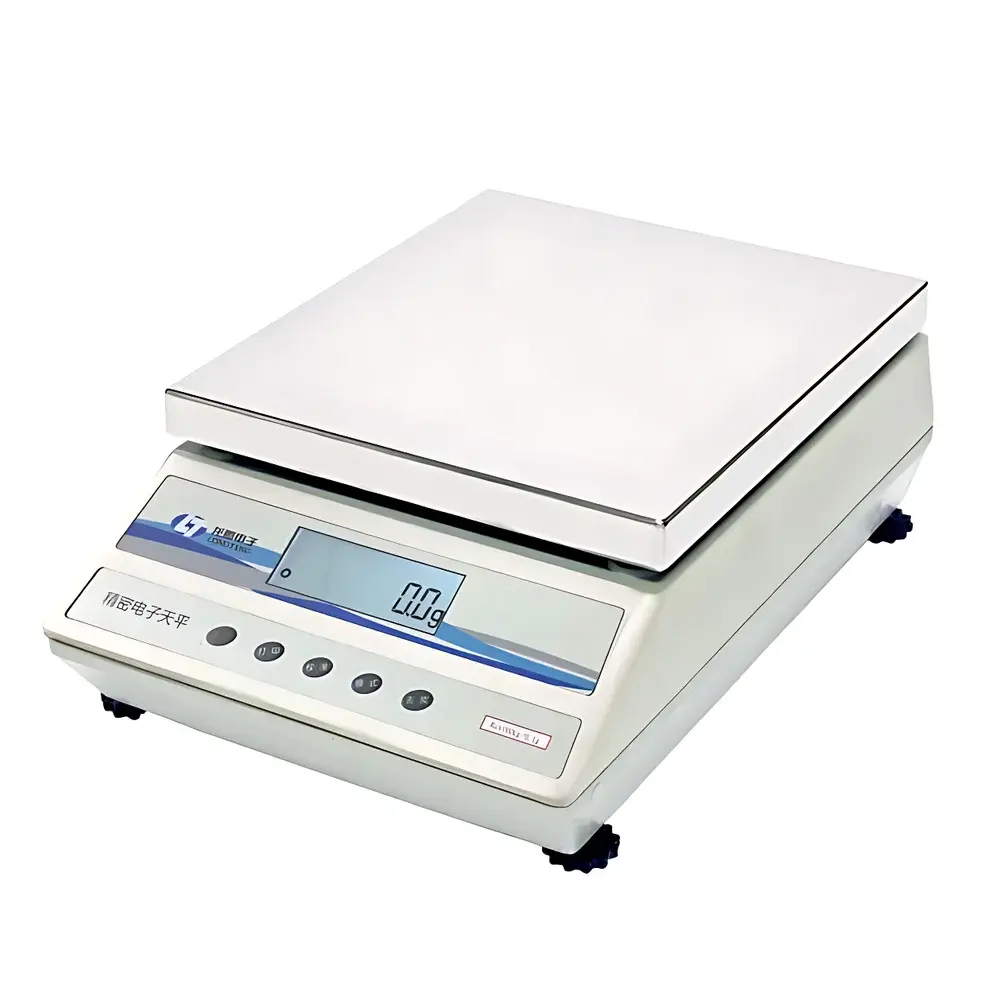
Longteng ESK Series High-Capacity Precision Electronic Balance
| Brand | Longteng |
|---|---|
| Origin | Liaoning, China |
| Model | ESK Series |
| Maximum Capacity | 60 kg |
| Readability | 0.01 g to 1 g (model-dependent) |
| Repeatability | ±0.02 g to ±1 g |
| Linearity Error | ±0.04 g to ±2 g |
| Pan Size | 340 × 300 mm |
| Display | Backlit LCD |
| Calibration | Internal/External Auto-Calibration |
| Interface | RS232 |
| Units | g, ct, oz, %, pcs, etc. |
| Functions | Counting, Percentage Weighing, Accumulation, Tare, Overload/Underload Alert, Temperature Compensation |
| Optional | Bottom Hook, Calibration Weights |
Overview
The Longteng ESK Series High-Capacity Precision Electronic Balance is engineered for demanding industrial and metrological applications requiring reliable mass measurement at elevated load ranges—up to 60 kg—with resolution down to 0.01 g. Utilizing electromagnetic force compensation (EMFC) sensor technology, the ESK platform delivers stable, drift-resistant performance under variable ambient conditions. Unlike strain-gauge-based platforms, EMFC architecture ensures high linearity, minimal hysteresis, and long-term stability—critical for calibration laboratories, foundry quality control, metallurgical material verification, and certified weight testing (e.g., cast iron standard weights per JJG 99-2006 or OIML R111). The balance operates within a temperature-compensated environment (10–30 °C), with automatic internal adjustment of zero point and sensitivity to maintain traceable accuracy across shifts and seasonal fluctuations.
Key Features
- Electromagnetic force compensation (EMFC) transducer system for high reproducibility and low drift over time.
- Stainless steel weighing pan (340 × 300 mm) optimized for large-volume or irregularly shaped samples—ideal for alloy ingots, machined components, and bulk raw materials.
- Backlit LCD display with adjustable contrast; readable under both low-light laboratory settings and high-ambient-brightness industrial floors.
- Auto-calibration capability with optional external reference weights (Class M1 or better); supports scheduled calibration routines compliant with ISO/IEC 17025 internal audit requirements.
- Real-time overload/underload detection with audible and visual alerts—prevents sensor damage and preserves measurement integrity.
- Multi-function operation including piece counting, percentage weighing, accumulation, tare, and net/gross switching—configured via intuitive front-panel navigation.
- RS232 serial interface enables direct integration with LIMS, ERP systems, or thermal label printers; ASCII-compatible output protocol supports GLP/GMP-compliant data logging when paired with validated software.
Sample Compatibility & Compliance
The ESK Series accommodates heterogeneous sample types—from dense ferrous alloys and refractory ceramics to packaged industrial components—without compromising repeatability. Its robust mechanical design includes shock-absorbing feet and anti-vibration damping to mitigate floor-transmitted noise in production environments. All models meet national metrological verification regulations (JJG 1036-2022 for electronic balances) and conform to international safety standards IEC 61010-1 (electrical safety) and EMC Directive 2014/30/EU. For regulated industries, the balance supports audit-ready documentation through timestamped calibration records, user-access logs (when used with compatible PC software), and configurable data export formats aligned with FDA 21 CFR Part 11 principles—though native electronic signature functionality requires third-party validation.
Software & Data Management
While the ESK Series operates as a standalone instrument, its RS232 port facilitates bidirectional communication with host systems using standard ASCII command sets (e.g., “W” for weight query, “T” for tare). When connected to validated laboratory software (e.g., LabX-compatible middleware or custom Python/Node.js daemons), users can automate data capture, generate calibration certificates, enforce role-based access controls, and embed metadata—including operator ID, environmental conditions, and balance ID—into CSV or XML exports. Audit trails are preserved externally; internal memory retains only real-time operational status—not historical measurements—ensuring compliance with data integrity expectations under ALCOA+ frameworks.
Applications
- Foundry QA/QC: Verification of casting mass consistency, alloy batch uniformity, and core box weight tolerances.
- Metrology labs: Intermediate calibration of Class F1–F2 weights up to 50 kg; supporting traceability chains to national standards.
- Manufacturing:配料 control for composite material mixing, additive dosing in polymer compounding, and final assembly verification.
- Education & vocational training: Hands-on instruction in mass metrology fundamentals, uncertainty analysis, and GUM-compliant reporting.
- Heavy-component inspection: Dimensional-to-mass correlation checks for aerospace forgings, railcar components, and hydraulic valve blocks.
FAQ
What is the recommended calibration frequency for the ESK Series in continuous industrial use?
For uninterrupted operation in production environments, daily zero-point verification and weekly full-range calibration with certified weights are advised. Annual third-party verification is required for ISO/IEC 17025 accreditation.
Can the ESK balance be integrated into a PLC-controlled production line?
Yes—via RS232 TTL-level signals and programmable command responses (e.g., “STABLE?” polling), it interfaces with Siemens S7, Allen-Bradley ControlLogix, or Mitsubishi FX series PLCs using Modbus RTU gateways.
Is bottom-hook weighing supported natively or only via optional accessories?
Bottom-hook suspension is available as an optional mechanical kit (part no. ESK-HK-01); firmware supports density determination mode once installed and configured.
Does the balance support dynamic weighing or motion compensation?
No—the ESK Series is designed for static mass measurement only; vibration-dampened mounting is required if deployed near machinery with >0.5 g RMS acceleration.
How is temperature drift compensated during extended operation?
An integrated NTC thermistor continuously monitors coil and housing temperature; gain and offset coefficients are dynamically adjusted using factory-characterized polynomial correction tables stored in non-volatile memory.