
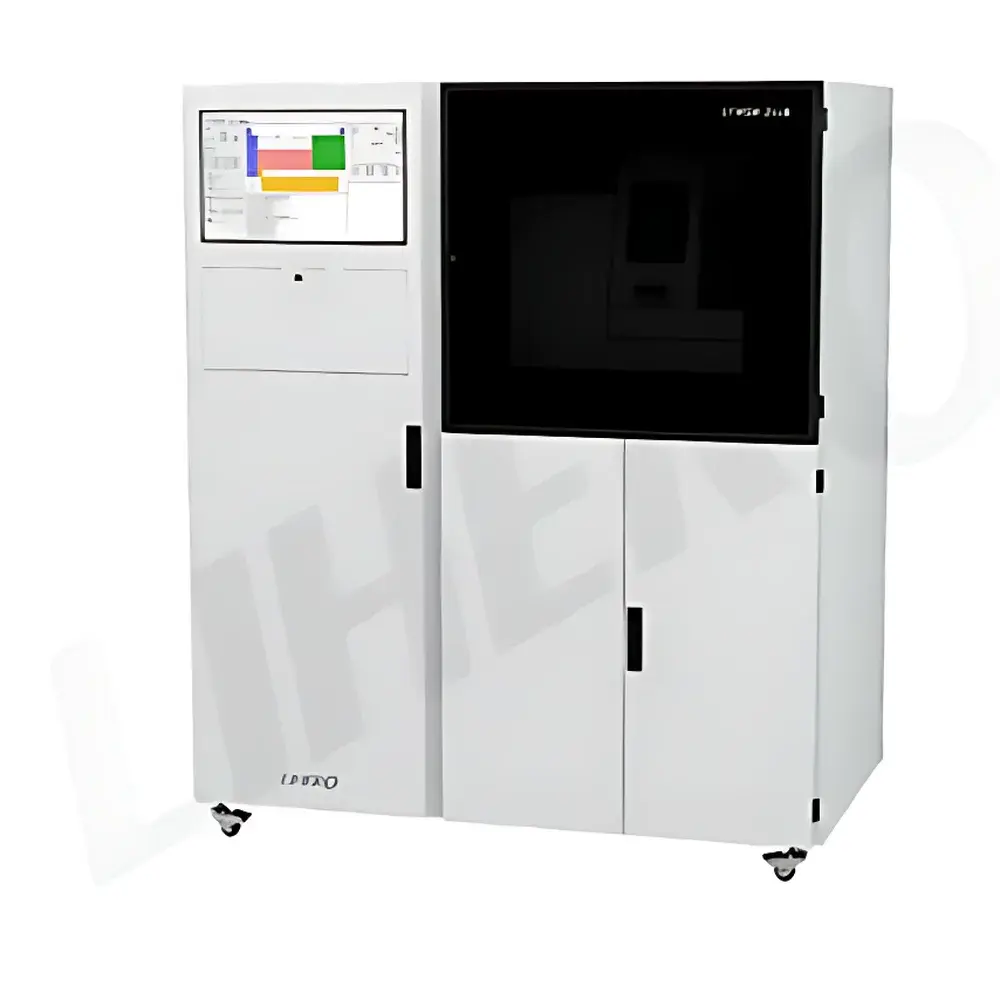
Lihero LFMSM-2016 ICP-MS Water Auto-Analyzer
| Brand | Lihero |
|---|---|
| Origin | Hunan, China |
| Model | LFMSM-2016 ICP-MS Water Auto-Analyzer |
| Mass Analyzer Type | Quadrupole Mass Spectrometer |
| Application | Field-deployable / Mobile Monitoring |
| Compliance Standard | HJ 700–2014 (China) |
| Filtration | Automated 0.45 µm Disposable Belt Filter |
| Elemental Coverage | Up to 66 Elements (Including As, Cd, Cr, Cu, Hg, Pb, Zn, Se, Ni, Mn, Fe, etc.) |
| Analysis Time per Sample | 3–5 min (steady-state operation) |
| Detection Capability | Sub-ppt Level for Key Elements |
| Operational Modes | Dissolved Fraction Analysis & Total Element Analysis (with Onboard Acid Digestion Option) |
Overview
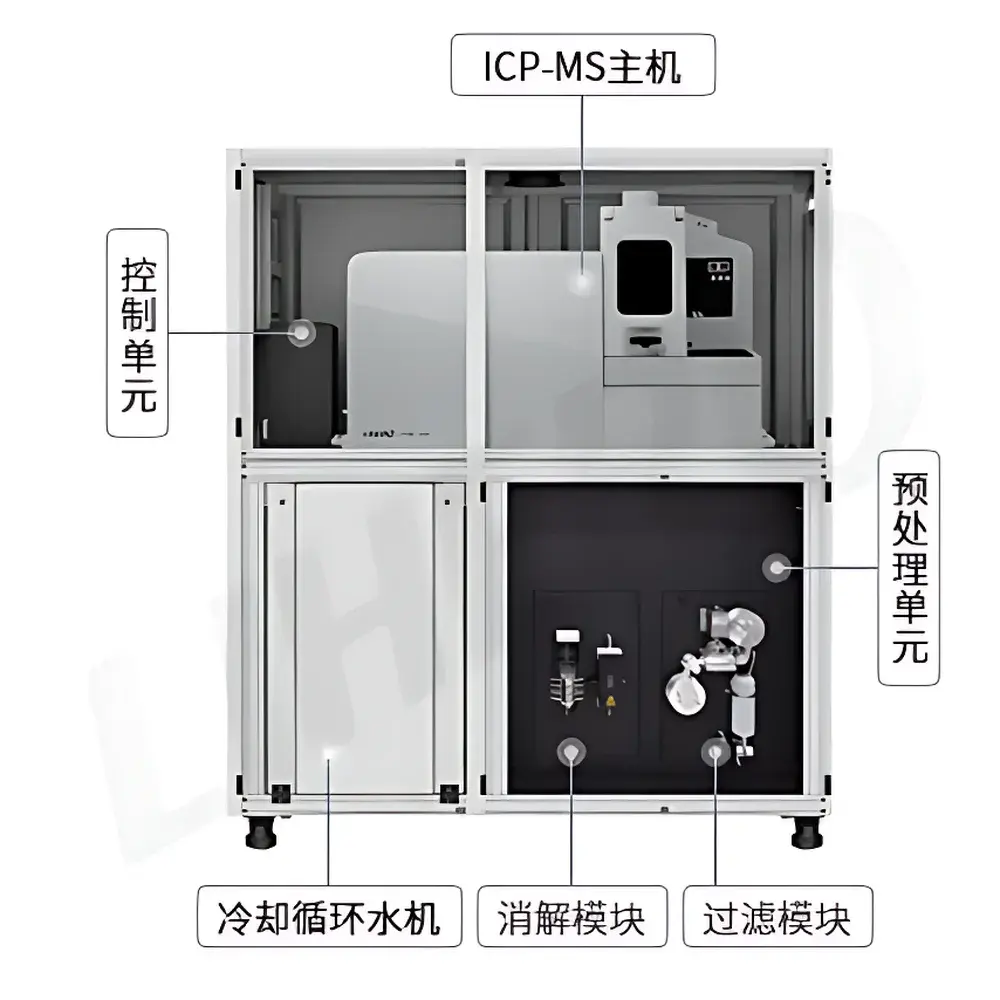
The Lihero LFMSM-2016 ICP-MS Water Auto-Analyzer is a field-deployable, fully automated analytical platform engineered for unattended, regulatory-compliant elemental monitoring in aqueous matrices. It integrates an inductively coupled plasma mass spectrometer (ICP-MS) — configured with a quadrupole mass analyzer — as its core detection engine, enabling highly sensitive, isotope-resolved quantification of metals and non-metals in water samples. The system operates on the fundamental principle of ionization in a high-temperature argon plasma (~7,000 K), followed by mass separation based on mass-to-charge ratio (m/z) and detection via electron multiplier. Designed specifically to implement the Chinese environmental standard HJ 700–2014 “Determination of 65 Elements in Water by Inductively Coupled Plasma Mass Spectrometry”, the LFMSM-2016 supports both dissolved-element analysis (via inline 0.45 µm filtration) and total-element analysis (when coupled with optional onboard acid digestion). Its mobile-ready architecture enables deployment at remote sampling sites, wastewater outfalls, drinking water intake points, and emergency response locations without reliance on fixed laboratory infrastructure.
Key Features
- Regulatory-Automated Sample Handling: Integrated control unit manages full workflow — including autonomous water intake, plasma ignition sequence, calibration bracketing, sample introduction, rinse cycles, and data export — minimizing manual intervention and operator dependency.
- Dual-Mode Analytical Flexibility: Switch between dissolved fraction analysis (HJ 700–2014 compliant 0.45 µm disposable belt filtration) and total element analysis (with optional integrated microwave-assisted acid digestion module), ensuring methodological traceability across regulatory reporting categories.
- Cross-Contamination Mitigation: Single-use 0.45 µm filter belt ensures complete physical isolation between sequential samples; no carryover or dilution artifacts. Additional pre-filtration within the intake line prevents long-term residue accumulation from historically high-concentration samples.
- Multi-Element Simultaneous Quantification: Capable of detecting and quantifying up to 66 elements in a single run, including priority contaminants such as As, Cd, Cr(VI)-proxy elements, Cu, Hg, Pb, Se, U, and rare earth elements. Default validated panel covers 22 elements (e.g., Al, Ba, Be, Co, Mo, Ni, Sb, Ti, Tl, V) with certified reference material traceability.
- Robust Interference Management: Employs mathematical correction algorithms (e.g., on-mass and off-mass interference correction, polyatomic ion subtraction) and internal standardization (e.g., Sc, Y, In, Bi) to compensate for spectral overlaps, matrix-induced signal suppression, and instrumental drift.
- Real-Time System Diagnostics: Embedded sensor network continuously monitors critical parameters — RF generator stability, vacuum integrity, coolant flow rate, nebulizer gas pressure, and detector voltage — feeding status logs into the central control interface for predictive maintenance and audit-ready operational records.
Sample Compatibility & Compliance
The LFMSM-2016 is validated for use with raw and treated water matrices including surface water, groundwater, potable water, industrial effluent, and leachate. All sample introduction pathways are constructed from inert fluoropolymer (e.g., PFA, FEP) and quartz to prevent adsorption or leaching. The system adheres to the procedural requirements of HJ 700–2014 for dissolved metal determination, including mandatory filtration prior to analysis and strict reagent blank control protocols. While not certified to ISO/IEC 17025 under third-party accreditation, its design incorporates features aligned with GLP principles — including electronic audit trails, user-access controls, and versioned method storage — supporting data integrity in regulated environments. For international deployments, method adaptation to EPA Method 200.8 or ISO 17294-2 can be implemented via software-configurable acquisition parameters and calibration schemes.
Software & Data Management
The embedded acquisition and analysis software provides ISO/IEC 17025-aligned data handling: all raw spectra, integration parameters, calibration curves, QC check results, and instrument status snapshots are timestamped and stored in a relational database with immutable logging. Data export complies with ASTM E1461 and LIMS-compatible CSV/Excel formats. Optional 21 CFR Part 11 compliance package includes electronic signatures, role-based access control, and full audit trail generation for regulatory submissions. Remote monitoring via secure TLS-encrypted web interface allows real-time oversight of instrument status, pending queue, and recent QC performance metrics without local login.
Applications
- Continuous compliance monitoring at municipal drinking water treatment plants
- Early-warning detection of heavy metal contamination in river basins and reservoirs
- Industrial discharge verification for electroplating, mining, and semiconductor manufacturing facilities
- Rapid-response elemental screening during environmental incidents (e.g., mine tailings breaches, pipeline leaks)
- Long-term trend analysis of trace metal bioavailability in groundwater aquifers
- Validation support for remediation effectiveness studies (e.g., post-capping or phytoremediation monitoring)
FAQ
Does the LFMSM-2016 meet international regulatory standards such as EPA or ISO?
The system is designed and validated against HJ 700–2014. With appropriate method validation and calibration using NIST-traceable standards, it can be adapted to support EPA Method 200.8 or ISO 17294-2 workflows.
Can the system perform total digestion onboard?
Yes — an optional integrated microwave-assisted acid digestion module enables closed-vessel, temperature- and pressure-controlled digestion of filtered samples for total element analysis.
What is the minimum detectable concentration for arsenic or lead?
Method detection limits (MDLs) are matrix-dependent; typical sub-ppt (≤0.1 ng/L) MDLs for As and Pb are achievable in low-TDS deionized water when operated under optimized conditions.
Is remote diagnostics and software update capability supported?
Yes — secure HTTPS-based remote access enables firmware updates, parameter adjustments, and diagnostic log retrieval without onsite technician presence.
How is data integrity ensured during unattended operation?
All analytical events are logged with digital signatures, timestamps, and contextual metadata; raw data files are write-once, read-many (WORM) archived with SHA-256 checksum validation.






