
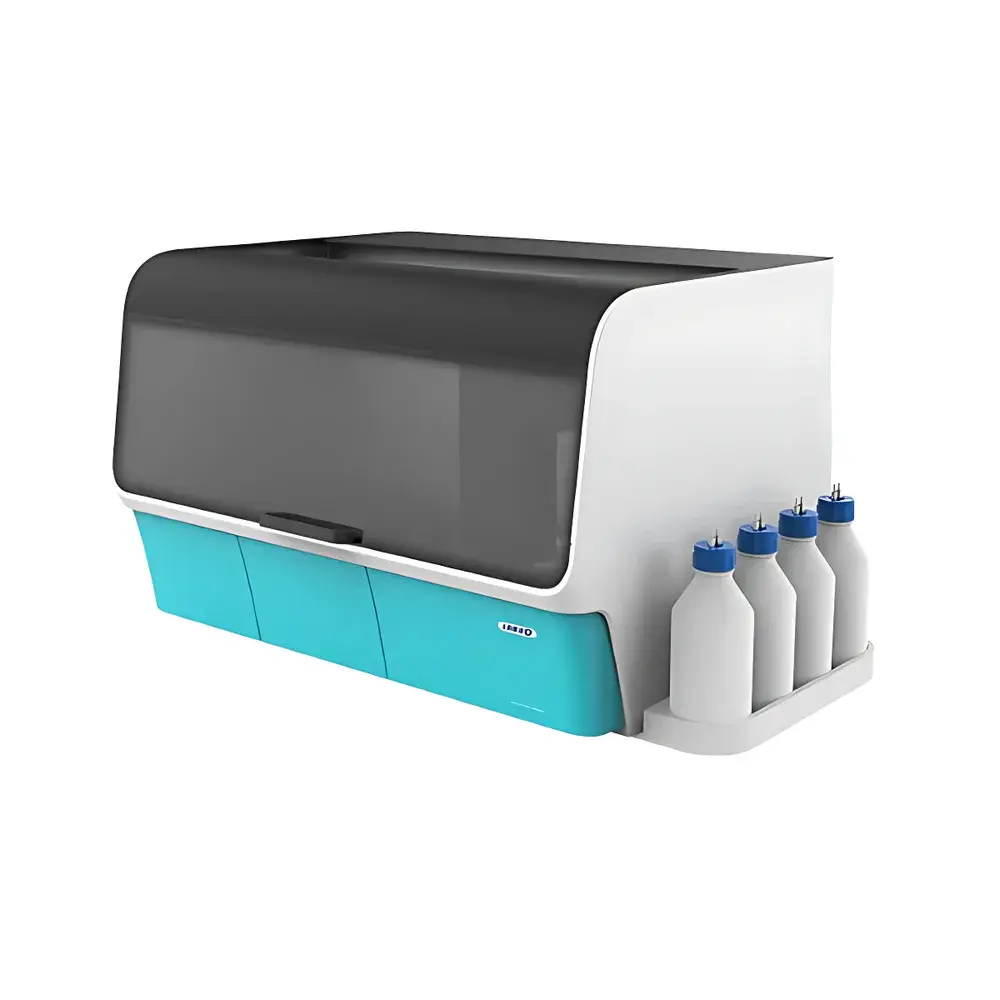
Lihero ART 700 Multi-Channel Automated Permanganate Index Analyzer
| Brand | Lihero |
|---|---|
| Origin | Hunan, China |
| Manufacturer Type | Authorized Distributor |
| Country of Manufacture | China |
| Model | ART 700 |
| Pricing | Available Upon Request |
Overview
The Lihero ART 700 Multi-Channel Automated Permanganate Index Analyzer is a laboratory-grade, fully automated benchtop system engineered for precise and reproducible determination of the permanganate index (CODMn) in water samples. It implements the standardized hot water bath digestion–potassium permanganate titration method, conforming rigorously to key regulatory protocols including GB 11892–1989 “Determination of Permanganate Index in Water”, the “Operation Instruction Manual for National Surface Water Environmental Quality Monitoring Network”, and GB/T 5750.7–2006 “Standard Methods for Examination of Drinking Water – Organic Comprehensive Indicators”. The instrument operates on the principle of controlled oxidation of organic and inorganic reductants under acidic or alkaline conditions at elevated temperature (typically 100 °C), followed by back-titration with standardized sodium oxalate solution using potentiometric endpoint detection. This gravimetric–volumetric hybrid approach ensures traceable, metrologically sound results aligned with national environmental monitoring requirements.
Key Features
- Fully automated workflow: integrated robotic arm handles sample cup transport across digestion, rinsing, titration, and waste disposal stations with sub-millimeter positional repeatability.
- High-throughput capacity: processes up to 48 samples per batch within an 8-hour operational cycle, with minimum inter-sample interval of 5 minutes.
- Dual-method support: programmable selection between acidic and alkaline digestion protocols per ASTM D1252–22 Annex A1 and GB 11892–1989 Clause 4.
- Intelligent calibration: automatic K-value standardization using certified potassium permanganate reference solutions; K-factor recalculated and logged for each run.
- Comprehensive self-maintenance: scheduled cleaning cycles for stirrers, reagent delivery lines, and titration nozzles using deionized water and optional dilute acid flush.
- Priority handling mode: supports emergency sample insertion mid-batch with dynamic queue reordering and real-time resource allocation.
- Time-scheduled operation: configurable start time for unattended overnight or weekend runs, synchronized with internal RTC and NTP-enabled network time sync.
Sample Compatibility & Compliance
The ART 700 accepts standard 50 mL borosilicate glass sample cups (ISO 8513-compliant) and accommodates turbid, colored, or low-conductivity aqueous matrices—including surface water, groundwater, drinking water, wastewater effluents, and treated industrial discharges. All analytical steps adhere to QA/QC requirements defined in ISO/IEC 17025:2017 for testing laboratories. Raw data capture includes digestion temperature (±0.5 °C), titration bath temperature (±0.3 °C), delivered titrant volume (±0.01 mL), and endpoint potential slope (mV/s). Audit trails comply with GLP principles and support FDA 21 CFR Part 11–compatible electronic signatures when deployed with validated LIMS integration.
Software & Data Management
The embedded Linux-based control software (v4.2+) provides role-based access control, encrypted local database storage (SQLite3), and TLS 1.2–secured HTTP(S) API endpoints for bidirectional data exchange. All measurements generate timestamped, immutable records containing full metadata: operator ID, instrument serial number, calibration history, environmental chamber logs, and diagnostic event flags. Reports are exportable in PDF/A-1b and CSV formats, with configurable templates meeting provincial environmental monitoring reporting standards. Data synchronization supports MQTT and RESTful push to centralized platforms such as EcoMonitor Cloud or custom ELK stacks.
Applications
- Regulatory compliance monitoring for municipal water utilities and provincial ecological environment monitoring centers.
- Long-term trend analysis of organic pollution load in river basins and reservoirs under China’s “Blue Sky and Clear Water” initiative.
- Method validation and inter-laboratory comparison studies requiring high inter-operator reproducibility (RSD < 3.2% at 2.0 mg/L KMnO4 eq.).
- Quality assurance in bottled water production facilities subject to GB 19298–2014 and GB 8537–2018.
- Research applications in limnology and environmental chemistry where CODMn serves as a surrogate for biodegradable organic carbon content.
FAQ
Does the ART 700 support both acidic and alkaline permanganate index methods?
Yes — method selection is software-configurable and validated per GB 11892–1989 Sections 4.1 (acidic) and 4.2 (alkaline), with independent reagent paths and temperature profiles.
How is system performance verified during routine operation?
Built-in QC routines execute blank, duplicate, spiked recovery, and certified reference material (CRM) checks; all results are auto-flagged against user-defined acceptance criteria (e.g., spike recovery 85–115%).
Can raw sensor data and intermediate values be exported for secondary analysis?
Yes — full-resolution time-series logs for temperature, titrant volume, electrode potential, and motor current are accessible via USB or secure API, retaining original acquisition timestamps and units.
Is remote diagnostics and firmware update supported?
Yes — over-the-air (OTA) updates and real-time health telemetry (pump pressure, valve actuation count, thermal stability index) are enabled through authenticated SSH and HTTPS channels.







